
[论文解读] Singling out SO(10) GUT models using recent PTA results
该论文仅使用伴随和基础表示的希格斯场构建了现实的超对称SO(10)大统一理论(GUT),在无需微调的情况下解决了二重态-三重态分裂问题。它识别出一个特定模型,其中包含两个伴随希格斯场,可产生亚稳态宇宙弦网络,从而产生与近期脉冲星计时阵列(PTA)在纳赫兹频段观测结果一致的随机引力波背景。
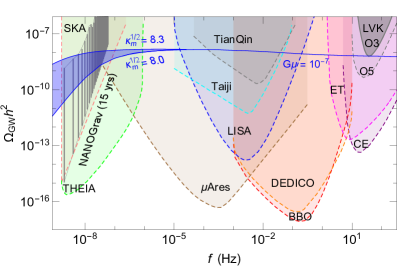
In this work, we construct promising model building routes towards SO(10) GUT inflation and examine their ability to explain the recent PTA results hinting at a stochastic gravitational wave (GW) background at nanohertz frequencies. We consider a supersymmetric framework within which the so-called doublet-triplet splitting problem is solved without introducing fine-tuning. Additionally, realistic fermion masses and mixings, gauge coupling unification, and cosmic inflation are incorporated by utilizing superfields with representations no higher than the adjoint representation. Among the three possible scenarios, two of these cases require a single adjoint Higgs field, and do not lead to cosmic strings. In contrast, the third scenario featuring two adjoints, can lead to a network of metastable cosmic strings that generates a GW background contribution compatible with the recent PTA findings and testable by various ongoing and upcoming GW observatories.
研究动机与目标
- 构建无需微调即可解决二重态-三重态分裂问题的现实超对称SO(10) GUT模型。
- 仅使用至伴随表示的希格斯场,实现对费米子质量、规范耦合统一和宇宙暴胀的现实描述。
- 识别出宇宙弦可形成并产生与近期PTA观测一致的随机引力波背景(SGWB)的模型构建情景。
- 确定哪些SO(10) GUT情景可通过亚稳态宇宙弦产生可探测的SGWB,且可由未来引力波天文台检验。
提出的方法
- 利用45H(伴随)和10H(基础)表示的希格斯场构建SO(10) GUT模型,将对称性破缺至标准模型(SM)。
- 在两种情景中采用单个伴随希格斯场(分别与B-L或I3R生成元成比例),并在双伴随情景中探索对称性破缺模式。
- 通过中间尺度上U(1)规范对称性的自发破缺,分析拓扑缺陷(特别是宇宙弦)的形成。
- 利用Buchmüller等人(2021)的理论框架估算来自亚稳态宇宙弦的随机引力波背景(SGWB),并校准至PTA数据。
- 在简并对称性破缺尺度和3 TeV超对称破缺的假设下,评估规范耦合统一性,规范耦合的不确定性为1%。
- 通过双伴随模型中Yukawa部门的微调,评估质子衰变约束,以抑制d=6算符。
实验结果
研究问题
- RQ1仅使用伴随和基础希格斯表示的现实SO(10) GUT模型能否在无需微调的情况下解决二重态-三重态分裂问题?
- RQ2哪些SO(10) GUT模型构建情景可产生能生成随机引力波背景的亚稳态宇宙弦网络?
- RQ3此类宇宙弦网络产生的引力波信号是否与近期PTA观测结果一致,即在纳赫兹频段呈现共同谱噪声?
- RQ4所提出的模型能否在保持现实费米子质量和抑制质子衰变的同时实现规范耦合统一?
- RQ5哪些未来的引力波天文台能够检验来自亚稳态宇宙弦的预测SGWB信号?
主要发现
- 双伴随希格斯情景导致形成亚稳态宇宙弦网络,其产生的随机引力波背景与近期PTA结果一致。
- 包含两个伴随希格斯场、破缺至U(1) × U(1)中间群的模型,可形成亚稳态宇宙弦,其单极子与弦的形成尺度在~10^9–10^17 GeV范围内近乎简并。
- 预测的引力波信号与PTA数据重叠,且处于当前及未来天文台(如LISA、Taiji、TianQin和SKA)探测灵敏度的边缘。
- 只要GUT尺度高于10^16 GeV且超对称破缺尺度固定为3 TeV,该模型在广泛的单极子/弦形成尺度范围(10^9–10^17 GeV)内可实现规范耦合统一。
- 双伴随模型需通过Yukawa部门的微调来抑制d=6质子衰变,使其不如单伴随情形自然,但仍具可行性。
- 单伴随模型(B-L与I3R情形)产生嵌入式弦,通常不稳定,因此无法产生可探测的SGWB,故被排除为PTA信号的解释。
更好的研究,从现在开始
从阅读论文到最终审阅,大幅缩短您的研究时间。
无需绑定信用卡
本解读由 AI 生成,并经人工编辑审核。