
[论文解读] Smaller Language Models are Better Black-box Machine-Generated Text Detectors
本文研究了利用较小的预训练语言模型作为通用检测器,通过基于曲率的局部最优性来实现零样本检测机器生成文本。研究发现,较小的、部分训练过的模型在跨模型检测中表现优于更大的模型,其中 OPT-125M 在检测 ChatGPT 生成文本时 AUC 达到 0.81,显著优于如 GPTJ-6B 这类更大的模型(AUC 为 0.45)。
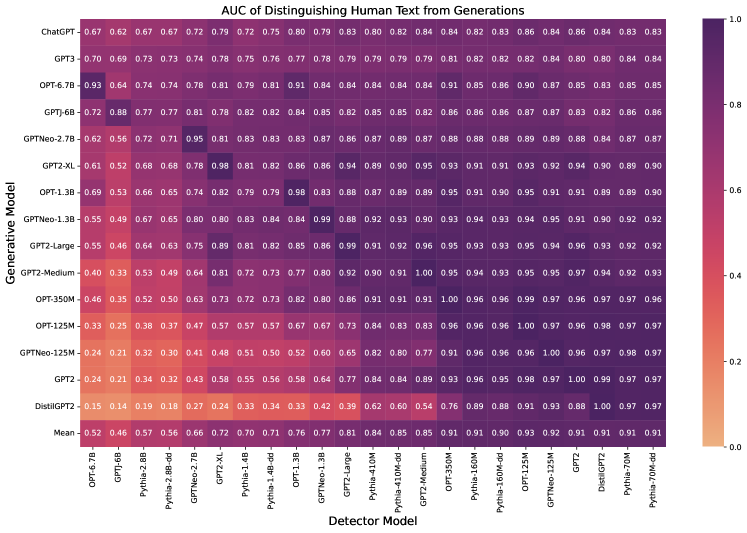
With the advent of fluent generative language models that can produce convincing utterances very similar to those written by humans, distinguishing whether a piece of text is machine-generated or human-written becomes more challenging and more important, as such models could be used to spread misinformation, fake news, fake reviews and to mimic certain authors and figures. To this end, there have been a slew of methods proposed to detect machine-generated text. Most of these methods need access to the logits of the target model or need the ability to sample from the target. One such black-box detection method relies on the observation that generated text is locally optimal under the likelihood function of the generator, while human-written text is not. We find that overall, smaller and partially-trained models are better universal text detectors: they can more precisely detect text generated from both small and larger models. Interestingly, we find that whether the detector and generator were trained on the same data is not critically important to the detection success. For instance the OPT-125M model has an AUC of 0.81 in detecting ChatGPT generations, whereas a larger model from the GPT family, GPTJ-6B, has AUC of 0.45.
研究动机与目标
- 探究一个语言模型是否能够检测由另一个架构和训练数据不同的模型生成的文本。
- 确定哪些语言模型作为机器生成文本的通用检测器最为有效。
- 评估模型规模、训练阶段以及预训练数据对检测性能的影响。
- 探究检测器性能是否依赖于与生成器在架构或数据分布上的对齐。
提出的方法
- 本研究采用基于曲率的检测方法,通过比较检测器模型下目标序列与其附近扰动的似然值,来度量局部最优性。
- 构建一个包含 50% 人类撰写和 50% 机器生成文本的目标语料库,覆盖多种模型和序列长度。
- 通过曲率度量评估检测器模型区分人类撰写与机器生成文本的能力,即使无法访问生成器的似然函数。
- 在不同规模(125M 到 6.7B 参数)、架构(GPT、OPT、Pythia)和预训练数据(WebText、The Pile)的模型上进行实验,包括部分训练阶段。
- 通过受试者工作特征曲线下面积(AUC)评估检测性能,以衡量人类与机器生成序列之间的可区分性。
- 该方法实现了黑箱检测,通过使用似然函数可访问的代理检测器模型,即使生成器未知或不可访问亦可实现。

实验结果
研究问题
- RQ1较小的语言模型能否有效检测由另一台架构不同、规模更大的模型生成的机器生成文本?
- RQ2检测器模型的性能是否取决于其是否与生成器使用相同的数据集或具有相似的参数量?
- RQ3为何较小且部分训练过的模型在跨模型检测中优于更大、完全训练过的模型?
- RQ4是否存在一种通用检测器,能在不同架构或预训练数据的生成器模型上均表现良好?
主要发现
- 较小的语言模型,如 OPT-125M,在检测机器生成文本方面表现显著优于更大的模型,其在检测 ChatGPT 生成文本时 AUC 达到 0.81。
- 更大的模型如 GPTJ-6B 作为检测器表现较差,同一任务下 AUC 仅为 0.45。
- 部分训练过的模型优于完全训练过的模型,尤其在大模型架构中表现明显,表明过度训练会降低检测能力。
- 较小模型对相似或更大规模模型生成的文本赋予更高的曲率,使其对机器生成模式更加敏感。
- 检测器性能并不严重依赖于检测器与生成器在架构上的相似性或共享的预训练数据。
- OPT-125M 模型在平均情况下与自检测性能的 AUC 差距仅为 0.07,展现出强大的通用检测能力。
更好的研究,从现在开始
从阅读论文到最终审阅,大幅缩短您的研究时间。
无需绑定信用卡
本解读由 AI 生成,并经人工编辑审核。