
[论文解读] SNeSCOPE - a python package for shock cooling fitting using the model of Morag et al 2024
该论文介绍了 SNeSCOPE,一个用于使用 Morag 等人 2024 年框架将激波冷却模型拟合至 II 型超新星早期紫外和光学光曲线的 Python 软件包。结果表明,早期紫外-光学色指数与黑体演化与球面对称激波冷却一致,并发现 66% 的红超巨星前身星的爆发半径与观测到的场中红超巨星分布一致,尽管由于 CSM 限制或膨胀包层导致的光度偏差,使分布向更大半径倾斜。
SNeSCOPE - SuperNovae Shock Cooling Observations Parameter Estimator Documentation SNeSCOPE is a python package for modeling supernova light curves using the analytic models of Morag et al 2023 and Morag et al 2024. Installation to install, git clone the repository. Then run from within the SNeSCOPE directory (where the script setup.py is) python setup.py install Alternatively, use pip pip install SNeSCOPE add simulation data files Use the following link to download the MG simulatiosn used for constructing the covariance matrix for the likelihood function: https://www.dropbox.com/scl/fi/kawt98t2lri5j90o61u60/RSG_batch_R03_20_removed_lines_Z1.mat?rlkey=1hnpbgiayol7jtu4cn4895slg&dl=0 and for the keys: https://www.dropbox.com/scl/fi/o22vj00kjskp9gk6ae2h1/RSG_batch_R03_20_removed_lines_Z1_key.mat?rlkey=kop5iq609h10pgkgsnycuvjyx&dl=0 If these links do not work for any reason, the files can be found in the zenodo repository linked in the bottom of this readme In addition to these, the filter transmission data I use is collected in the Filters folder avilable in this repository and in the zenodo repository. running the script To run pre exsiting script, modify the parameter files (e.g., see in tests). You will modify paths, SN parameters (e.g., distance, redshift, extinction), package options, and the photometric filters used while observing (an extensive folder is added, but you can always add more. Make sure to update the plotting parameters accordingly). If you encounter errors at this point, make sure you have the correct paths and consider moving from relative to absolute paths. Then run the script fit_SC.py, e.g., from the SNeSCOPE directory (for a unix based system): python ./scripts/fit_SC.py --path_params ./tests/params_2020jfo.py or (if using windows) python .\scripts\fit_SC.py --path_params . ests\params_2020jfo.py As the script is currently written, it requires a data file containing magnituds, fluxes, instruments and filters as is shown in the example test files. The script uses a non-rectangular prior on the recombination time of Hydrogen at a photospheric temperature of roughly t_rec 0.7 eV~ 8000K. Given the typical deviations from blackbody and given a mild amount of host extinction (up to E(B-V) = 0.2), a blackboyd fit assuming E(B-V) = 0 mag at 8000K can give anywhere between 5000 and 10000 K. I recommend to first fix the extinction to lower than 0.2, using the color curves of Irani 2024. Then add a dates files. This is a list of times (JD) where E(B-V) = 0 blackbody fits are made, and then used as priors. The script will run the fitter in the following steps: blackbody fits prepare covariance matrix for likelihood function using the light curve sampling provided fit the data get the results. re-fit a blackbody using the fit host-extinciton save the results as a pickle object plot calculate physical parameters and save to a table (for a full description of these parameters, see Irani 2024, and Morag 2024, and references therein). There are 4 plots which are provided. Light curve fits. These include a vertical line indicating the early validity time of the model (the time the breakout pulse is over and homologous expansion is reached). I also provide these plots with a logarithmic axis, which are more convenient for high cadence sampling of the early light curves. Blackbody fits compared to the model predictions. These are compared to the new blackbody fits, using the fit E(B-V) (and Rv, if fitted). A good fit should also fit the blackbody temperature and radius reasonable well, although some deviations are expected as the SED is not a perfect blackbody. corner plots SED plot - These can be used to evaluate the observed and model SED at various epochs. The different lines are both the blackbody and the frequency dependent formulas smapled from the posterior. Keep in mind sometimes, due to a low mass envelope or fast V*, the model can be no longer valid at the lowest temperature plotted in these plots. Python version python 3 Required python packages numpy dynesty matplotlib scipy astropy numba astropy os pandas Support I'm happy to provide support in setting up the package and interpreting its results. You can contact me at idoirani@gmail.com. For the most up to date version of the package, please visit the github repository at https://github.com/idoirani/shock_cooling. Credit If you are using SNeSCOPE, please cite the following papers: light curve fitter: Irani et al 2024, "the early UV light curves of Type II SNe" @ARTICLE{2023arXiv231016885I, author = {{Irani}, Ido and {Morag}, Jonathan and {Gal-Yam}, Avishay and {Waxman}, Eli and {Schulze}, Steve and {Sollerman}, Jesper and {Hinds}, K-Ryan and {Perley}, Daniel A. and {Chen}, Ping and {Strotjohann}, Nora L. and {Yaron}, Ofer and {Zimmerman}, Erez A. and {Bruch}, Rachel and {Ofek}, Eran O. and {Soumagnac}, Maayane T. and {Yang}, Yi and {Groom}, Steven L. and {Masci}, Frank J. and {Riddle}, Reed and {Bellm}, Eric C. and {Hale}, David}, title = "{The Early Ultraviolet Light-Curves of Type II Supernovae and the Radii of Their Progenitor Stars}", journal = {arXiv e-prints}, keywords = {Astrophysics - High Energy Astrophysical Phenomena}, year = 2023, month = oct, eid = {arXiv:2310.16885}, pages = {arXiv:2310.16885}, doi = {10.48550/arXiv.2310.16885}, archivePrefix = {arXiv}, eprint = {2310.16885}, primaryClass = {astro-ph.HE}, adsurl = {https://ui.adsabs.harvard.edu/abs/2023arXiv231016885I}, adsnote = {Provided by the SAO/NASA Astrophysics Data System} } analytic model for T,L evolution: Morag et al 2023 "Shock cooling emission from explosions of red super-giants: I. A numerically calibrated analytic model" @ARTICLE{2023MNRAS.522.2764M, author = {{Morag}, Jonathan and {Sapir}, Nir and {Waxman}, Eli}, title = "{Shock cooling emission from explosions of red supergiants - I. A numerically calibrated analytic model}", journal = {\mnras}, keywords = {shock waves, supernovae: general, Astrophysics - High Energy Astrophysical Phenomena}, year = 2023, month = jun, volume = {522}, number = {2}, pages = {2764-2776}, doi = {10.1093/mnras/stad899}, archivePrefix = {arXiv}, eprint = {2207.06179}, primaryClass = {astro-ph.HE}, adsurl = {https://ui.adsabs.harvard.edu/abs/2023MNRAS.522.2764M}, adsnote = {Provided by the SAO/NASA Astrophysics Data System} } deviations from blackbody: Morag et al 2024, "Shock cooling emission from explosions of red super-giants: II. An analytic model of deviations from blackbody emission" @ARTICLE{2024MNRAS.528.7137M, author = {{Morag}, Jonathan and {Irani}, Ido and {Sapir}, Nir and {Waxman}, Eli}, title = "{Shock cooling emission from explosions of red supergiants: II. An analytic model of deviations from blackbody emission}", journal = {\mnras}, keywords = {radiation: dynamics, radiative transfer, shock waves, transients: supernovae, Astrophysics - High Energy Astrophysical Phenomena, Astrophysics - Solar and Stellar Astrophysics}, year = 2024, month = mar, volume = {528}, number = {4}, pages = {7137-7155}, doi = {10.1093/mnras/stae374}, archivePrefix = {arXiv}, eprint = {2307.05598}, primaryClass = {astro-ph.HE}, adsurl = {https://ui.adsabs.harvard.edu/abs/2024MNRAS.528.7137M}, adsnote = {Provided by the SAO/NASA Astrophysics Data System} } Variable validity domain: Soumagnac et al 2020 "SN 2018fif: The Explosion of a Large Red Supergiant Discovered in Its Infancy by the Zwicky Transient Facility" @ARTICLE{2020ApJ...902....6S, author = {{Soumagnac}, Maayane T. and {Ganot}, Noam and {Irani}, Ido and {Gal-yam}, Avishay and {Ofek}, Eran O. and {Waxman}, Eli and {Morag}, Jonathan and {Yaron}, Ofer and {Schulze}, Steve and {Yang}, Yi and {Rubin}, Adam and {Cenko}, S. Bradley and {Sollerman}, Jesper and {Perley}, Daniel A. and {Fremling}, Christoffer and {Nugent}, Peter and {Neill}, James D. and {Karamehmetoglu}, Emir and {Bellm}, Eric C. and {Bruch}, Rachel J. and {Burruss}, Rick and {Cunningham}, Virginia and {Dekany}, Richard and {Golkhou}, V. Zach and {Graham}, Matthew J. and {Kasliwal}, Mansi M. and {Konidaris}, Nicholas P. and {Kulkarni}, Shrinivas R. and {Kupfer}, Thomas and {Laher}, Russ R. and {Masci}, Frank J. and {Riddle}, Reed and {Rigault}, Mickael and {Rusholme}, Ben and {van Roestel}, Jan and {Zackay}, Barak}, title = "{SN 2018fif: The Explosion of a Large Red Supergiant Discovered in Its Infancy by the Zwicky Transient Facility}", journal = {\apj}, keywords = {Supernovae, Type II supernovae, Astronomy data modeling, Observational astronomy, Ultraviolet transient sources, Transient sources, 1668, 1731, 1859, 1145, 1854, 1851, Astrophysics - High Energy Astrophysical Phenomena}, year = 2020, month = oct, volume = {902}, number = {1}, eid = {6}, pages = {6}, doi = {10.3847/1538-4357/abb247}, archivePrefix = {arXiv}, eprint = {1907.11252}, primaryClass = {astro-ph.HE}, adsurl = {https://ui.adsabs.harvard.edu/abs/2020ApJ...902....6S}, adsnote = {Provided by the SAO/NASA Astrophysics Data System} } If using Piro 2021 "Shock Cooling Emission from Extended Material Revisited" @ARTICLE{2021ApJ...909..209P, author = {{Piro}, Anthony L. and {Haynie}, Annastasia and {Yao}, Yuhan}, title = "{Shock Cooling Emission from Extended Material Revisited}", journal = {\apj}, keywords = {Radiative transfer, Supernovae, 1335, 1668, Astrophysics - High Energy Astrophysical Phenomena}, year = 2021, month = mar, volume = {909}, number = {2}, ei
研究动机与目标
- 开发一个稳健的框架,利用多波段紫外和光学数据,将激波冷却模型拟合至早期超新星光曲线。
- 通过分析 II 型超新星的激波爆发相,约束前身星半径和爆炸能量。
- 区分激波冷却与周围介质(CSM)相互作用作为主导机制,解释早期光曲线的成因。
- 基于 X 射线探测结果和上限,推导出延伸 CSM 密度和质量损失率的约束。
- 通过观测到的紫外-光学色指数,经验性地校正宿主星系消光,并利用多组辐射流体动力学模拟验证拟合框架。
提出的方法
- SNeSCOPE 软件包实现了 Morag 等人 2024 年的激波冷却模型,用于拟合来自兹维基瞬变设施(ZTF)的多波段光曲线,包括紫外、光学和 X 射线数据。
- 该模型基于前身星半径、密度分布和爆炸能量,利用激波爆发 timescale 和光度演化,关键参数为:$ R_{bo} $、$ v_{bo ext{ }} $、$ E_{\text{exp}} $ 和 $ M_{\text{ej}} $。
- 通过 dynesty 库实现嵌套采样进行拟合,支持对模型参数的后验推断及不确定性量化。
- 基于观测到的紫外-光学色指数演化,经验性地推导宿主星系消光校正,避免依赖光谱建模。
- 利用 X 射线数据,在独立于光谱拟合的前提下,假设能量预算和辐射效率,约束 $ \tilde{10^{15}} $ cm 处的 CSM 密度。
- 通过多组辐射流体动力学模拟验证该框架,结果显示在半径和速度方面,对输入参数的恢复偏差小于 20%。
实验结果
研究问题
- RQ1早期紫外-光学光曲线能否在不依赖闪光电离特征的情况下,被球面对称激波冷却模型一致解释?
- RQ2II 型超新星前身星爆发半径的分布如何?其与观测到的红超巨星群体有何关联?
- RQ3周围介质(CSM)相互作用或膨胀包层在多大程度上影响早期光曲线的上升阶段和爆发特性?
- RQ4如何利用 X 射线探测结果和上限,对前身星的质量损失率和 CSM 密度施加约束?
- RQ5观测光度偏差在多大程度上影响样本中推断的爆发半径分布?
主要发现
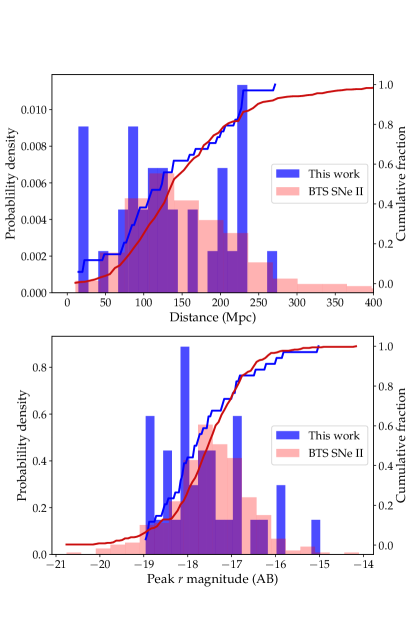
- 34 个 II 型超新星的早期紫外-光学色指数与黑体演化与球面对称激波冷却模型一致,无论是否存在闪光电离特征。
- SNeSCOPE 在多组模拟中对输入参数的恢复偏差在半径和速度上均小于 20%,验证了拟合框架的有效性。
- 样本中约一半(17/34)的事件最适配于爆发半径 $ <10^{14} $ cm 的模型,而另一半则需要 $ >10^{14} $ cm,提示前身星结构可能具有双峰特征。
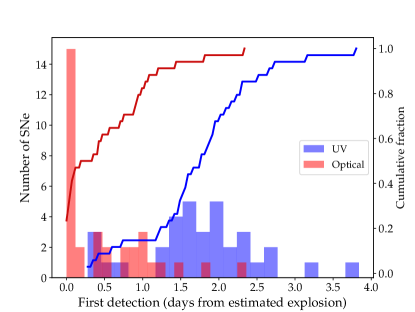
- 大半径拟合预测首日光度上升过于缓慢,表明大爆发半径事件可能源于膨胀包层或陡峭的 CSM 密度分布。
- X 射线探测结果和上限将 CSM 质量损失率约束在 $ \dot{M} < 10^{-4} M_{\odot} \, \text{yr}^{-1} $ 以内,表明大多数 II 型超新星前身星具有受限的 CSM。
- 观测到的爆发半径分布因光度偏差而向更大半径倾斜;经校正后,66% 的红超巨星前身星爆炸半径与场中红超巨星分布一致,其向更大半径延伸的尾部可能源于 CSM。
更好的研究,从现在开始
从阅读论文到最终审阅,大幅缩短您的研究时间。
无需绑定信用卡
本解读由 AI 生成,并经人工编辑审核。