
[论文解读] Soft graviton exchange and the information paradox
本文提出,近黑洞视界处,软胶子交换介导了量子信息从下落物质向霍金辐射的传递,通过有效场论中阶梯图的非微扰重求和,解决了信息佯谬。S矩阵成为一个对紫外物理不敏感的纯相位,保持幺正性,使得尽管霍金采用热近似,信息仍可被恢复。
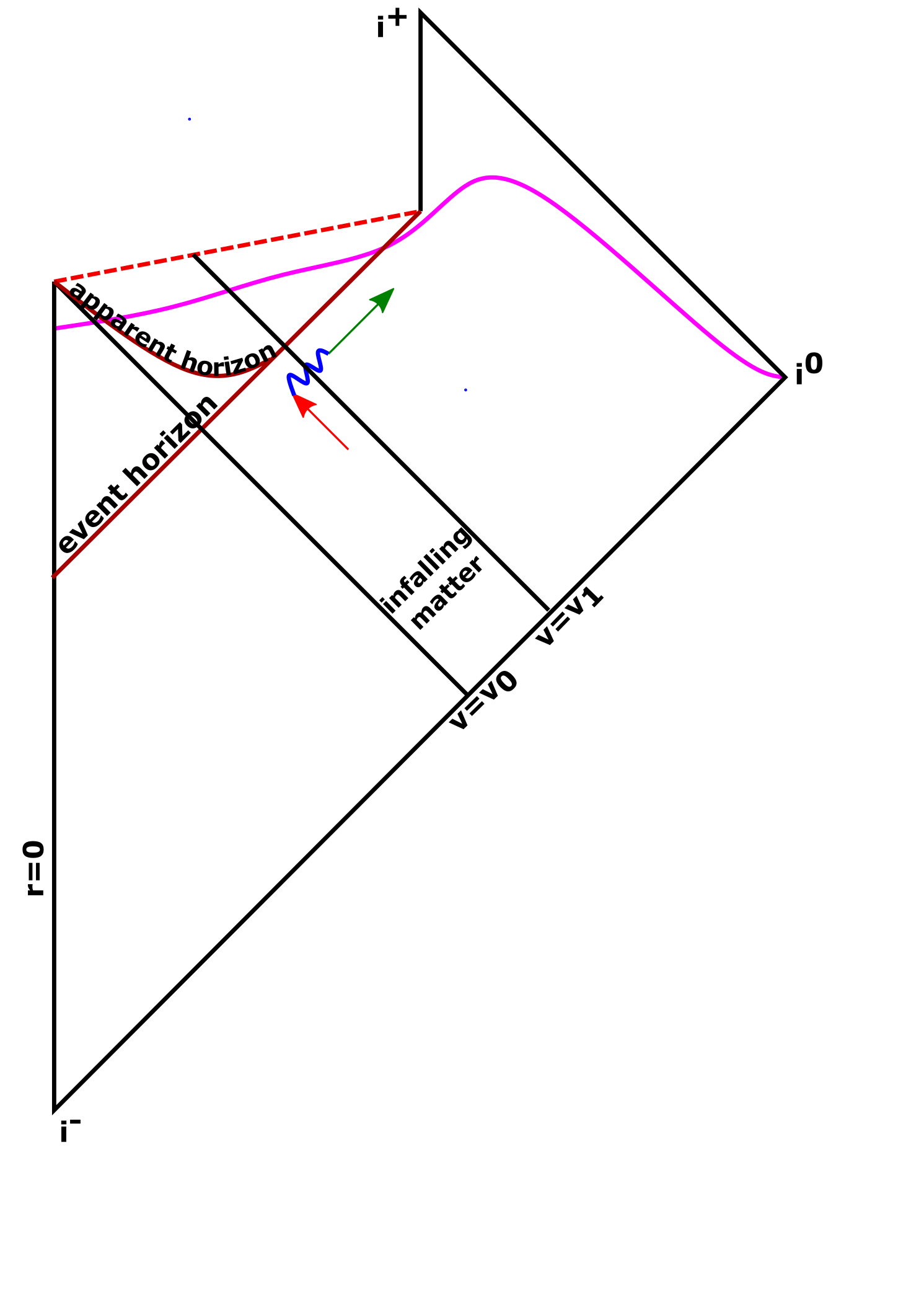
We show that there is a remarkable phase in quantum gravity where gravitational scattering amplitudes mediated by virtual gravitons can be calculated explicitly in effective field theory, when the impact parameter $b$ satisfies $L_{Pl}\ll b \lesssim R_S$, with $R_S$ being the Schwarzschild radius. This phase captures collisions with energies satisfying $\sqrt{s}\gg γM_{Pl}$ (with $γ\sim M_{Pl}/M_{BH}$) near the horizon. We call this the black hole eikonal phase, in contrast to its flat space analogue where collisions are trans-Planckian. Hawking's geometric optics approximation neglects gravitational interactions near the horizon, and results in thermal occupation numbers in the Bogoliubov coefficients. We show that these interactions are mediated by graviton exchange in $2 ightarrow 2$ scattering near the horizon, and explicitly calculate the S-matrix non-perturbatively in $M_{Pl}/M_{BH}$. This involves a re-summation of infinitely many ladder diagrams near the horizon, all mediated by virtual soft gravitons. The S-matrix turns out to be a pure phase upon this re-summation and is agnostic of Planckian physics and any specific ultraviolet completion. In contrast to the flat space eikonal limit, the black hole eikonal phase captures collisions of extremely low energy near the horizon.
研究动机与目标
- 通过在视界附近纳入霍金半经典近似中被忽略的强引力相互作用,解决黑洞信息佯谬。
- 证明在视界附近的2→2散射过程中,通过虚软胶子交换,量子相干性得以保持。
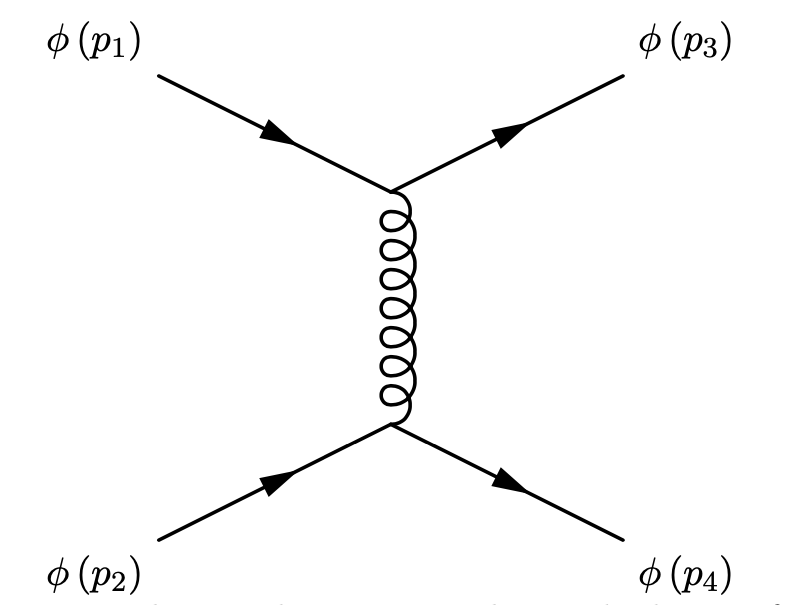
- 通过重求和由软胶子介导的无限阶梯图,在 $ M_{Pl}/M_{BH} $ 上非微扰地计算S矩阵。
- 表明所得S矩阵为纯相位,对普朗克尺度物理不敏感,且独立于紫外完成形式。
- 建立一个信息通过视界附近的几何极限中的引力相互作用被记录在出射辐射上的区域。
提出的方法
- 使用有效场论,在 $ L_{Pl} \ll b \lesssim R_S $ 的区域计算引力散射振幅,其中 $ b $ 为碰撞参数,$ R_S $ 为史瓦西半径。
- 在视界附近的2→2散射中,应用eikonal近似以重求和涉及虚软胶子的无限系列阶梯图。
- 通过在 $ M_{Pl}/M_{BH} $ 上非微扰求解重求和问题,将S矩阵表示为纯相位,该结果在 $ \gamma = M_{Pl}/M_{BH} \ll 1 $ 时有效。
- 通过修改的拉普拉斯算子和径向算子构建弯曲背景中的胶子传播子,包含如 $ \tilde{\Delta}^{-1}_{ab} $ 和 $ \ell(\ell+1)/r^2 $ 等项,以捕捉视界尺度的物理效应。
- 通过度规微扰 $ h_{xx} = 2A(x,y)\delta(x)F(\Omega) $ 实现冲击波技术,以协变规范下求解爱因斯坦方程,源项为狄拉克函数。
- 通过里奇张量变分和球面拉普拉斯算子 $ \Delta_\Omega $ 推导 $ F(\Omega) $ 的运动方程,得到 $ \frac{\delta(x)}{R^2}(\Delta_\Omega - 1)F = 8\pi G_N T_{xx} $。
实验结果
研究问题
- RQ1在黑洞视界附近的引力相互作用能否保留原本会在霍金热辐射模型中丢失的量子信息?
- RQ2在视界附近,如何非微扰地计算 $ M_{Pl}/M_{BH} $ 展开中的黑洞散射S矩阵?
- RQ3软胶子交换在介导下落物质与出射辐射之间信息传递中起什么作用?
- RQ4标准eikonal近似为何在小碰撞参数下失效?能否在黑洞区域定义新的eikonal相位?
- RQ5当引力相互作用被完全重求和时,所得S矩阵是否仍保持幺正性且独立于紫外完成形式?
主要发现
- 在重求和所有由虚软胶子介导的阶梯图后,黑洞视界附近的2→2散射S矩阵为纯相位。
- 该相位对普朗克尺度物理不敏感,且不依赖于量子引力的任何特定紫外完成形式。
- 在 $ L_{Pl} \ll b \lesssim R_S $ 区域,可通过有效场论显式计算散射振幅,捕捉到 $ \sqrt{s} \gg \gamma M_{Pl} $ 的碰撞过程。
- 软胶子交换机制使下落物质的信息能够被记录在出射辐射上,如视界附近柯西截面上所见。
- 重求和程序产生一个有限且非微扰的S矩阵,避免了在 $ b \sim G_N\sqrt{s} $ 处出现的超越普朗克尺度eikonal近似中的发散。
- 冲击波微扰的运动方程简化为 $ \frac{\delta(x)}{R^2}(\Delta_\Omega - 1)F = 8\pi G_N T_{xx} $,证实了线性化引力在冲击波极限下的自洽性。
更好的研究,从现在开始
从阅读论文到最终审阅,大幅缩短您的研究时间。
无需绑定信用卡
本解读由 AI 生成,并经人工编辑审核。