
[论文解读] Space Group Constrained Crystal Generation
DiffCSP++ 将扩散模型生成晶体的能力扩展为通过整合空间群约束,从而在对称性下实现晶格、Wyckoff 位置与原子类型的生成。实验表明在结构预测和带有空间群感知控制的 ab initio 生成方面有改进。
Crystals are the foundation of numerous scientific and industrial applications. While various learning-based approaches have been proposed for crystal generation, existing methods seldom consider the space group constraint which is crucial in describing the geometry of crystals and closely relevant to many desirable properties. However, considering space group constraint is challenging owing to its diverse and nontrivial forms. In this paper, we reduce the space group constraint into an equivalent formulation that is more tractable to be handcrafted into the generation process. In particular, we translate the space group constraint into two parts: the basis constraint of the invariant logarithmic space of the lattice matrix and the Wyckoff position constraint of the fractional coordinates. Upon the derived constraints, we then propose DiffCSP++, a novel diffusion model that has enhanced a previous work DiffCSP by further taking space group constraint into account. Experiments on several popular datasets verify the benefit of the involvement of the space group constraint, and show that our DiffCSP++ achieves promising performance on crystal structure prediction, ab initio crystal generation and controllable generation with customized space groups.
研究动机与目标
- 激发将空间群对称性引入到扩散基晶体生成中,以提高准确性和可控性。
- 将空间群约束转化为晶格(基底)和 Wyckoff (分数坐标) 约束的可处理形式。
- 开发一个扩散模型,在这些约束下联合生成晶格矩阵、分数坐标和原子类型。
- 在多个数据集上演示晶体结构预测和 ab initio 晶体生成的性能提升。
提出的方法
- 将空间群约束解释为两部分:在不变量对数空间中的晶格基底约束,以及 Wyckoff 位点对分数坐标的约束。
- 通过极分解将晶格 L 表示为 L = Q exp(S),使不变量部分 S(对称矩阵)决定晶格形状,与 O(3) 旋转无关。
- 将空间群分为 6 个晶系,以将晶格约束映射到对称基系数 k_i (i=1..6)。
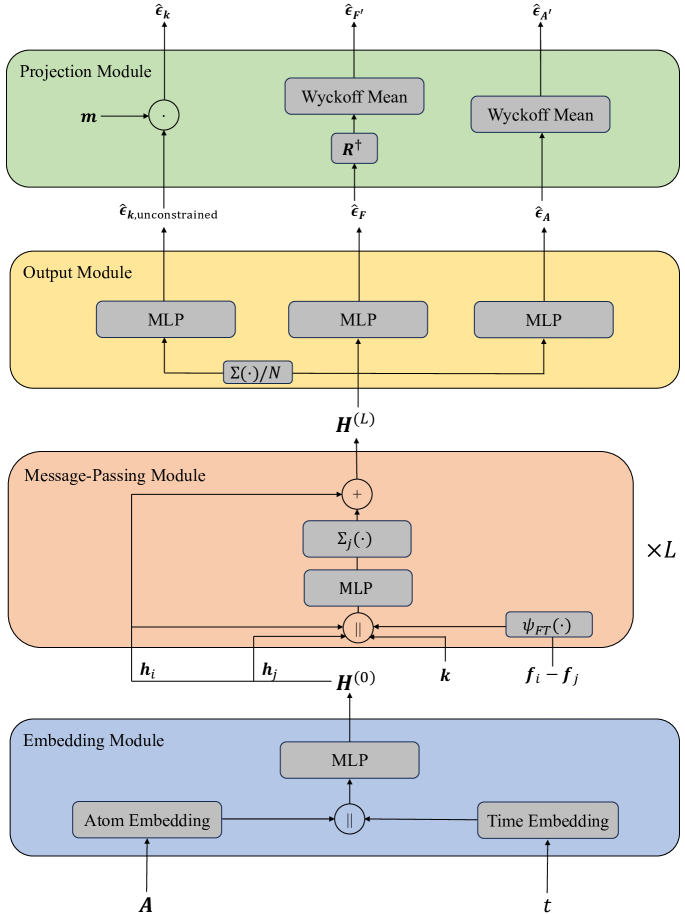
- 通过受位点对称性和 Wyckoff 重复性约束分数坐标来建模 Wyckoff 位置,必要时使用伪逆将去噪后的坐标投影到 Wyckoff 约束子空间。
- 在不变量 k 向量 L 上、在 Wyckoff 约束的分数坐标 F′ 上、以及在基本原子类型 A′ 上应用扩散过程,具有联合训练目标 L_M = λ_k L_k + λ_F′ L_F′ + λ_A′ L_A′。
- 通过不变量图神经网络特征、时间嵌入和基于傅里叶的相对位置编码,将空间群对称性编码入去噪模型,在适当处确保 E(3)-不变性。

实验结果
研究问题
- RQ1是否可以通过将晶格与 Wyckoff 约束分离来将空间群对称性有效地整合到扩散基晶体生成中?
- RQ2在生成过程中强制空间群约束时,DiffCSP++ 是否能提升晶体结构预测和 ab initio 生成的性能?
- RQ3使用真值(ground-truth)与基于模板的空间群输入对生成质量的影响是什么?
- RQ4相对于之前的 DiffCSP 方法,不变量晶格表示如何影响模型性能?
主要发现
- 在 Perov-5、MP-20 和 MPTS-52 数据集上,带有空间群约束的 DiffCSP++ 在晶体结构预测方面取得了较强的性能。
- 在 GT 空间群条件下,DiffCSP++ 在匹配率和 RMSE 上超过基线方法。
- 在 GT 空间群不可用时,使用 CSPML 模板与 DiffCSP++ 可以改善预测,尽管与 GT 条件相比仍有差距(MP-20 上 MR 的 70.58% 与 80.27%)。
- 在 ab initio 生成中,DiffCSP++ 在有效性和覆盖度方面达到或超过基线,并显示出属性统计的改进(例如密度、形成能),表明晶体更具真实感。
- 消融研究表明,不变量晶格表示和前/后平均策略影响 MR 和 RMSE,其中 DiffCSP++(Post)实现了更高的 MR(80.27%)和更低的 RMSE,相较于变体。
- 该方法表明将空间群对称性纳入扩散基晶体生成有益于复杂结构。
更好的研究,从现在开始
从论文设计到论文写作,大幅缩短您的研究时间。
无需绑定信用卡
本解读由 AI 生成,并经人工编辑审核。