
[论文解读] Sparse Blossom: correcting a million errors per core second with minimum-weight matching
引入 sparse blossom,一种基于快速 MWPM 的解码器,用于量子纠错码,避免全域搜索,使在表面码大规模下实现实时解码成为可能。
In this work, we introduce a fast implementation of the minimum-weight perfect matching (MWPM) decoder, the most widely used decoder for several important families of quantum error correcting codes, including surface codes. Our algorithm, which we call sparse blossom, is a variant of the blossom algorithm which directly solves the decoding problem relevant to quantum error correction. Sparse blossom avoids the need for all-to-all Dijkstra searches, common amongst MWPM decoder implementations. For 0.1% circuit-level depolarising noise, sparse blossom processes syndrome data in both $X$ and $Z$ bases of distance-17 surface code circuits in less than one microsecond per round of syndrome extraction on a single core, which matches the rate at which syndrome data is generated by superconducting quantum computers. Our implementation is open-source, and has been released in version 2 of the PyMatching library.
研究动机与目标
- 为大规模表面码量子计算机提供实时、可扩展的解码需求。
- 开发一个针对图状误差模型的快速解码器,直接在探测器图上解决嵌入式 MWPM 问题。
- 通过避免代价高昂的全对全搜索并实现实时操作,在先前的 MWPM 实现之上提供改进。
- 提供开源软件(PyMatching v2),以促进快速仿真和面向硬件的解码工作流程。
提出的方法
- 从图状误差模型定义探测器图,边权 w(e)=log((1-p)/p)。
- 将解码形式化为探测器图上的最小权嵌入匹配(MWEM),而非传统的 MWPM。
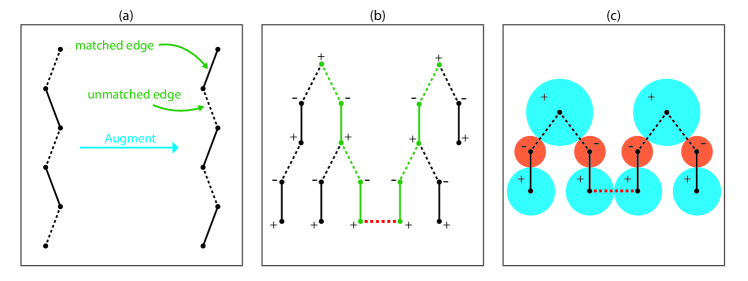
- 开发 sparse blossom,是 Edmonds’ blossom 算法的一种变体,在全局优先队列下扩展区域以高效找到 MWEM。
- 通过预处理将边权转为非负权并进行最小失真调整来处理负边权,如 PyMatching 中所实现。
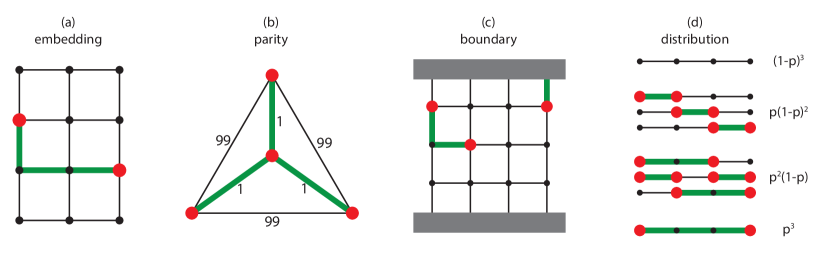
- 通过路径图构造和三步化简(构建路径图、在其上求解 MWPM、重构 MWEM)证明 MWEM 与 MWPM 之间的联系。
- 在距离-17 和距离-29 的表面码电路上,在电路水平去极化噪声为 0.1% 的情形下进行基准测试,报告单核微秒级解码。
实验结果
研究问题
- RQ1是否可以在探测器图上直接对量子纠错以最小权嵌入匹配形式进行实际求解?
- RQ2如何改编 blossom 算法以在无需全对全搜索的情况下为大规模表面码提供快速实时解码?
- RQ3与传统的 MWPM 方法相比,MWEM 基解码器能够实现的性能提升(速度和可扩展性)有哪些?
主要发现
- Sparse blossom 在 0.1% 噪声下,距离-17 表面码电路的 X 和 Z 基底每轮在单核上小于 1 微秒完成解码。
- 在距离-29、同一噪声模型下,解码器在单核上每轮运行时间为 3.5 微秒。
- 该实现显著优于现有工具,实现实时解码和可扩展的仿真。
- 该解码器以 PyMatching version 2 实现,作为开源软件(提供的 GitHub 链接),并可与 Stim 一起用于快速仿真。
更好的研究,从现在开始
从论文设计到论文写作,大幅缩短您的研究时间。
无需绑定信用卡
本解读由 AI 生成,并经人工编辑审核。