
[论文解读] Spatio-Temporal Graph Neural Networks for Predictive Learning in Urban Computing: A Survey
对城市计算中用于预测学习的时空图神经网络(STGNNs)的综合综述,涵盖数据构建、架构、领域、数据集和未来方向。
With recent advances in sensing technologies, a myriad of spatio-temporal data has been generated and recorded in smart cities. Forecasting the evolution patterns of spatio-temporal data is an important yet demanding aspect of urban computing, which can enhance intelligent management decisions in various fields, including transportation, environment, climate, public safety, healthcare, and others. Traditional statistical and deep learning methods struggle to capture complex correlations in urban spatio-temporal data. To this end, Spatio-Temporal Graph Neural Networks (STGNN) have been proposed, achieving great promise in recent years. STGNNs enable the extraction of complex spatio-temporal dependencies by integrating graph neural networks (GNNs) and various temporal learning methods. In this manuscript, we provide a comprehensive survey on recent progress on STGNN technologies for predictive learning in urban computing. Firstly, we provide a brief introduction to the construction methods of spatio-temporal graph data and the prevalent deep-learning architectures used in STGNNs. We then sort out the primary application domains and specific predictive learning tasks based on existing literature. Afterward, we scrutinize the design of STGNNs and their combination with some advanced technologies in recent years. Finally, we conclude the limitations of existing research and suggest potential directions for future work.
研究动机与目标
- 在庞大的城市时空数据上激发预测学习的动力,并将 STGNNs 作为一种解决方案进行综述。
- 按城市领域和预测任务对 STGNN 应用进行分类。
- 分析 STGNN 架构(时空与融合)及其与高级技术的整合。
- 总结公开数据集、基准、局限性以及未来研究方向。
提出的方法
- 描述时空图的构建方式(基于拓扑、基于距离、基于相似性、基于交互)。
- 综述基础 STGNN 架构:空间 GCNs、谱域 GCNs、GATs、用于时序学习的 RNNs/TCNs/TSANs,以及 STGNN 数据流(DPM、STGLM、TPM)。
- 按空间学习、时间学习、时空融合对 STGNN 设计进行分类,以及增强型和高级混合方法。
- 讨论 STGNN 与其他学习框架以及新兴技术的融合。
实验结果
研究问题
- RQ1在城市计算中构建时空图的主要方法有哪些?
- RQ2STGNN 架构如何设计以捕捉空间、时间和时空依赖关系?
- RQ3STGNN 关注的主要城市应用领域与预测任务有哪些?
- RQ4常用的数据集与基准有哪些,STGNN 在城市预测学习中的关键局限性和未来方向是什么?
主要发现
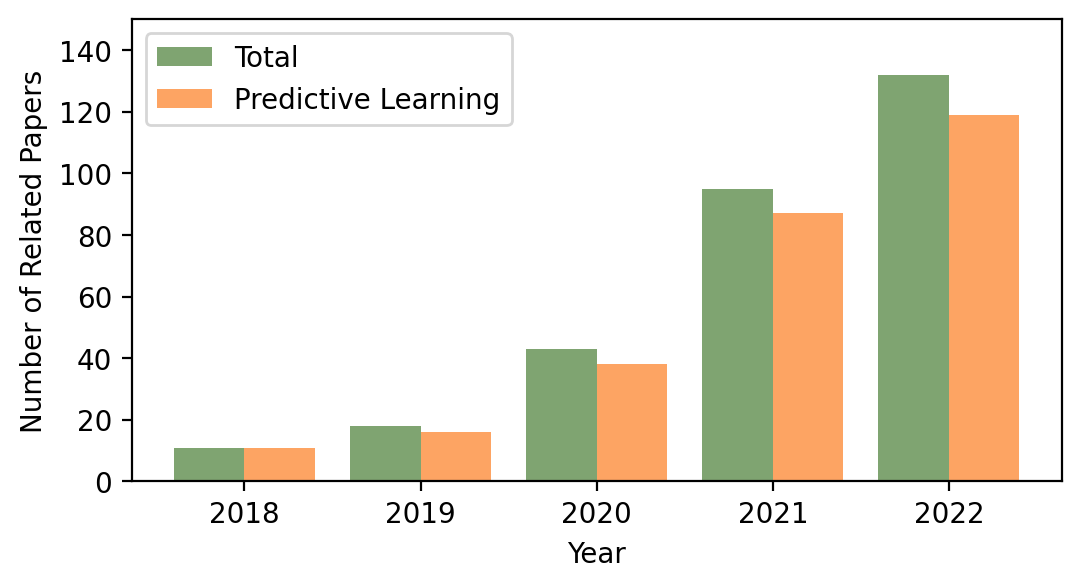
- STGNNs 越来越多地应用于交通、环境、公共安全和公共卫生领域,交通领域在文献中占比超过 60%。
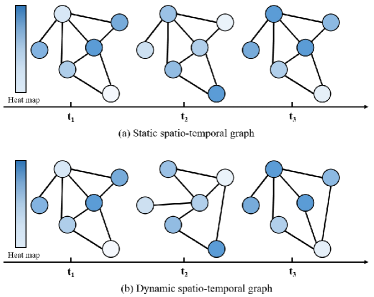
- 共有四种主要的时空图构建策略:基于拓扑、基于距离、基于相似性、基于交互,以及自适应图学习方法。
- STGNN 通常遵循数据处理模块、时空图学习模块和任务感知的预测模块。
- STGNN 的基础神经架构包括空间 GCNs(谱域和空间变体)和图注意力网络,与用于时序学习的 RNNs、LSTMs/GRUs、TCNs 和 TSANs 结合。
- 该综述提供了一个分类体系,讨论了数据集/基准,并概述了城市背景下预测学习的挑战与未来方向。
更好的研究,从现在开始
从论文设计到论文写作,大幅缩短您的研究时间。
无需绑定信用卡
本解读由 AI 生成,并经人工编辑审核。