
[论文解读] Specificity-Preserving Federated Learning for MR Image Reconstruction
该论文提出FedMRI,一种用于磁共振图像重建的保留特异性联邦学习框架,通过在k空间和图像空间中将全局共享编码器与客户端特定解码器解耦,实现性能提升。通过引入加权对比正则化以纠正局部梯度漂移,FedMRI在多机构数据上实现了最先进的重建性能,同时保留了特定于领域的扫描仪特性。
Federated learning (FL) can be used to improve data privacy and efficiency in magnetic resonance (MR) image reconstruction by enabling multiple institutions to collaborate without needing to aggregate local data. However, the domain shift caused by different MR imaging protocols can substantially degrade the performance of FL models. Recent FL techniques tend to solve this by enhancing the generalization of the global model, but they ignore the domain-specific features, which may contain important information about the device properties and be useful for local reconstruction. In this paper, we propose a specificity-preserving FL algorithm for MR image reconstruction (FedMRI). The core idea is to divide the MR reconstruction model into two parts: a globally shared encoder to obtain a generalized representation at the global level, and a client-specific decoder to preserve the domain-specific properties of each client, which is important for collaborative reconstruction when the clients have unique distribution. Such scheme is then executed in the frequency space and the image space respectively, allowing exploration of generalized representation and client-specific properties simultaneously in different spaces. Moreover, to further boost the convergence of the globally shared encoder when a domain shift is present, a weighted contrastive regularization is introduced to directly correct any deviation between the client and server during optimization. Extensive experiments demonstrate that our FedMRI's reconstructed results are the closest to the ground-truth for multi-institutional data, and that it outperforms state-of-the-art FL methods.
研究动机与目标
- 解决由于扫描协议和硬件异构性导致的多机构磁共振图像重建中的领域偏移问题。
- 保留因模型平均而丢失的客户端特定成像特性(例如,扫描仪特定属性),这些特性在传统联邦学习中常被忽略。
- 通过在k空间和图像空间中联合优化,提升全局模型泛化能力,同时不牺牲本地重建保真度。
- 开发一种轻量化、高效的训练机制,避免客户端间的重复对齐,降低通信开销。
提出的方法
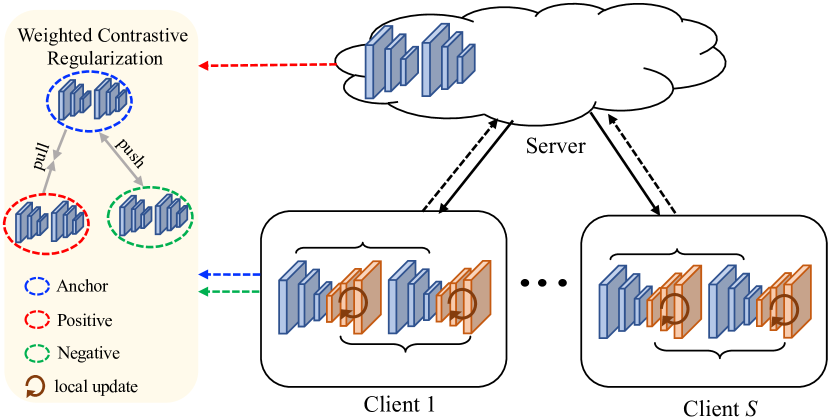
- 将磁共振图像重建模型分解为全局共享编码器和客户端特定解码器,以联合学习通用特征与领域特定特征。
- 在k空间(频域)和图像空间中同时进行模型训练,以捕捉互补表征。
- 引入一种加权对比正则化项,通过比较客户端之间的模型权重(而非特征)来纠正优化过程中的局部梯度偏差。
- 在加权对比损失中使用L1范数以提升鲁棒性和收敛性,避免对大型小批量数据的依赖,这在基于特征的对比学习中较为常见。
- 采用客户端平均更新规则训练共享编码器,结合对比正则化,将本地更新对齐至共同的全局表征。
- 仅将编码器和首个下采样层的参数进行共享,以在解码器中保留客户端特定信息。
![Figure 1: ${}_{\!}$ Classical FL algorithm for MR image reconstruction: (a) average all the local client models to obtain a general global model [ 9 ] , or (b) repeatedly align the latent features between the source and target clients [ 13 ] . In contrast, we propose a specificity-preserving mecha](https://ar5iv.labs.arxiv.org/html/2112.05752/assets/x1.png)
实验结果
研究问题
- RQ1在存在领域偏移的情况下,保留客户端特定成像特性是否能提升联邦磁共振图像重建的重建质量?
- RQ2在k空间和图像空间中联合优化是否能带来比单空间训练更优的泛化能力和保真度?
- RQ3基于权重的对比正则化机制是否能有效纠正局部梯度漂移,而无需特征级对齐或大批次数据?
- RQ4在联邦设置中,共享模型参数的比例如何影响重建性能和隐私保护?
主要发现
- FedMRI在多机构磁共振数据集上实现了最高的PSNR和SSIM分数,优于最先进的联邦学习方法,包括FedAvg、FedProx和FL-MRCM。
- 消融实验表明,共享整个本地模型(Ours₁)会降低性能,证实保留客户端特定解码器至关重要。
- 基于L1范数的加权对比正则化实现了最佳重建精度——相比L2损失提升1.53 dB,相比NT-Xent损失提升1.78 dB,证明其在处理领域偏移方面的优越性。
- FedMRI的训练时间与FedAvg和FedBN相当,仅因对比正则化带来微小增加,使其在实际部署中具备计算可行性。
- 该方法通过避免在源客户端和目标客户端之间重复进行对抗性训练,降低了通信成本,而FL-MRCM中此类训练会使训练时间翻倍。
- 结果表明,在k空间和图像空间中同时保留领域特定属性,可实现比仅在图像空间中优化的方法更准确、更鲁棒的重建。
更好的研究,从现在开始
从阅读论文到最终审阅,大幅缩短您的研究时间。
无需绑定信用卡
本解读由 AI 生成,并经人工编辑审核。