
[论文解读] Spectral calculations of 3D RMHD simulations of super-Eddington accretion onto a stellar-mass black hole
本研究对质量为6.62 M⊙的恒星级黑洞超爱丁顿吸积的3D RMHD模拟结果,采用蒙特卡洛辐射转移后处理方法,计算了合成X射线谱。结果表明,多组分康普顿散射处理方法产生的谱线更硬,温度更高,其后处理谱与ULXs(如NGC 1313 X-1)中观测到的硬X射线尾巴高度吻合。
We use the Athena++ Monte Carlo (MC) radiation transfer module to post-process simulation snapshots from non-relativistic Athena++ radiation magnetohydrodynamic (RMHD) simulations. These simulations were run using a gray (frequency integrated) approach but were also restarted and ran with a multi-group approach that accounts for Compton scattering with a Kompaneets operator. These simulations produced moderately super-Eddington accretion rates onto a 6.62 $M_\odot$ black hole. Since we only achieve inflow equilibrium out to 20-25 gravitational radii, we focus on the hard X-ray emission. We provide a comparison between the MC and RMHD simulations showing that the treatment of Compton scattering in the gray RMHD simulations underestimates the gas temperature in the regions above and below the accretion disk. In contrast, the restarted multi-group snapshots provides a treatment for the radiation field that is more consistent with the MC calculations, and result in post-processed spectra with harder X-ray emission compared to their gray snapshot counterparts. We characterize these MC post-processed spectra using commonly employed phenomenological models used for spectral fitting. We also attempt to fit our MC spectra directly to observations of the ultraluminous X-ray source (ULX) NGC 1313 X-1, finding best fit values that are competitive to phenomenological model fits, indicating that first principle models of super-Eddington accretion may adequately explain the observed hard X-ray spectra in some ULX sources.
研究动机与目标
- 从恒星级黑洞超爱丁顿吸积的3D非相对论性RMHD模拟中计算合成X射线谱。
- 评估在模拟中采用灰度与多组分康普顿散射处理方式对谱线和气体温度的影响。
- 将后处理的蒙特卡洛谱与ULX NGC 1313 X-1的观测数据进行比较。
- 评估第一性原理模拟是否能在不依赖现象学模型的前提下,重现ULX中观测到的硬X射线成分。
提出的方法
- 使用蒙特卡洛辐射转移模块对Athena++非相对论性RMHD模拟的快照进行后处理。
- 在初始模拟中采用频率积分截面和辐射力的灰度辐射转移方法。
- 通过引入Kompaneets算子,使用多组分方法重启模拟,以更准确地模拟康普顿散射。
- 通过蒙特卡洛光子输运计算能量分布,初始康普顿冷却估算采用黑体假设。
- 使用标准现象学模型(如SIMPL、POW)对结果谱进行拟合,并与XMM-Newton和NuSTAR的观测数据直接比较。
- 从蒙特卡洛谱生成XSPEC表格模型,以实现与观测数据的直接拟合。
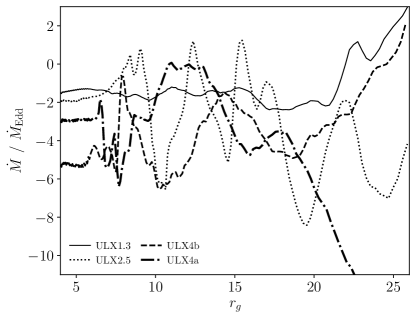
实验结果
研究问题
- RQ1在灰度与多组分RMHD模拟中,康普顿散射的处理方式如何影响预测的X射线谱和气体温度?
- RQ23D RMHD模拟经后处理的蒙特卡洛谱在多大程度上能重现NGC 1313 X-1等ULX中观测到的硬X射线尾巴?
- RQ3第一性原理的超爱丁顿吸积模拟能否产生与现象学模型在谱拟合中相当的谱线?
- RQ4当前模拟设置的局限性(特别是吸积流平衡状态和辐射场处理)在多大程度上影响了对观测ULX谱的重现?
主要发现
- 灰度RMHD模拟由于在喷流区域使用黑体假设进行康普顿冷却估算,导致对喷流区域上方和下方气体温度的低估。
- 采用Kompaneets型康普顿散射处理的多组分模拟,其气体温度更高,且X射线谱显著比灰度模拟更硬。
- 多组分快照生成的谱线在硬X射线波段具有约Γ ≈ 2–3的幂律谱指数,与NGC 1313 X-1和Holmberg IX X-1的观测结果一致。
- 当对灰度RMHD快照的谱线进行拟合时,SIMPL模型对硬X射线成分的拟合效果优于幂律(POW)模型,其谱指数Γ ≈ 2–4。
- 将蒙特卡洛谱直接拟合NGC 1313 X-1的观测数据,在10 keV以下获得良好拟合,但谱线在硬X射线尾巴区域的陡度或平缓程度取决于源的组分。
- 最佳拟合的归一化值对应于比实际观测值更低的光度,暗示可能存在缺失的一般相对论效应或吸积流未达完全平衡状态。

更好的研究,从现在开始
从阅读论文到最终审阅,大幅缩短您的研究时间。
无需绑定信用卡
本解读由 AI 生成,并经人工编辑审核。