
[论文解读] Stable Quantum-Correlated Many Body States through Engineered Dissipation
本文展示了通过工程化耗散来制备和稳定超导量子比特上的纠缠多体态,揭示了长程量子相关性和非平衡传输现象。
Engineered dissipative reservoirs have the potential to steer many-body quantum systems toward correlated steady states useful for quantum simulation of high-temperature superconductivity or quantum magnetism. Using up to 49 superconducting qubits, we prepared low-energy states of the transverse-field Ising model through coupling to dissipative auxiliary qubits. In one dimension, we observed long-range quantum correlations and a ground-state fidelity of 0.86 for 18 qubits at the critical point. In two dimensions, we found mutual information that extends beyond nearest neighbors. Lastly, by coupling the system to auxiliaries emulating reservoirs with different chemical potentials, we explored transport in the quantum Heisenberg model. Our results establish engineered dissipation as a scalable alternative to unitary evolution for preparing entangled many-body states on noisy quantum processors.
研究动机与目标
- 证明耗散性储层能够将多体系统引导到对量子仿真有用的相关稳态。
- 展示跨系统尺度的长程量子相关性和非平凡的基态保真度随尺度的缩放。
- 通过将系统耦合到具有不同化学势的储层来探索非平衡传输。
- 提供证据表明耗散性制备在可扩展性和鲁棒性方面优于幺正态制备。
提出的方法
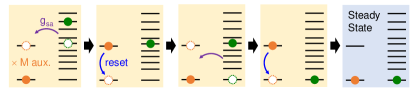
- 使用 M 个耗散性辅助量子比特连接到 L 个系统量子比特,以实现朝向 TFIM 低能态的耗散冷却。
- 使用一个周期量子电路,实施类 Floquet 演化,其循环单位算子 U 由 XX/YY 型和 Z 旋转构成。
- 通过带角度 theta 的部分 iSWAP 门来调整系统-储层耦合 g_sa,并用 Z^h 门调整辅助能量。
- 定期重置辅助量子比特,以实现自主动反馈回路,稳定冷却态。
- 通过量子态层析和一阶密度矩阵(1RDM)的纯化来表征态并估计基态保真度。
- 测量互信息和非局部相关子以诊断超出最近邻的量子相关性。
实验结果
研究问题
- RQ1在可扩展的超导量子处理器中,工程化耗散是否能制备并稳定纠缠的多体态?
- RQ2在一维和二维几何中,稳态保真度相对于 TFIM 基态/低激发态的随系统规模的缩放如何?
- RQ3在稳态中出现了哪些非局部量子相关性(与纠缠度量),以及它们与基态预期相比如何?
- RQ4将系统耦合到具有不同化学势的储层如何在像 XXZ 这样的自旋模型中驱动非平衡传输?
主要发现
- 在 d>50 时,稳态能量 E/E0 从一维反铁磁相的 0.7 到顺磁相的 0.8。
- 在临界点 g/J=1.0 的经纯化 1RDM 的基态保真度为 0.92(L=6),0.90(L=12),和 0.86(L=18)。
- 一维 TFIM 稳态下最近邻 concurrence 稳定在大约 0.1。
- 非局部量子相关子 C_q 在反铁磁区域显示边缘模相关性,在临界点呈幂律衰减,反映了基态行为。
- 在 2D TFIM(35 个量子比特,14 个辅助量子比特)中,临界点 g/J=1.5 时 E/E0 = 0.58,且长程互信息表明稳态存在超出最近邻的相关态。
- 使用边界驱动的 Floquet XXZ,实验在易平面相下呈现发射状传输,在易轴相下呈现绝缘体样行为,在各向同性点表现为亚扩散传输,指数约为 -2/3,突出了一种新的非平衡传输调控。
![Figure 2: Dissipative cooling and stabilization of a 1D TFIM. (A) A periodic quantum circuit used to implement dissipative cooling on a quantum processor. Here the $XX(J)$ and iSWAP( $\theta$ ) gates are composed from tunable CPHASE and fermionic simulation (fSim) gates [ 13 ] . (B) $E/E_{0}$ as a f](https://ar5iv.labs.arxiv.org/html/2304.13878/assets/x2.png)
更好的研究,从现在开始
从论文设计到论文写作,大幅缩短您的研究时间。
无需绑定信用卡
本解读由 AI 生成,并经人工编辑审核。