
[论文解读] Standard Siren Cosmology with Gravitational Waves from Binary Black Hole Mergers in Active Galaxy Nuclei
该论文提出了一种新颖的标准siren宇宙学方法,利用活动星系核(AGNs)中双黑洞并合产生的引力波,通过AGN耀斑或星表作为红移指示器,无需识别独特的宿主星系。在LIGO/Virgo/KAGRA达到设计(A+)灵敏度的1–2年内,该方法可实现2–7%精度的H₀约束,具体取决于耀斑探测效率和宇宙学先验。
The detection of gravitational waves (GW) with an electromagnetic counterpart enabled the first Hubble Constant $H_0$ measurement through the standard siren method. Current constraints suggest that $\sim 20-30\%$ of LIGO/Virgo/KAGRA (LVK) Binary Black Hole (BBH) mergers might occur in Active Galactic Nuclei (AGN) disks. The claim for a possible association of several BBH mergers with flaring AGNs suggests that cosmological analyses using BBH and AGNs might be promising. We explore standard siren analyses through a method that takes into account the presence of background flaring AGNs, without requiring a unique host galaxy identification, and apply it to realistic GW simulations. Depending on the fraction of LVK BBHs that induce flares, we expect to constrain $H_0$ at the $\sim 6-7\%$ ($\sim 4-5\%$) precision with $\sim 2-3$ years or $\sim 160-240$ events ($\sim 1$ year or $500$ events) of LVK at design (A+) sensitivity, assuming that systematic BBH follow-up searches are performed. %Assuming a more restrictive $Ω_{ m m}$ prior and that at least $20\%$ of BBHs produces detectable flares, we may reach a $3\%$ ($2\%$) precision in $H_0$ after 2 (1) year of LVK at design (A+) sensitivity. We also show that in a scenario where only $\sim 1\%$ of the BBHs induce detectable flares it is possible to achieve an $H_0$ precision from $7.5\%$ to $15\%$ with $\sim 240$ events. In addition, a $\sim 5-27\%$ precision is achievable with complete AGN catalogs and 1 year of LVK run, without the need of any flare identification.
研究动机与目标
- 通过利用引力波实现独立的宇宙学测量,解决持续存在的H₀张力问题。
- 通过使用AGN耀斑作为红移指示器,克服大多数双黑洞(BBH)并合缺乏电磁对应体的挑战。
- 开发一种统计方法,将引力波事件与AGNs或耀斑关联,无需依赖时间敏感的后续观测或独特的宿主星系识别。
- 量化在考虑现实AGN密度和耀斑概率的情况下,利用AGNs中的BBH并合可实现的宇宙学精度。
- 评估宇宙学先验(如Ω_m)和AGN耀斑探测效率对H₀测量精度的影响。
提出的方法
- 使用非齐次泊松过程对GW-AGN关联进行建模,以考虑AGNs和耀斑的空间与时间分布。
- 应用贝叶斯定理计算宇宙学参数的后验分布,对诱导耀斑的BBH比例(λ)和天球位置进行边缘化。
- 使用似然函数(公式3),结合引力波事件与AGN天球位置和红移匹配的概率,以及偶然重合的背景率。
- 引入AGN和耀斑的探测概率(P_det^AGN),并通过对天球和红移的积分计算背景关联的期望数量(μ_i,公式4)。
- 使用emcee MCMC软件包对后部分布进行采样,以估计wCDM宇宙学模型中的宇宙学参数和λ。
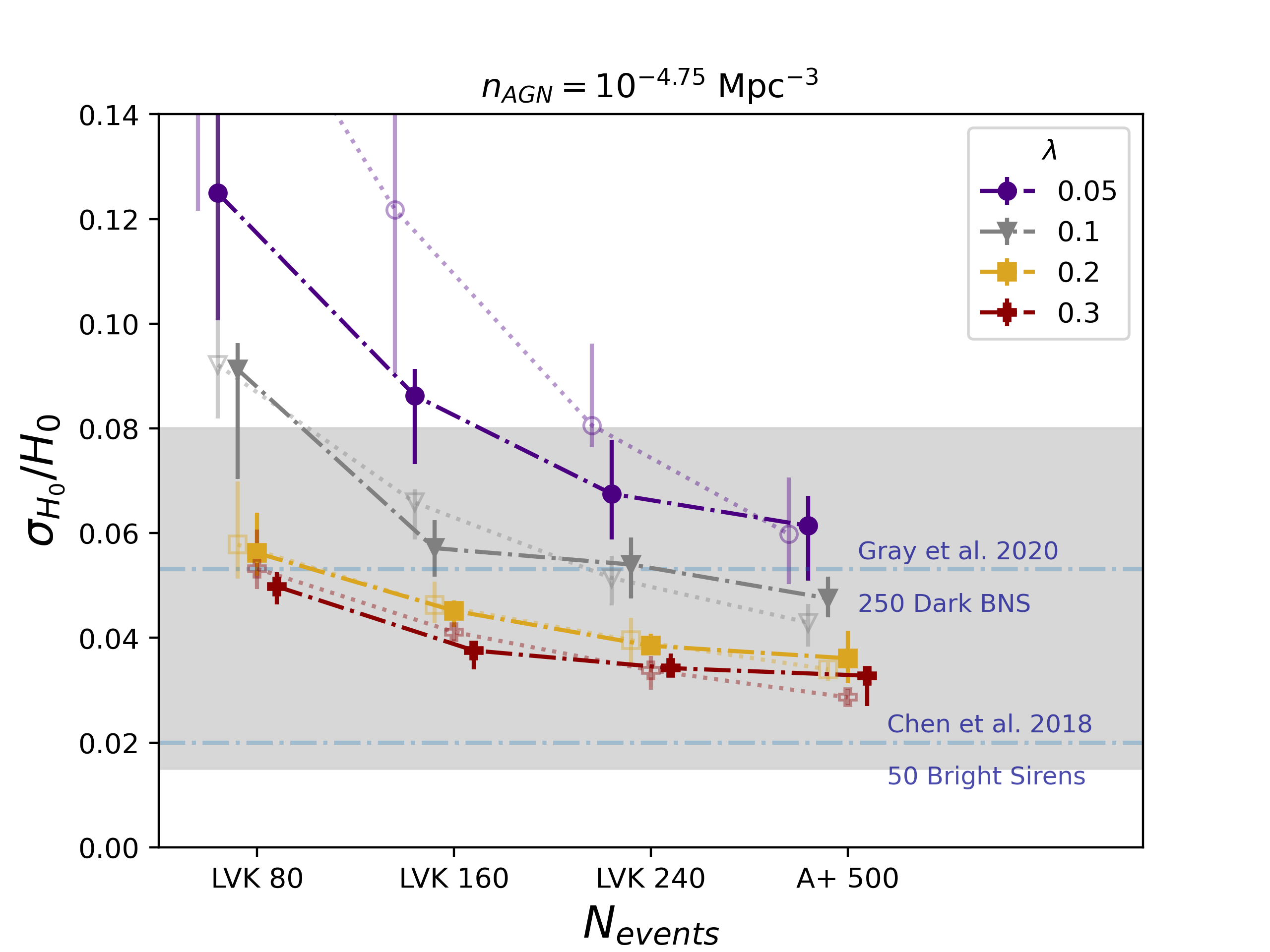
- 在具有不同AGN数密度(n_AGN = 10^{-4.75} 至 10^{-4.5} Mpc⁻³)和耀斑概率(α_flare = 10^{-4} 至 10^{-3})的真实引力波模拟上测试该方法。
实验结果
研究问题
- RQ1是否可以不识别唯一宿主星系,仅使用AGN耀斑或星表作为标准siren宇宙学的红移指示器?
- RQ2在当前和未来引力波探测器灵敏度下,利用AGNs中的BBH并合可实现多高的H₀精度?
- RQ3在该框架中,包含宇宙学先验(如Ω_m)如何影响H₀测量的精度?
- RQ4测量诱导可探测AGN耀斑的BBH比例(λ)的预期精度是多少?其与事件数量和AGN密度的关系如何?
- RQ5该方法是否可在无需时间敏感后续观测的情况下,仅使用AGN星表实现子5%的H₀精度?
主要发现
- 在LIGO/Virgo/KAGRA达到设计灵敏度的约2年内,若160个BBH事件发生,且20–80%的BBH并合发生在AGNs中,H₀可实现3.5–7%的精度约束。
- 在A+灵敏度下约1年内发生500个事件时,H₀精度提升至2.5–5%,在相同假设下。
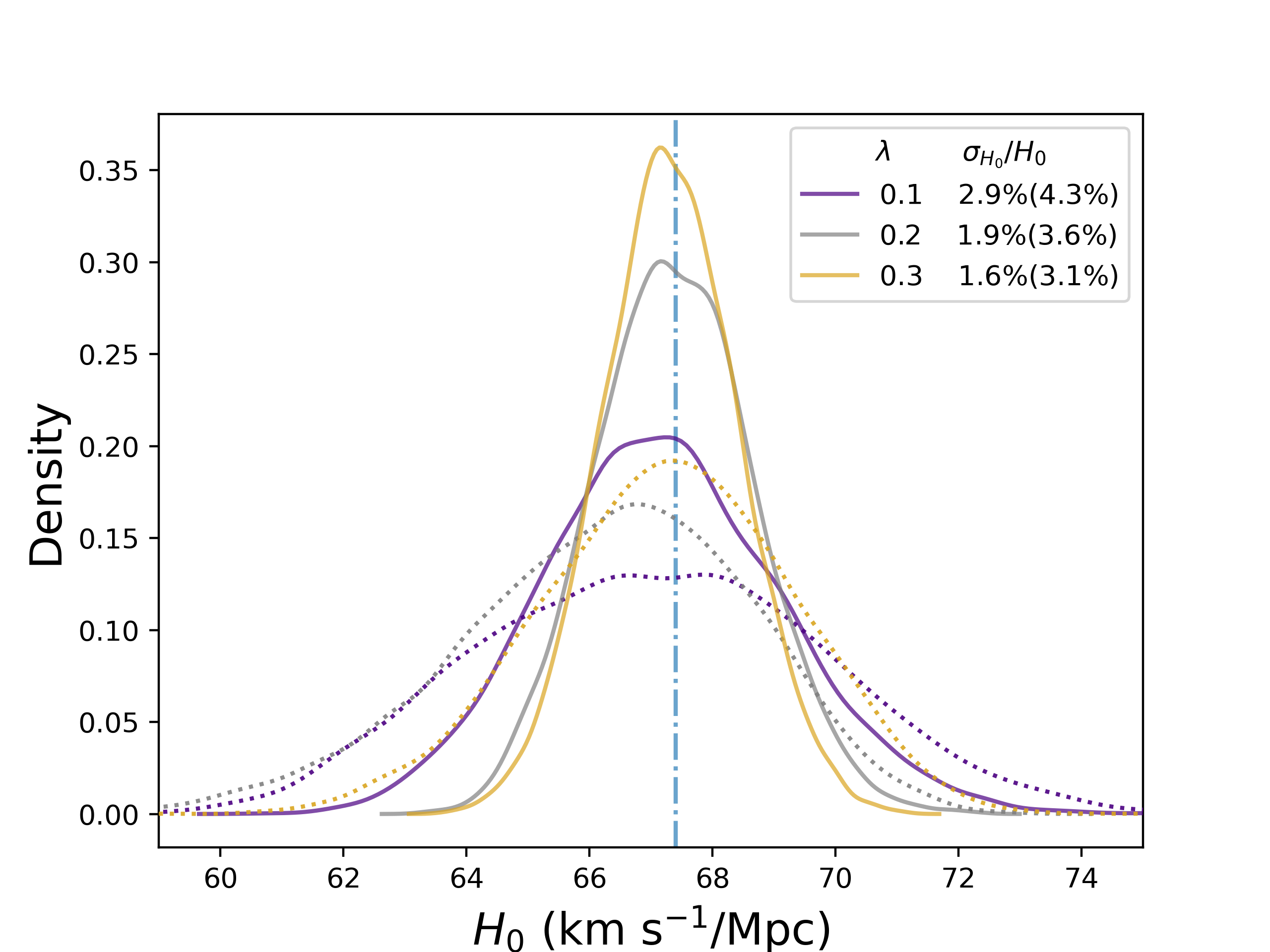
- 假设BBH耀斑比例为20%,且Ω_m先验较严格,H₀精度在A+灵敏度下1年(2年)后可达到2%(3%)。
- 仅使用完整的AGN星表和1年LVK数据,即可实现5–10%的H₀精度,无需时间敏感的后续观测。
- 该方法可实现约10–30%精度的λ(诱导耀斑的BBH比例)约束,为AGNs中BBH形成通道提供洞见。
- 后验等高线显示典型的香蕉形退化,证实该方法与标准siren宇宙学原理的一致性。
更好的研究,从现在开始
从阅读论文到最终审阅,大幅缩短您的研究时间。
无需绑定信用卡
本解读由 AI 生成,并经人工编辑审核。