
[论文解读] Star-Planet Interaction at radio wavelengths in YZ Ceti: Inferring planetary magnetic field
本研究首次通过射电波段的极光射电辐射(ARE)确认探测到YZ Ceti系统中恒星-行星相互作用(SPI)。利用升级版巨型米波射电望远镜(uGMRT),研究人员检测到与YZ Cet b轨道相位相关的圆偏振射电爆发,推断出系外行星磁场下限为0.4 G,标志着首次对系外行星磁层的间接测量。
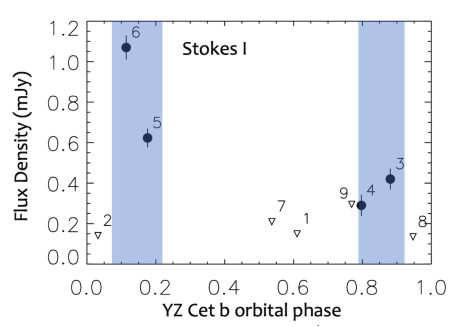
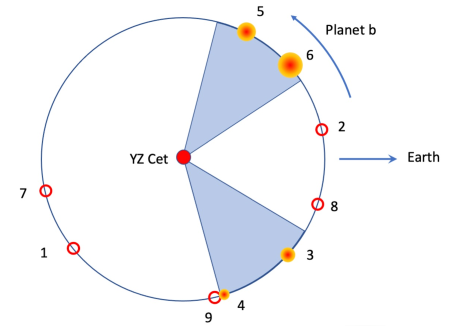
In exoplanetary systems, the interaction between the central star and the planet can trigger Auroral Radio Emission (ARE), due to the Electron Cyclotron Maser mechanism. The high brightness temperature of this emission makes it visible at large distances, opening new opportunities to study exoplanets and to search for favourable conditions for the development of extra-terrestrial life, as magnetic fields act as a shield that protects life against external particles and influences the evolution of the planetary atmospheres. In the last few years, we started an observational campaign to observe a sample of nearby M-type stars known to host exoplanets with the aim to detect ARE. We observed YZ Ceti with the upgraded Giant Metrewave Radio Telescope (uGMRT) in band 4 (550-900 MHz) nine times over a period of five months. We detected radio emission four times, two of which with high degree of circular polarization. With statistical considerations we exclude the possibility of flares due to stellar magnetic activity. Instead, when folding the detections to the orbital phase of the closest planet YZ Cet b, they are at positions where we would expect ARE due to star-planet interaction (SPI) in sub-Alfvenic regime. With a degree of confidence higher than 4.37 sigma, YZ Cet is the first extrasolar systems with confirmed SPI at radio wavelengths. Modelling the ARE, we estimate a magnetic field for the star of about 2.4 kG and we find that the planet must have a magnetosphere. The lower limit for the polar magnetic field of the planet is 0.4 G.
研究动机与目标
- 利用射电波段探测系外行星系统中恒星-行星相互作用(SPI)产生的极光射电辐射(ARE)。
- 在M型矮星系统中区分SPI驱动的射电辐射与恒星耀斑。
- 通过射电辐射建模推断行星磁场的存在与强度。
- 检验极光射电辐射的空心圆锥束模型在系外行星系统中的适用性。
- 建立一种通过射电辐射间接探测系外行星磁层的方法。
提出的方法
- 在五个月内对YZ Ceti进行了九次uGMRT观测,频率范围为550–900 MHz,以探测射电辐射。
- 通过分析圆偏振特性与时间变异性,区分ARE与恒星耀斑。
- 将检测结果折叠至YZ Cet b的轨道相位,以识别与预期SPI区域的相关性。
- 利用电子回旋脉泽辐射(ECME)机制对观测到的射电辐射进行建模。
- 通过入射磁能功率与观测射电辐射之间的功率平衡,推断行星磁层截面。
- 应用广义射电-磁性Bode定律与偶极场标度关系,估算行星磁场的下限。
实验结果
研究问题
- RQ1能否在系外行星系统中通过射电波段探测到由恒星-行星相互作用产生的极光射电辐射(ARE)?
- RQ2YZ Ceti中探测到的射电辐射是否与SPI导致的ARE一致,而非恒星耀斑?
- RQ3基于射电辐射建模,YZ Cet b的行星磁场下限是多少?
- RQ4观测到的辐射模式是否支持ARE的空心圆锥束模型?
- RQ5射电辐射能否作为间接探测系外行星磁层的代理指标?
主要发现
- 在九次uGMRT观测中检测到四次射电辐射,其中两次检测到高圆偏振度,表明为相干辐射。
- 射电辐射与YZ Cet b的轨道相位强烈相关,在两个对称区域达到峰值,与ARE的空心圆锥束模型一致。
- 统计分析表明,发射源并非恒星耀斑,置信水平超过4.37σ。
- 观测到的射电光度(1.0–1.7×10²² erg s⁻¹)超过若行星无磁层时的最大入射磁能功率,表明磁层截面至少为行星半径的2.4倍。
- 在假设为偶极场与功率平衡的前提下,推导出YZ Cet b极区磁场下限为0.4 G。
- 本研究结果代表首次在系外行星系统中实现对行星磁场的间接探测,对行星宜居性与大气演化具有重要意义。
更好的研究,从现在开始
从阅读论文到最终审阅,大幅缩短您的研究时间。
无需绑定信用卡
本解读由 AI 生成,并经人工编辑审核。