
[论文解读] Statistics for Galaxy Outflows at $z\sim 6-9$ with Imaging and Spectroscopic Signatures Identified with JWST/NIRCam and NIRSpec Data
本研究利用詹姆斯·韦布空间望远镜(JWST)的NIRCam和NIRSpec数据,分析了61个红移z≈6–9的高红移星系中的电离气体外流,识别出五个具有空间扩展[O iii]发射的星系和五个具有宽[O iii]谱线的星系,表明由恒星反馈驱动的广泛外流普遍存在。与低红移星系相比,高红移星系中扩展气体比例更高,提示早期星系中频繁的并合事件可能触发了持续的外流循环。
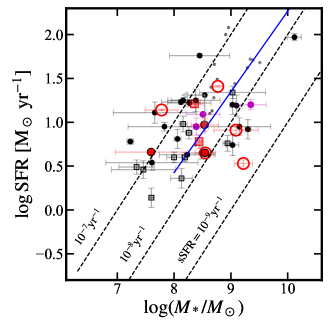
We present statistics of $z\sim 6-9$ galaxy outflows indicated by spatially-extended gas emission and broad lines. With a total of 61 spectroscopically confirmed galaxies at $z\sim 6-9$ in the JWST CEERS, GLASS, and ERO data, we find four galaxies with [O{\sc iii}]+H$β$ ionized gas emission significantly extended beyond the kpc-scale stellar components on the basis of the emission line images constructed by the subtraction of NIRCam broadband (line on/off-band) images. By comparison with low-$z$ galaxies, the fraction of galaxies with the spatially extended gas, 4/18, at $z\sim 6-9$ is an order of magnitude higher than those at $z\sim 0-1$, which can be explained by events triggered by frequent major mergers at high redshift. We also investigate medium- and high-resolution NIRSpec spectra of 30 galaxies at $z\sim 6-9$, and identify five galaxies with broad ($140-800$ km s$^{-1}$) lines in the [O{\sc iii}] forbidden line emission, suggestive of galaxy outflows. One galaxy at $z=6.38$ shows both the spatially-extended gas emission and the broad lines, while none of the galaxies with the spatially-extended gas emission or broad lines present a clear signature of AGN either in the line diagnostics or Type 1 AGN line broadening ($>1000$ km s$^{-1}$), which hint outflows mainly driven by stellar feedback. The existence of galaxies with/without spatially-extended gas emission or broad lines may be explained by different viewing angles towards outflows, or that these are galaxies in the early, late, post phases of galaxy outflows at high redshift, where the relatively large fractions of such galaxies indicate the longer-duration and/or more-frequent outflows at the early cosmic epoch.
研究动机与目标
- 研究红移z≈6–9的高红移星系中电离气体外流的普遍性及其物理起源。
- 确定空间扩展[O iii]发射和宽发射线(外流的特征)在高红移星系中是否比在本地宇宙中更为频繁。
- 通过分析谱线轮廓和诊断方法,区分驱动外流的反馈机制(恒星 vs. AGN)。
- 通过空间扩展与宽谱线共存或缺失的关系,探索外流的演化阶段(早期、晚期、后外流阶段)。
- 量化表现出扩展电离气体和持续外流的星系比例,以评估其在早期星系演化中的作用。
提出的方法
- 通过从多波段成像数据中减去NIRCam宽波段(通带内/外)的恒星连续成分,构建[O iii]发射线图像。
- 通过将发射形态与61个光谱确认星系中kpc量级的恒星成分进行比较,识别出空间扩展的[O iii]发射。
- 分析30个星系的中、高分辨率NIRSpec光谱,检测FWHM为140–800 km s⁻¹的宽[O iii]发射线,该特征表明存在外流。
- 通过双高斯拟合发射线,分离出与外流相关的宽成分。
- 通过最大外流速度与逃逸速度之比(v_max/v_esc < 1)评估外流喷射效率,该比值表明气体保留在晕中。
- 通过线诊断(如BPT比值)和未见Type 1 AGN线型展宽(>1000 km s⁻¹)排除AGN贡献。
![Figure 1: Filter response curves of JWST/NIRCam F277w, F356w, and F444w broadband filters overplotted with example spectra of SF galaxies at $z\sim 6$ and 8. At $z\sim 6$ , H $\beta$ +[O iii ] emission lines are covered by F356w filter while F277 filter traces the optical continuum. At $z\sim 8$ , H](https://ar5iv.labs.arxiv.org/html/2306.07940/assets/x1.png)
实验结果
研究问题
- RQ1在z≈6–9的星系中,有多少比例表现出超出其恒星成分的[O iii]空间扩展发射?
- RQ2在z≈6–9的星系中,有多少比例表现出指示电离气体外流的宽[O iii]发射线?
- RQ3基于光谱和形态诊断,观测到的外流主要由恒星反馈还是AGN活动驱动?
- RQ4在星系外流演化阶段的背景下,空间扩展气体与宽发射线之间存在何种关系?
- RQ5与低红移星系相比,观测到的外流统计特征有何差异?这如何反映大质量并合事件在触发外流中的作用?
主要发现
- 在z≈6–9的61个星系中,有5个(8.2%)表现出超出其kpc量级恒星成分的空间扩展[O iii]发射,该比例比z≈0–1星系高出一个数量级。
- 5个星系表现出宽[O iii]发射线(140–800 km s⁻¹),表明存在持续的电离气体外流,其中1个星系(ERO_05144)同时具有扩展发射和宽线。
- 所有5个识别出外流的星系均满足v_max/v_esc < 1,表明电离气体不太可能逃逸暗物质晕,暗示气体保留在星系晕(CGM)中。
- 未发现具有扩展发射或宽线的星系在光谱诊断中显示明确的AGN特征,也未见Type 1 AGN的线型展宽(>1000 km s⁻¹),支持恒星反馈是主导驱动力。
- 同时存在具有扩展发射但无宽线的星系,以及具有宽线但无扩展发射的星系,表明外流可能遵循包含早期、晚期和后外流阶段的循环模型。
- 高红移星系中扩展气体比例高于低红移星系,可能归因于早期宇宙中频繁的大质量并合事件,这些事件可能延长后外流阶段或提高外流效率。
更好的研究,从现在开始
从阅读论文到最终审阅,大幅缩短您的研究时间。
无需绑定信用卡
本解读由 AI 生成,并经人工编辑审核。