
[论文解读] Stream-K: Work-centric Parallel Decomposition for Dense Matrix-Matrix Multiplication on the GPU
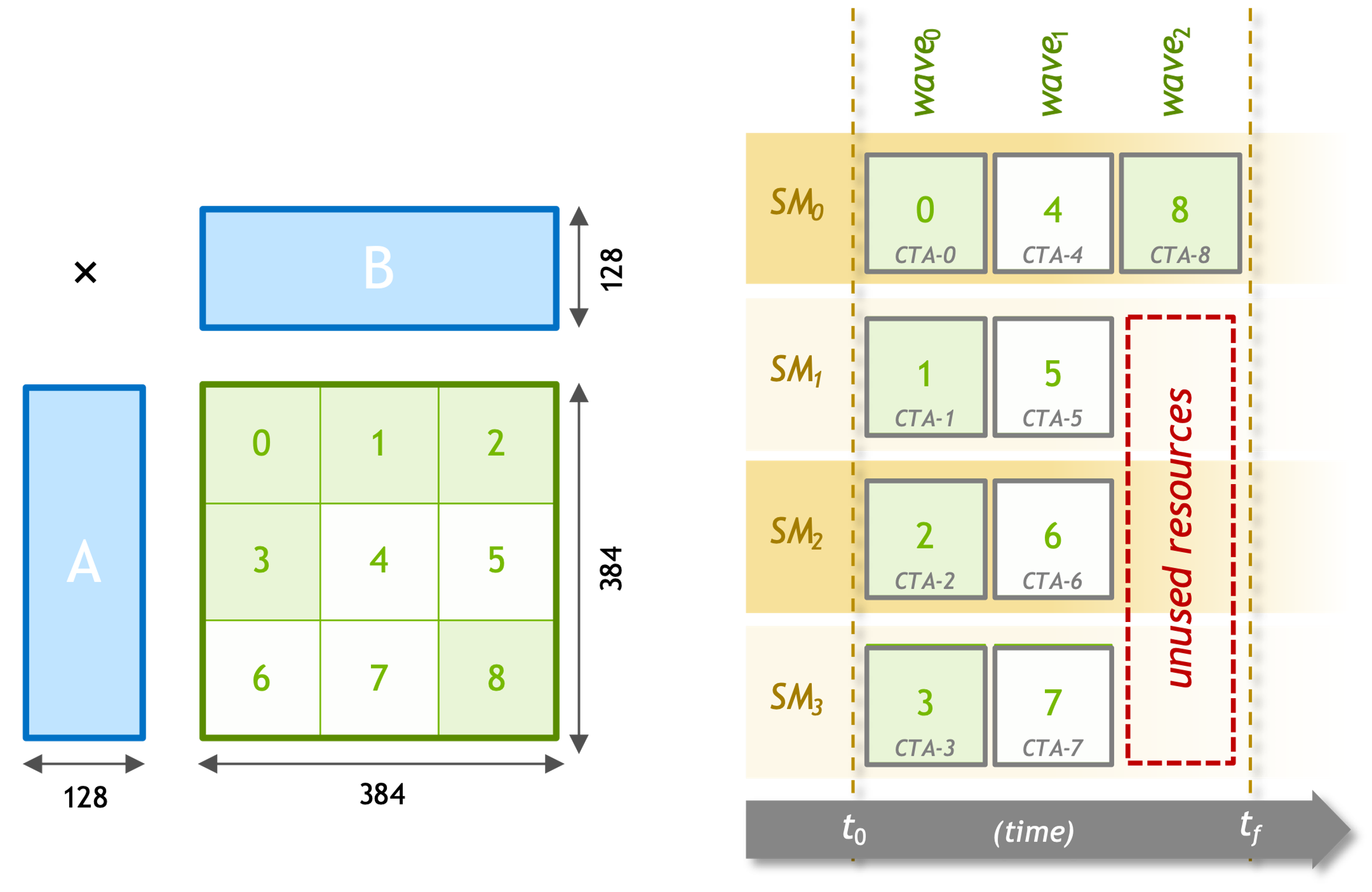
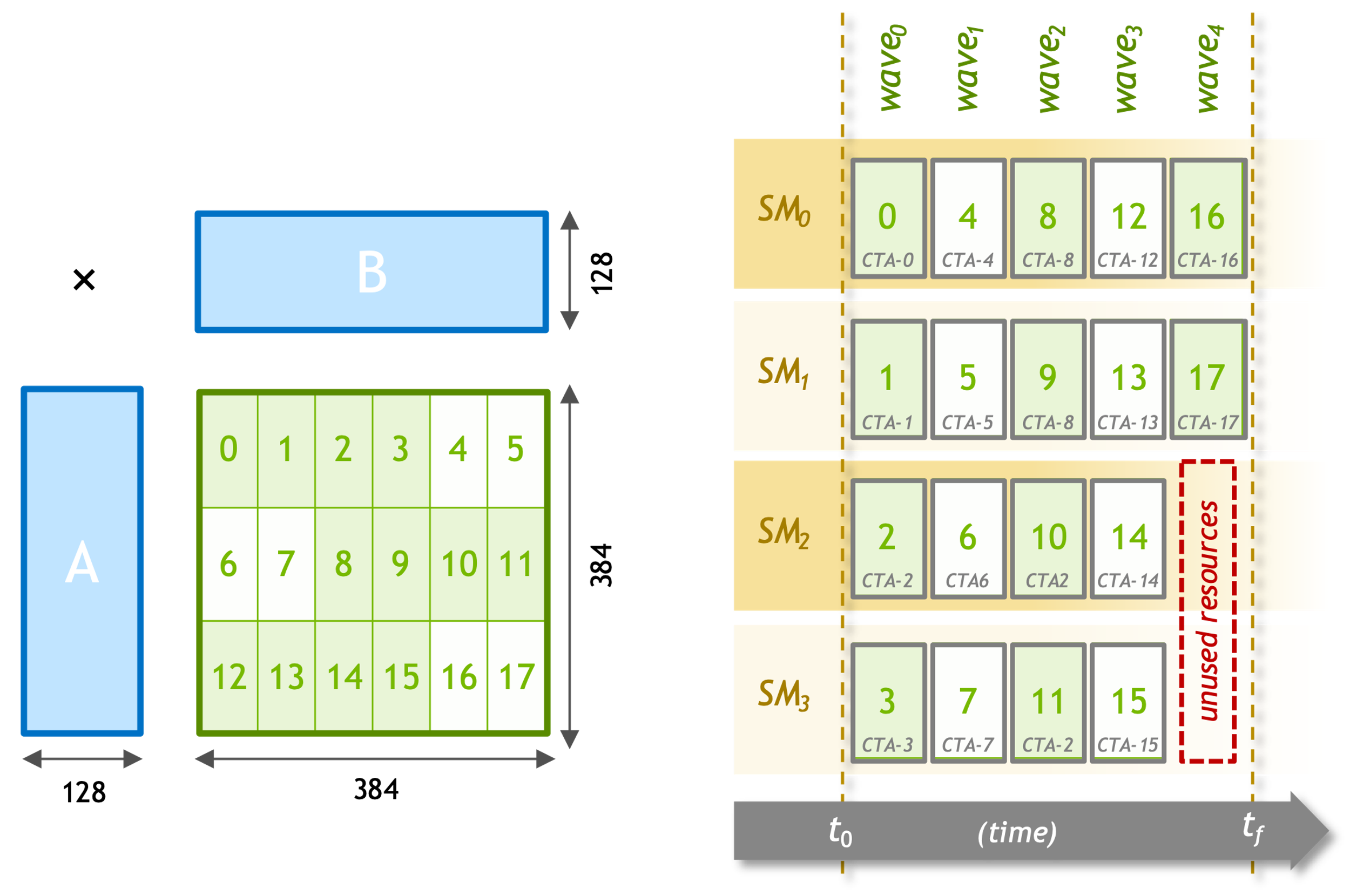
Stream-K 在 GPU 上引入了一种以工作为中心的并行分解方法,用于密集矩阵-矩阵乘法(GEMM),将乘加(MAC)循环迭代均匀分配给流式多处理器(SMs),而非对输出矩阵进行分块。这种方法在各种问题形状下实现了接近 100% 的处理器利用率,相较于 cuBLAS 和 CUTLASS,最高可实现 14× 的峰值加速和 6.7× 的平均性能提升,且每个精度仅使用一个内核,而非复杂的内核集合。
We introduce Stream-K, a work-centric parallelization of matrix multiplication (GEMM) and related computations in dense linear algebra. Whereas contemporary decompositions are primarily tile-based, our method operates by partitioning an even share of the aggregate inner loop iterations among physical processing elements. This provides a near-perfect utilization of computing resources, regardless of how efficiently the output tiling for any given problem quantizes across the underlying processing elements. On GPU processors, our Stream-K parallelization of GEMM produces a peak speedup of up to 14$ imes$ and 6.7$ imes$, and an average performance response that is both higher and more consistent across 32,824 GEMM problem geometries than state-of-the-art math libraries such as CUTLASS and cuBLAS. Furthermore, we achieve this performance from a single tile size configuration per floating-point precision, whereas today's math libraries employ complex kernel-selection heuristics to select from a large ensemble of kernel variants.
研究动机与目标
- 为解决在宽 GPU 上基于分块的 GEMM 工作负载中因量化效率低下导致的性能下降问题。
- 通过在各种问题形状下实现一致且高性能的执行,消除数学库中复杂的内核选择启发式方法的需求。
- 通过在乘加循环级别重新定义工作量化,无论问题大小或形状如何,均实现接近 100% 的处理器利用率。
- 通过用每个精度仅一个高度可移植的内核替代大型内核集合,减少库的膨胀和维护复杂性。
提出的方法
- Stream-K 将乘加(MAC)循环迭代的总数在 GPU 流式多处理器(SMs)之间均匀分配,确保工作负载分布均衡。
- 它将 MAC 循环迭代作为工作量量化的基本单位,其成本恒定且最低,相较于整个输出分块而言。
- 该方法动态创建 O(p) 个分割缝(p 为 SM 数量),按处理器宽度而非问题大小扩展工作量分配。
- 它为每种浮点精度使用单一固定分块因子,避免了对多个内核变体或复杂选择启发式方法的需求。
- 该方法最小化了通信和同步开销,这些开销随 SM 数量增长,而非随问题大小增长。
- 该方法已集成至 CUTLASS 2.11,支持 FP64、FP16→FP32 及其他精度格式,并保持一致的高性能表现。
实验结果
研究问题
- RQ1以工作为中心的分解方法,若在 MAC 循环级别进行量化,是否能在现代 GPU 上实现比基于分块的 GEMM 更高且更一致的性能?
- RQ2在不牺牲性能的前提下,每个精度仅用一个内核是否足以替代 cuBLAS 等数学库中庞大的内核集合?
- RQ3在各种不同的问题几何形状下,Stream-K 的工作量平衡与基于分块的方法相比,在量化效率方面表现如何?
- RQ4与复杂的内核选择启发式方法相比,采用统一的、以工作为中心的分解方法,其性能影响如何?
主要发现
- 在 32,824 种 GEMM 问题几何形状中,Stream-K 相较于 cuBLAS 实现了最高 14× 的峰值加速和 6.7× 的平均性能提升。
- 对于 FP64,Stream-K 的吞吐量比 cuBLAS 高 6%;对于 FP16→FP32,其吞吐量高出 13%。
- Stream-K 的性能分布范围比 cuBLAS 和理想化的 CUTLASS 模拟器(oracle)更窄,表明其具备更优的一致性和资源利用率。
- 在计算密集型场景下(FP64 每字节操作数 >150,FP16→FP32 每字节操作数 >400),Stream-K 持续优于 cuBLAS 内核集合。
- 与 cuBLAS 相比,Stream-K 将分发大小减少了最多 20×,仅用一个内核每精度即可实现峰值性能,而非数百个专用内核。
- 该方法无论问题形状如何,均实现了接近 100% 的处理器利用率,消除了基于分块方法因量化效率低下而产生的 75–90% 理论上限。
更好的研究,从现在开始
从阅读论文到最终审阅,大幅缩短您的研究时间。
无需绑定信用卡
本解读由 AI 生成,并经人工编辑审核。