
[论文解读] Strong coupling and single-photon nonlinearity in free-electron quantum optics
本文提出自由电子纤维——一种一维光子系统,利用辐射压引导抑制电子衍射,并实现与导引光子模式的长相互作用长度。该方案实现了强耦合($|g_Q| \gtrsim 1$)和单光子非线性($δ_{νι} \sim 2\pi$),从而实现确定性的单光子发射及复杂的多模动力学。
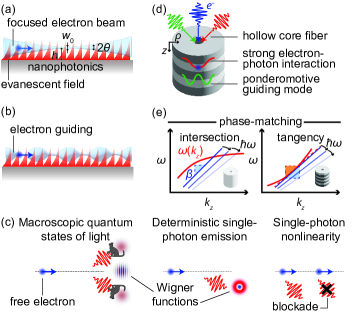
The observation that free electrons can interact coherently with quantized electromagnetic fields and matter systems has led to a plethora of proposals leveraging the unique quantum properties of free electrons. At the heart of these proposals lies the assumption of a strong quantum interaction between a flying free electron and a photonic mode. However, existing schemes are intrinsically limited by electron diffraction, which puts an upper bound on the interaction length and therefore the quantum coupling strength. Here, we propose the use of "free-electron fibers'': effectively one-dimensional photonic systems where free electrons co-propagate with two guided modes. The first mode applies a ponderomotive trap to the free electron, effectively lifting the limitations due to electron diffraction. The second mode strongly couples to the guided free electron, with an enhanced coupling that is orders of magnitude larger than previous designs. Moreover, the extended interaction lengths enabled by our scheme allows for strong single-photon nonlinearities mediated by free electrons. We predict a few interesting observable quantum effects in our system, such as deterministic single-photon emission and complex, nonlinear multimode dynamics. Our proposal paves the way towards the realization of many anticipated effects in free-electron quantum optics, such as non-Gaussian light generation, deterministic single photon emission, and quantum gates controlled by free-electron--photon interactions.
研究动机与目标
- 克服自由电子量子光学中电子衍射带来的根本限制,该限制限制了相互作用长度和耦合强度。
- 通过辐射压约束实现电子的长相互作用长度,从而在自由电子与光子模式之间实现强量子耦合。
- 通过自由电子介导实现强单光子非线性,这对于非高斯光场生成和确定性量子光学至关重要。
- 构建一个用于量子信息处理和传感的平台,利用具有高相干性和可调性的自由电子-光子相互作用。
- 在介电波导结构中展示确定性单光子发射和复杂非线性多模动力学的可行性。
提出的方法
- 设计一种一维光子系统,其中自由电子与两个导引光子模式共传播:一个用于辐射压捕获,另一个用于强耦合。
- 使用辐射压势来抵消电子衍射,有效延长电子的平均自由程,从而实现长相互作用长度。
- 采用定制化的光子模式结构,实现增强的耦合强度 $|g_Q| \gtrsim 1$,进入强耦合 regime。
- 利用类似 Jaynes-Cummings 的哈密顿量建模电子-光子相互作用,引入非线性反冲项以描述单光子非线性。
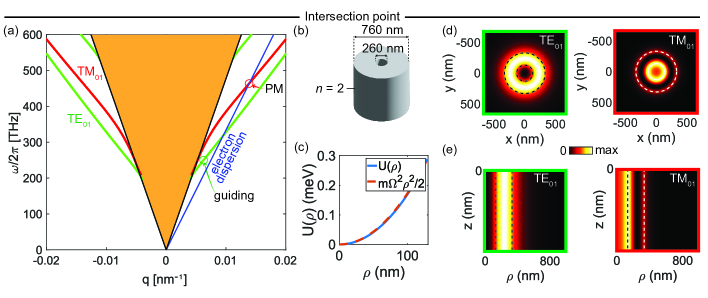
- 通过 Hertite-Gaussian 模式展开,分析连续模(交点与切点)和离散腔模的相位匹配条件。
- 推导在不同色散关系(线性和二次)下光子发射振幅 $̅{s}_n(t)$ 的解析表达式,并优化电子波函数宽度 $σ$ 以实现最大耦合。
实验结果
研究问题
- RQ1在光子纤维结构中,辐射压引导是否能够克服电子衍射,实现与光子模式的长相互作用长度?
- RQ2当衍射被抑制时,自由电子-光子系统中可实现的最大耦合强度 $|g_Q|$ 是多少?
- RQ3能否通过量子反冲效应在基于自由电子的平台上实现强单光子非线性($δ_{νι} \sim 2\pi$)?
- RQ4对连续模或离散腔模的相位匹配如何影响光子发射和非线性相互作用的动力学?
- RQ5该系统中可能出现哪些可观测的量子效应——例如确定性单光子发射或多模纠缠?
主要发现
- 所提出的自由电子纤维可实现远超衍射极限的相互作用长度,支持强耦合,$|g_Q| \gtrsim 1$。
- 在交点相位匹配情况下,最优缩放参数为 $\sigma' \approx 1.4$,可最大化光子向单个模式的发射。
- 在切点相位匹配情况下,最优缩放为 $\sigma' \approx 0.93$,仅激发偶数模,且发射谱呈现特征性的 $\arctan$-型相位演化。
- 在离散腔模情况下,当 $1 - v_g/v_e = 2m$($m$ 为整数)时,超模基与腔模基对齐,动力学简化为 $s_n(t) = \frac{|g_Q|}{T} \exp(in \cdot 2\pi m t / T)$。
- 当非线性失谐 $2\kappa$ 为腔模自由光谱范围 $\Delta$ 的整数倍时,发生级联相位匹配至相邻模式,实现非线性多模动力学。
- 在电子速度缓慢($v_e \ll v_g$)且 $δ_{νι}$ 较大的极限下,系统退化为单模 Jaynes-Cummings 相互作用,验证了模型的有效性。
更好的研究,从现在开始
从阅读论文到最终审阅,大幅缩短您的研究时间。
无需绑定信用卡
本解读由 AI 生成,并经人工编辑审核。