
[论文解读] Strong gravitational lenses from the Vera C. Rubin Observatory
本文预测,薇拉·C·鲁宾天文台将发现超过10万个强引力透镜——是目前已知数量的100多倍——通过四种互补的透镜探测手段,实现对暗能量的变革性约束:时延类星体、强引力透镜Ia型超新星、具有恒星运动学的单透镜体以及双源面系统。研究证明,结合这些样本将使强透镜成为鲁宾LSST时代最强大的暗能量探针,对暗能量状态方程参数 $w_0$ 和 $w_a$ 的约束将超越当前限制。
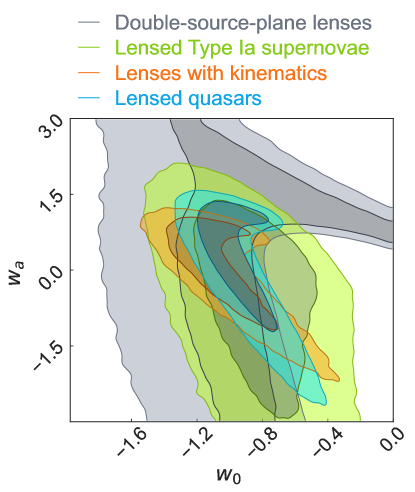
Like many areas of astrophysics and cosmology, the Vera C. Rubin Observatory will be transformational for almost all the applications of strong lensing, thanks to the dramatic increase in the number of known strong lenses by two orders of magnitude or more and the readily available time-domain data for the lenses with transient sources. In this article, we provide an overview of the forecasted number of discovered lenses of different types and describe the primary science cases these large lens samples will enable. We provide an updated forecast on the joint constraint for the dark energy equation-of-state parameters, $w_0$ and $w_a$, from combining all strong lensing probes of dark energy. We update the previous forecast from the Rubin Observatory Dark Energy Science Collaboration's Science Review Document by adding two new crucial strong lensing samples: lensed Type Ia supernovae and single-deflector lenses with measured stellar kinematics. Finally, we describe the current and near-future activities and collaborative efforts within the strong lensing community in preparation for the arrival of the first real dataset from Rubin in early 2026.
研究动机与目标
- 预测鲁宾LSST在10年巡天期间预期发现的强引力透镜数量,包括星系尺度透镜、强引力透镜类星体和强引力透镜Ia型超新星。
- 评估这些大规模透镜样本在宇宙学参数估计中的科学潜力,特别是对暗能量的约束。
- 通过整合新的透镜探测手段,更新对暗能量状态方程参数 $w_0$ 和 $w_a$ 的联合约束预测。
- 总结当前社区为应对鲁宾LSST首次数据发布(2026年)所开展的准备工作,包括模拟流水线和数据挑战。
提出的方法
- 作者基于LSST十年巡天的最新模拟与预测,估算可探测到的强透镜系统数量,包括星系尺度透镜和强引力透镜暂现源。
- 他们采用真实的模拟流水线(SLSim)对透镜星系和源星系种群进行建模,使用经验性光度函数和比例关系,以实现准确的选择函数估计。
- 对暗能量约束的预测结合了四种透镜探测手段:时延强引力透镜类星体、时延强引力透镜Ia型超新星、具有恒星运动学的单平面透镜体,以及双源面系统。
- 使用马尔可夫链蒙特卡洛(MCMC)方法计算 $w_0$ 和 $w_a$ 的联合约束,相关代码已公开于GitHub。
- 研究利用了现有的工具,如 lenstronomy、emcee 和 hierArc,用于透镜建模和统计推断。
- 社区协作通过LSST强透镜科学合作组织和DESC-SLTT支持,联合推进流水线开发和针对早期数据(数据预览2,2026年)的数据挑战。
![Figure 1: Forecasted number of galaxy–galaxy lenses to be discovered by the Rubin LSST [ 4 ] . The numbers for the Year-10 dataset are the directly forecasted ones, and those for the intermediate years are scaled with the imaging signal-to-noise ratio, simply assuming a uniform coverage and cadence,](https://ar5iv.labs.arxiv.org/html/2406.08919/assets/x1.png)
实验结果
研究问题
- RQ1在鲁宾LSST的10年巡天中,预计会发现多少个强引力透镜,包括星系尺度系统和强引力透镜暂现源?
- RQ2当结合四种不同的强透镜探测手段时,对暗能量状态方程参数 $w_0$ 和 $w_a$ 的约束将获得多大程度的提升?
- RQ3与以往研究相比,纳入强引力透镜Ia型超新星和具有恒星运动学的单透镜体将如何增强对暗能量的预测精度?
- RQ4目前有哪些社区主导的努力正在推进,以准备分析预计于2026年初发布的鲁宾LSST首份数据?
- RQ5机器学习和公民科学技术在从LSST星表中的 $\mathcal{O}(10^{10})$ 颗恒星中识别出 $\mathcal{O}(10^5)$ 个强透镜方面,其有效性如何?
主要发现
- 鲁宾LSST预计通过最优图像堆叠技术发现约12万个星系尺度强引力透镜,是目前已知系统的两个数量级增长。
- 即使在需要蓝-红差异成像的保守情景下,鲁宾LSST仍预计发现6.2万个星系尺度透镜。
- 鲁宾LSST预计通过放大选择探测到约380个未分辨的强引力透镜超新星,其中包括约180个Ia型超新星。
- 对四种强透镜探测手段——时延类星体、强引力透镜Ia型超新星、具有运动学的单平面透镜体以及双源面系统——的联合分析,将使强透镜成为鲁宾LSST时代最具有约束力的暗能量探针。
- 更新后的预测表明,结合这四个样本可显著提升对暗能量状态方程参数 $w_0$ 和 $w_a$ 的约束,其灵敏度超越其他探测手段。
- 社区正通过SLSim模拟流水线的开发和协调数据挑战积极准备,预计在2026年初鲁宾LSST首次数据发布时全面就绪。
更好的研究,从现在开始
从阅读论文到最终审阅,大幅缩短您的研究时间。
无需绑定信用卡
本解读由 AI 生成,并经人工编辑审核。