
[论文解读] Structural Attention-Based Recurrent Variational Autoencoder for Highway Vehicle Anomaly Detection
该论文提出SABeR-VAE,一种用于高速公路车辆异常检测的无监督结构化注意力递归变分自编码器,显式建模车道结构与车辆交互关系。通过融合车道-车辆注意力机制与Koopman算子正则化的潜在空间,其在MAAD数据集上的异常检测AUPR相比STGAE-KDE提升18%,且潜在空间转移具有可解释性,能够捕捉逆行等异常行为。
In autonomous driving, detection of abnormal driving behaviors is essential to ensure the safety of vehicle controllers. Prior works in vehicle anomaly detection have shown that modeling interactions between agents improves detection accuracy, but certain abnormal behaviors where structured road information is paramount are poorly identified, such as wrong-way and off-road driving. We propose a novel unsupervised framework for highway anomaly detection named Structural Attention-Based Recurrent VAE (SABeR-VAE), which explicitly uses the structure of the environment to aid anomaly identification. Specifically, we use a vehicle self-attention module to learn the relations among vehicles on a road, and a separate lane-vehicle attention module to model the importance of permissible lanes to aid in trajectory prediction. Conditioned on the attention modules' outputs, a recurrent encoder-decoder architecture with a stochastic Koopman operator-propagated latent space predicts the next states of vehicles. Our model is trained end-to-end to minimize prediction loss on normal vehicle behaviors, and is deployed to detect anomalies in (ab)normal scenarios. By combining the heterogeneous vehicle and lane information, SABeR-VAE and its deterministic variant, SABeR-AE, improve abnormal AUPR by 18% and 25% respectively on the simulated MAAD highway dataset over STGAE-KDE. Furthermore, we show that the learned Koopman operator in SABeR-VAE enforces interpretable structure in the variational latent space. The results of our method indeed show that modeling environmental factors is essential to detecting a diverse set of anomalies in deployment. For code implementation, please visit https://sites.google.com/illinois.edu/saber-vae.
研究动机与目标
- 为解决现有异常检测模型在识别环境结构化异常(如逆行)方面的局限性,此类异常常因仅建模车辆交互而被遗漏。
- 通过将显式的道路结构(车道布局)融入轨迹预测,提升自动驾驶场景下的无监督异常检测性能。
- 通过学习一个结构化、连续的潜在空间,利用Koopman算子显式编码异常转移,增强模型可解释性。
- 在多种异常类型(包括非交互、偏离道路、逆行)上实现高性能检测。
- 证明环境上下文与交互建模对于真实高速公路场景下鲁棒、泛化性强的异常检测至关重要。
提出的方法
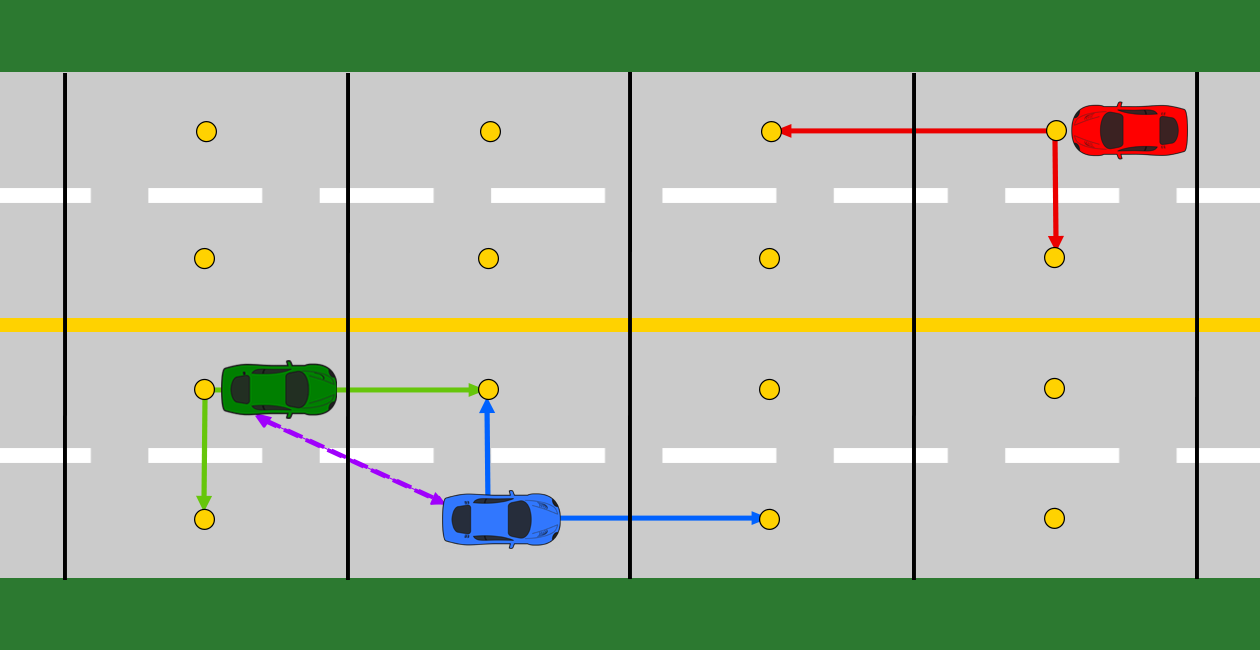
- 模型使用车辆自注意力模块,捕捉高速公路上邻近车辆之间的动态交互。
- 独立的车道-车辆注意力模块建模合法车道与车辆行为的相关性,将道路结构编码至预测过程。
- 采用具有随机潜在空间的循环编码器-解码器架构,通过Koopman算子正则化,从注意力特征中预测未来车辆轨迹。
- 潜在空间通过正常轨迹的重建损失端到端训练,异常检测基于高预测误差实现。
- Koopman算子强制潜在空间中实现可解释、平滑的转移,支持从正常到异常状态的行为转变可视化。
- 还评估了其确定性变体SABeR-AE,用于消融实验与对比分析。
实验结果
研究问题
- RQ1显式建模车道结构是否能提升自动驾驶系统中环境依赖型异常(如逆行)的检测性能?
- RQ2同时整合车辆交互与道路结构对高速公路场景下无监督异常检测的性能与鲁棒性有何影响?
- RQ3变分自编码器学习到的潜在空间在多大程度上能提供异常行为转移的可解释表征?
- RQ4Koopman算子正则化是否能带来更结构化、更有意义的潜在动力学,真实反映现实世界的行为转变?
- RQ5SABeR-VAE在多种异常类型(包括非交互与高影响行为)下,与SOTA模型STGAE-KDE相比表现如何?
主要发现
- 在模拟的MAAD高速公路数据集上,SABeR-VAE相比STGAE-KDE将异常AUPR提升18%,证明其检测性能更优。
- SABeR-AE(确定性变体)在异常AUPR上实现25%的提升,证实结构化注意力机制的有效性。
- 模型在检测逆行异常方面相比STGAE-KDE提升35%的AUPR,凸显车道结构建模的重要性。
- 学习到的Koopman算子强制实现潜在空间中可解释的连续转移,异常行为被清晰映射至特定区域或聚类间的过渡。
- 高预测误差的异常轨迹始终被编码至主聚类的外围区域,而正常、低误差轨迹则保持在密集聚类区域内。
- 潜在空间可视化显示,Koopman算子捕捉了从正常到异常行为的转变——例如,逆行转弯导致从顶部聚类到中部/底部聚类的明显跳跃,与预测损失的峰值变化一致。
更好的研究,从现在开始
从阅读论文到最终审阅,大幅缩短您的研究时间。
无需绑定信用卡
本解读由 AI 生成,并经人工编辑审核。