
[论文解读] Studying continuous, time-varying, and/or complex exposures using longitudinal modified treatment policies
本文介绍纵向修正治疗策略(LMTPs),一种用于复杂、随时间变化或连续暴露的统一因果推断框架,包含估计策略,并以使用 lmtp R package 的 COVID-19 插管时序案例研究。
This tutorial discusses methodology for causal inference using longitudinal modified treatment policies. This method facilitates the mathematical formalization, identification, and estimation of many novel parameters, and mathematically generalizes many commonly used parameters, such as the average treatment effect. Longitudinal modified treatment policies apply to a wide variety of exposures, including binary, multivariate, and continuous, and can accommodate time-varying treatments and confounders, competing risks, loss-to-follow-up, as well as survival, binary, or continuous outcomes. Longitudinal modified treatment policies can be seen as an extension of static and dynamic interventions to involve the natural value of treatment, and, like dynamic interventions, can be used to define alternative estimands with a positivity assumption that is more likely to be satisfied than estimands corresponding to static interventions. This tutorial aims to illustrate several practical uses of the longitudinal modified treatment policy methodology, including describing different estimation strategies and their corresponding advantages and disadvantages. We provide numerous examples of types of research questions which can be answered using longitudinal modified treatment policies. We go into more depth with one of these examples--specifically, estimating the effect of delaying intubation on critically ill COVID-19 patients' mortality. We demonstrate the use of the open-source R package lmtp to estimate the effects, and we provide code on https://github.com/kathoffman/lmtp-tutorial.
研究动机与目标
- 推动需要涉及连续且随时间变化暴露的因果问题的理由,超越静态干预。
- 提出 LMTPs 作为一个通用框架,涵盖静态、动态、随机和修正干预。
- 通过广义 g-公式说明识别性,并讨论正向性与序贯随机化假设。
- 展示实际的估计策略(参数化 g-计算、IPW、TMLE、SDR),包括机器学习的可能性。
- 提供一个案例研究,估计在住院 COVID-19 患者中推迟气管插管对死亡率的影响,并提供可复现的代码。
提出的方法
- 定义纵向修正治疗策略(LMTPs)以及它们如何通过允许策略函数取决于治疗的自然值来扩展静态/动态干预。
- 在 LMTPs 内将干预函数 d_t 分类为静态、动态、随机和修正。
- 在正向性与序贯随机化假设下通过广义 g-公式进行识别。
- 描述估计方法:参数化 g-计算、逆概率加权(IPW),以及非参数、基于机器学习 的方法(TMLE、SDR、iTMLE)。
- 讨论使用开源 R 包 lmtp 的软件实现,并提供复现代码和合成数据。
实验结果
研究问题
- RQ1在 LMTP 下,对于时间变化和复杂暴露,可以定义和识别哪些因果参数?
- RQ2LMTP 如何在纵向设定中应对正向性违背和信息删失?
- RQ3在 LMTP 下,g-计算、IPW、TMLE、SDR 等估计策略的性质与权衡是什么?
- RQ4在 LMTP 假设下,COVID-19 患者推迟气管插管对 14 天死亡率的影响如何?
主要发现
- LMTPs 提供了一种统一的方式来定义、识别和估计因果效应,适用于包括时间变化、连续和多暴露情景在内的广泛暴露与结果。
- 通过在观测到的支持范围内设计干预来缓解正向性问题,并讨论结构性与实际违背。
- 非参数估计量(TMLE、SDR、iTMLE)允许灵活建模并具有有效的不确定性和双重鲁棒性特性;它们可以利用机器学习。
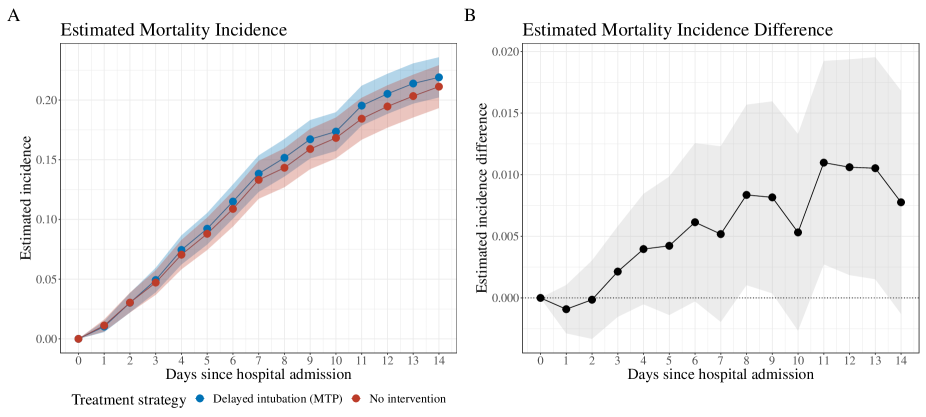
- 在 COVID-19 案例研究中,未干预的 14 天死亡率为 0.211(95% CI 0.193–0.229),在一个日延迟气管插管的 LMTP 下为 0.219(95% CI 0.202–0.236)。
更好的研究,从现在开始
从论文设计到论文写作,大幅缩短您的研究时间。
无需绑定信用卡
本解读由 AI 生成,并经人工编辑审核。