
[论文解读] Sub-Terahertz Spatial Statistical MIMO Channel Model for Urban Microcells at 142 GHz
该论文基于大量测量,提出了一种适用于城市微小区142 GHz频段的空域统计MIMO信道模型,重点建模了簇数和功率分布。通过双向信道生成方法,结果表明在视 Line-of-Sight (LOS) 环境下波束成形优于空间复用,这是由于存在较强的视 Line-of-Sight 路径;而在非视 Line-of-Sight (NLOS) 环境下,两流空间复用可实现最高的频谱效率,这是由于强簇数量有限。
Sixth generation (6G) cellular systems are expected to extend the operational range to sub-Terahertz (THz) frequencies between 100 and 300 GHz due to the broad unexploited spectrum therein. A proper channel model is needed to accurately describe spatial and temporal channel characteristics and faithfully create channel impulse responses at sub-THz frequencies. This paper studies the channel spatial statistics such as the number of spatial clusters and cluster power distribution based on recent radio propagation measurements conducted at 142 GHz in an urban microcell (UMi) scenario. For the 28 measured locations, we observe one to four spatial clusters at most locations. A detailed spatial statistical multiple input multiple output (MIMO) channel generation procedure is introduced based on the derived empirical channel statistics. We find that beamforming provides better spectral efficiency than spatial multiplexing in the LOS scenario due to the boresight path, and two spatial streams usually offer the highest spectral efficiency at most NLOS locations due to the limited number of spatial clusters.
研究动机与目标
- 为未来6G系统在142 GHz频段的城市微小区环境中表征空域信道统计特性。
- 基于对空间簇、功率分布和角扩展的实测数据,建立统计MIMO信道模型。
- 评估在LOS和NLOS条件下波束成形与空间复用之间的频谱效率权衡。
- 为亚太赫兹频段的系统级仿真提供实用的信道生成方法。
提出的方法
- 在142 GHz频段,使用增益为27 dBi、半功率波束宽度为8°的定向喇叭天线,在12.9–117.4 m距离范围内进行了28次城市微小区传播测量。
- 将空间簇的数量建模为泊松随机变量,平均每个位置约有2个簇。
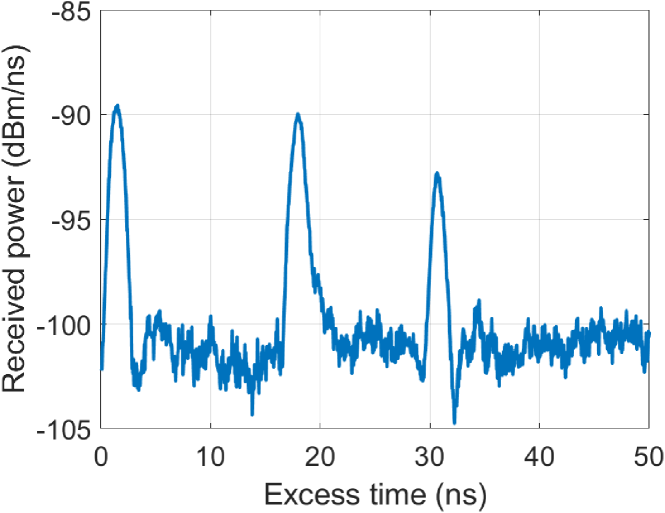
- 从实测的信道冲激响应中推导出簇的功率分布和全向均方根角扩展。
- 提出一种基于奇异值分解(SVD)的双向MIMO信道生成方法,采用特征波束成形进行预编码和合并。
- 利用该统计模型生成数千个信道矩阵,以评估在波束成形和空间复用下的频谱效率。
- 假设基站具备完美的信道状态信息,并在基站和用户设备上分别采用16×8和4×2的均匀矩形阵列(URAs)。
![Figure 1 : 142 GHz outdoor UMi measurement locations [ 18 ] . TX locations are denoted as stars in different colors. RX locations are denoted as circles. One RX location filled with multiple colors indicates that the channels between this RX location and multiple TX locations were measured.](https://ar5iv.labs.arxiv.org/html/2110.06361/assets/x1.png)
实验结果
研究问题
- RQ1在城市微小区环境中,142 GHz频段的亚太赫兹MIMO信道中通常存在多少个空间簇?
- RQ2在142 GHz频段的LOS和NLOS传播环境中,簇的功率分布和角扩展特性如何?
- RQ3在何种信噪比(SNR)条件下,空间复用在亚太赫兹MIMO系统中优于波束成形?
- RQ4在142 GHz频段的LOS和NLOS场景下,为实现频谱效率最大化,最优数据流数量是多少?
主要发现
- 在全部28个测量位置中,空间簇的平均数量约为两个,每个位置观测到1至4个簇。
- 在LOS场景中,由于存在强波束轴向路径,波束成形的频谱效率高于空间复用,尤其在低信噪比条件下更为明显。
- 空间复用优于波束成形的频谱效率阈值为:LOS环境下24 dB SNR,NLOS环境下15 dB SNR。
- 在NLOS环境中,两流空间复用实现了最高的频谱效率,因为多个簇具有相近的功率,更适合复用。
- 尽管最多观测到六个空间簇,但延迟到达的弱簇能量贡献可忽略不计,且不可靠,不适合用于传输。
- 簇功率分布显示,最先到达的簇携带了显著更多的能量,表明早期反射或视 Line-of-Sight 成分具有主导作用。
更好的研究,从现在开始
从阅读论文到最终审阅,大幅缩短您的研究时间。
无需绑定信用卡
本解读由 AI 生成,并经人工编辑审核。