
[论文解读] Sum-Rate Maximization of Uplink Rate Splitting Multiple Access (RSMA) Communication
本文提出了一种联合优化用户功率分配与基站解码顺序的上行链路速率复用多址接入(RSMA)容量最大化框架。通过将非凸问题转化为仅含速率复用变量的优化问题,作者推导出最优速率复用与功率分配的闭式解,随后通过穷举搜索确定最优解码顺序。仿真结果表明,RSMA相较于TDMA的容量增益高达83.7%,相较于FDMA为22.2%,相较于NOMA为10.0%。
In this paper, the problem of maximizing the wireless users' sum-rate for uplink rate splitting multiple access (RSMA) communications is studied. In the considered model, each user transmits a superposition of two messages to a base station (BS) with separate transmit power and the BS uses a successive decoding technique to decode the received messages. To maximize each user's transmission rate, the users must adjust their transmit power and the BS must determine the decoding order of the messages transmitted from the users to the BS. This problem is formulated as a sum-rate maximization problem with proportional rate constraints by adjusting the users' transmit power and the BS's decoding order. However, since the decoding order variable in the optimization problem is discrete, the original maximization problem with transmit power and decoding order variables can be transformed into a problem with only the rate splitting variable. Then, the optimal rate splitting of each user is determined. Given the optimal rate splitting of each user and a decoding order, the optimal transmit power of each user is calculated. Next, the optimal decoding order is determined by an exhaustive search method. To further reduce the complexity of the optimization algorithm used for sum-rate maximization in RSMA, a user pairing based algorithm is introduced, which enables two users to use RSMA in each pair and also enables the users in different pairs to be allocated with orthogonal frequency. For comparisons, the optimal sum-rate maximizing solutions with proportional rate constraints are obtained in closed form for non-orthogonal multiple access (NOMA), frequency division multiple access (FDMA), and time division multiple access (TDMA). Simulation results show that RSMA can achieve up to 10.0\%, 22.2\%, and 83.7\% gains in terms of sum-rate compared to NOMA, FDMA, and TDMA.
研究动机与目标
- 解决上行链路RSMA中功率分配与解码顺序联合优化缺失的问题,该问题对频谱效率与用户公平性至关重要。
- 在比例速率约束下建立容量最大化问题,同时考虑离散解码顺序与连续功率变量。
- 将原始的非凸混合整数问题转化为仅含速率复用变量的等价问题,以实现闭式解。
- 在给定解码顺序下,推导每个用户的最优速率复用与传输功率分配,随后通过穷举搜索确定全局最优解码顺序。
- 提出一种基于用户配对的算法,以降低计算复杂度,同时保持高容量性能。
提出的方法
- 建立包含用户发射功率与基站解码顺序作为优化变量的上行链路RSMA容量最大化问题,同时满足比例速率约束。
- 通过解析推导消除功率与解码顺序变量,将原始问题转化为仅含速率复用变量的等价问题。
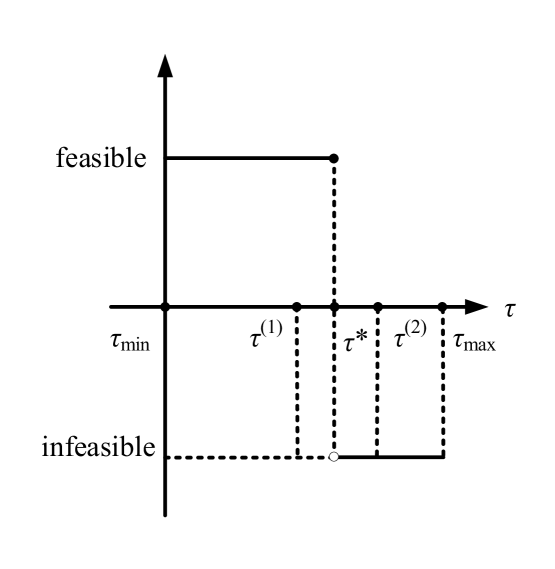
- 利用Karush-Kuhn-Tucker(KKT)条件与功率约束,以闭式形式推导每个用户的最优速率复用因子。
- 在固定解码顺序下,利用推导出的速率复用因子与信干噪比(SINR)表达式,计算最优发射功率分配。
- 通过穷举搜索所有可能的用户消息解码顺序排列,确定全局最优解码顺序。
- 引入基于用户配对的算法,通过在配对内启用RSMA并实现配对间的正交频谱分配,以降低复杂度。
实验结果
研究问题
- RQ1当同时优化发射功率与解码顺序时,如何在比例速率约束下最大化上行链路RSMA的容量?
- RQ2在功率与解码顺序约束下,每个用户的最优速率复用策略是什么,以实现容量最大化?
- RQ3解码顺序的选择如何影响上行链路RSMA的可实现容量?全局最优解码顺序是什么?
- RQ4在容量增益方面,RSMA相较于传统多址接入方案(NOMA、FDMA、TDMA)的性能如何?
- RQ5基于用户配对的算法能否在计算复杂度显著降低的同时实现接近最优的容量性能?
主要发现
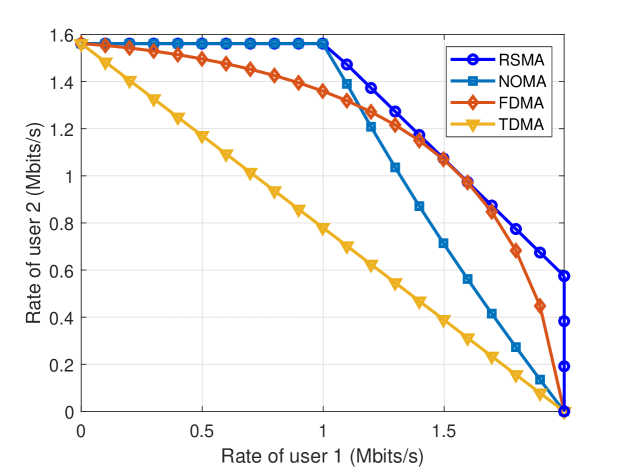
- 所提出的RSMA框架在相同功率与速率约束下,相较于非正交多址接入(NOMA),容量最高提升10.0%。
- RSMA在容量增益方面相较于频分多址接入(FDMA)最高提升22.2%,展现出更优的频谱效率。
- RSMA相较于时分多址接入(TDMA)的容量增益高达83.7%,凸显其在支持大规模连接与高谱效率方面的优越性。
- 每个用户的最优速率复用因子以闭式形式推导得出,可高效计算任意给定解码顺序下的功率分配。
- 基于穷举搜索的解码顺序选择方法实现了全局容量最优,且用户配对算法显著降低了复杂度,同时保持了高性能。
- 为基准方案(NOMA、FDMA、TDMA)推导出闭式最优解,实现了与RSMA的直接比较与性能验证,证实了RSMA的优越性。
更好的研究,从现在开始
从阅读论文到最终审阅,大幅缩短您的研究时间。
无需绑定信用卡
本解读由 AI 生成,并经人工编辑审核。