
[论文解读] Superconducting Diode Effect -- Fundamental Concepts, Material Aspects, and Device Prospects
简要:对超导二极管效应(SDE)的全面评述,涵盖基本机制、材料平台与器件前景,重点强调磁手征各向异性、自旋轨道耦合与有限动量配对。
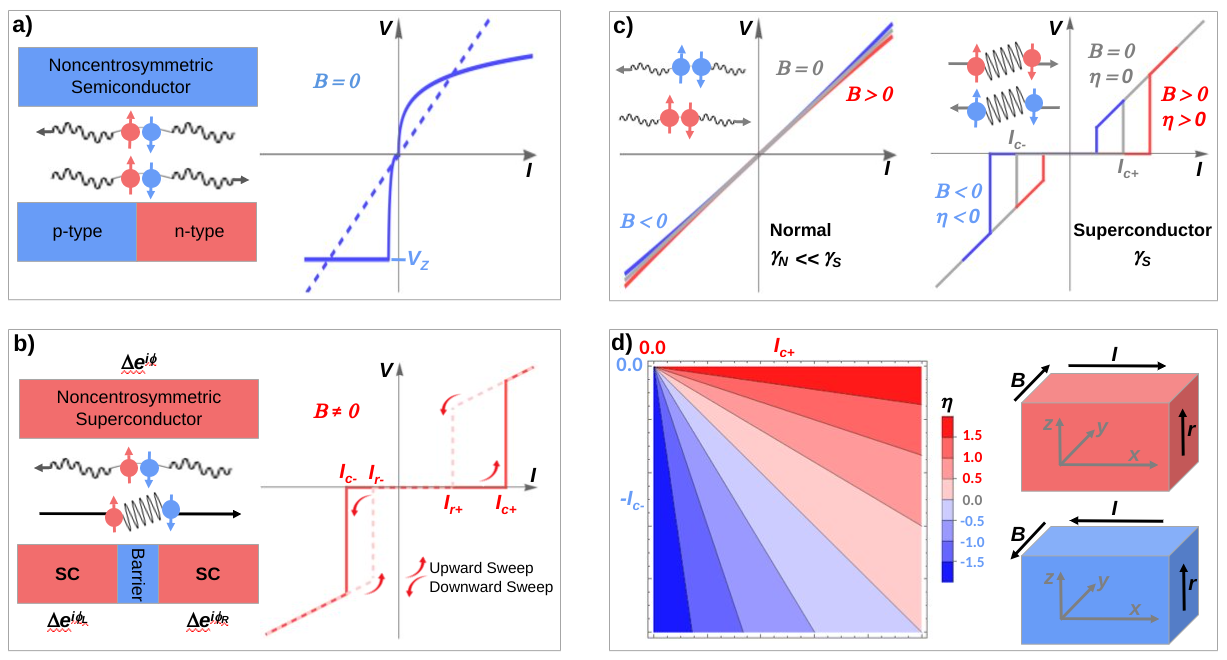
Superconducting diode effect, in analogy to the nonreciprocal resistive charge transport in semiconducting diode, is a nonreciprocity of dissipationless supercurrent. Such an exotic phenomenon originates from intertwining between symmetry-constrained supercurrent transport and intrinsic quantum functionalities of helical/chiral superconductors. In this article, research progress of superconducting diode effect including fundamental concepts, material aspects, device prospects, and theoretical/experimental development is reviewed. First, fundamental mechanisms to cause superconducting diode effect including simultaneous space-inversion and time-reversal symmetry breaking, magnetochiral anisotropy, interplay between spin-orbit interaction energy and the characteristic energy scale of supercurrent carriers, and finite-momentum Cooper pairing are discussed. Second, the progress of superconducting diode effect from theoretical predictions to experimental observations are reviewed. Third, interplay between various system parameters leading to superconducting diode effect with optimal performance is presented. Then, it is explicitly highlighted that nonreciprocity of supercurrent can be characterized either by current-voltage relation obtained from resistive direct-current measurements in the metal-superconductor fluctuation region ($T\approx T_c$) or by current-phase relation and nonreciprocity of superfluid inductance obtained from alternating-current measurements in the superconducting phase ($T
研究动机与目标
- 概括能够实现超导二极管效应(SDE)的基本概念与机制。
- 回顾从大块体超导体到工程化器件的理论与实验进展。
- 分类观察到SDE的材料与器件结构。
- 讨论SDE强度如何依赖系统参数与测量方法。
- 展望将带拓扑与螺旋超导性联系起来的未来方向。
提出的方法
- 讨论对称性破缺的要求(反演对称性和时间反转对称性)以及磁手征各向异性作为SDE起源。
- 描述MCA如何影响在电阻性与超导性区间的电流-电压和基于电感的测量。
- 总结用于建模SDE的理论框架(Ginzburg-Landau、Bogoliubov–de Gennes、平均场理论)。
- 概述在直流电阻和交流电感设置下的SDE实验观测方法。
- 评估优化SDE的材料参数(SOI、磁化、化学势、无序)。
实验结果
研究问题
- RQ1在超导体中,哪些对称性条件与机制会产生非互易的超电流(SDE)?
- RQ2材料特性与器件设计如何影响SDE的强度与可调性?
- RQ3SDE能否在无结点的体块超导体中自产生(无结点结/Josephson结)?
- RQ4哪些测量策略(Tc附近的直流电阻 vs. 超导相中的交流电感)最能表征SDE?
- RQ5自旋轨道耦合与螺旋/手性超导性在实现SDE中扮演何种角色?
主要发现
- 当空间反演对称性与时间反转对称性同时被破坏时,超电流的非互易性出现,从而实现有限动量的配对电子对。
- 在Tc附近的涨落/电阻区间,MCA可产生较大的非互险电流,在某些材料中γ_S远大于γ_N。
- SDE可在无结的非中心对称体块超导体以及在具有多种材料与势垒的JJ基器件中观测到。
- SDE强度取决于磁场方向、温度、SOI、化学势与无序,并可通过在Tc附近的直流I–V或在超导相中的交流电感来探针。
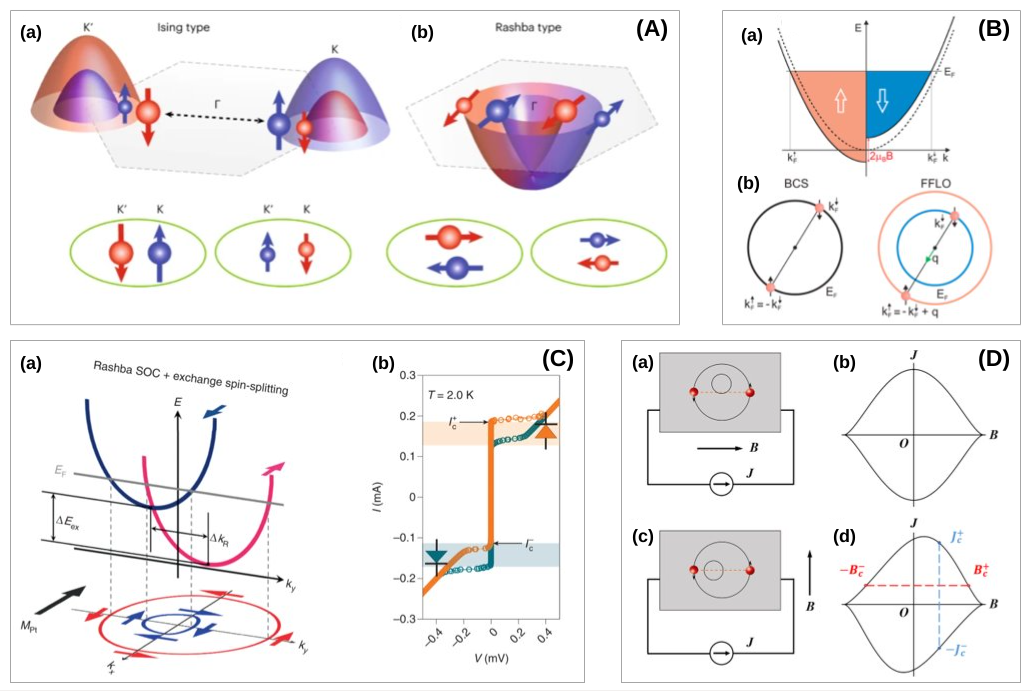
- Ising型与Rashba型自旋轨道耦合,结合适当的磁化方向,可增强SDE并与拓扑/螺旋超导性相关。
- 在非常规与拓扑超导体中观察到的SDE表明超导电子学与量子技术具有更广阔的平台潜力。
更好的研究,从现在开始
从论文设计到论文写作,大幅缩短您的研究时间。
无需绑定信用卡
本解读由 AI 生成,并经人工编辑审核。