
[论文解读] Superconductivity emerging from density-wave-like order in a correlated kagome metal
本研究识别出CsCr₃Sb₅为一种关联kagome坏金属,具有强电子关联和脆弱的密度波(DW)序。在高压(~4–8 GPa)下,DW序在量子临界点附近被抑制,触发非传统超导性,其最大Tc为6.4 K,确立了一个罕见平台,用于研究关联kagome体系中的非传统超导性。
Unconventional superconductivity (USC) in a highly correlated kagome system has been theoretically proposed for years, yet the experimental realization is hard to achieve. The recently discovered vanadium-based kagome materials, which exhibit both superconductivity and charge density wave (CDW) orders, are nonmagnetic and weakly correlated, thus unlikely host USC as theories proposed. Here we report the discovery of a chromium-based kagome metal, CsCr$_3$Sb$_5$, which is contrastingly characterised by strong electron correlations, frustrated magnetism, and characteristic flat bands close to the Fermi level. Under ambient pressure, it undergoes a concurrent structural and magnetic phase transition at 55 K, accompanying with a stripe-like $4a_0$ structural modulation. At high pressure, the phase transition evolves into two transitions, probably associated with CDW and antiferromagnetic spin-density-wave orderings, respectively. These density-wave (DW)-like orders are gradually suppressed with pressure and, remarkably, a superconducting dome emerges at 3.65-8.0 GPa. The maximum of the superconducting transition temperature, $T_\mathrm{c}^{\mathrm{max}}=$ 6.4 K, appears when the DW-like orders are completely suppressed at 4.2 GPa, and the normal state exhibits a non-Fermi-liquid behaviour, reminiscent of USC and quantum criticality in iron-based superconductors. Our work offers an unprecedented platform for investigating possible USC in a correlated kagome system.
研究动机与目标
- 识别并表征一种具有强电子关联和脆弱密度波序的新型铬基kagome材料。
- 研究在竞争性密度波序和磁序存在下超导性的出现机制。
- 探讨电子关联和量子临界性在驱动kagome晶格中非传统超导性中的作用。
- 为研究关联kagome体系中的非传统超导性建立新平台。
提出的方法
- 通过自 flux 法生长CsCr₃Sb₅单晶,并利用单晶X射线衍射和能谱色散X射线谱进行表征。
- 通过电阻率、比热、磁化率和磁电输运测量探测电子和磁性相变。
- 利用高压电阻率和磁化率测量将体系调制至量子临界点,并检测超导转变。
- 采用密度泛函理论(DFT)计算分析电子结构,并确认kagome晶格中存在近似平带。
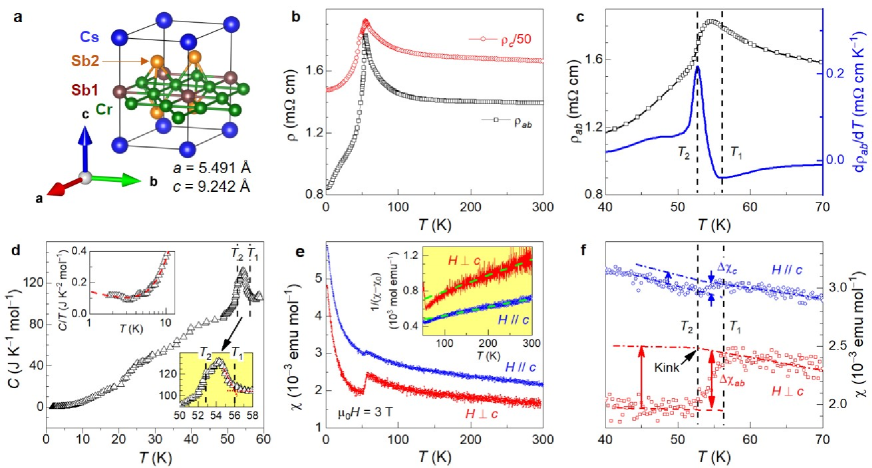
- 分析在T₁ ≈ 54 K和T₂ ≈ 52 K处的电阻率和比热异常,识别出与电荷序和自旋密度波序相关的连续相变。
- 通过居里-外斯拟合反磁化率,确认存在局域磁矩和反铁磁自旋关联。
实验结果
研究问题
- RQ1在具有强电子关联和竞争性密度波序的kagome晶格材料中,非传统超导性是否能够出现?
- RQ2电子关联和量子临界性在CsCr₃Sb₅中如何介导超导性?
- RQ3压力诱导的相变如何抑制密度波序并稳定超导性?
- RQ4CsCr₃Sb₅的电子结构是什么?其与平带的出现及关联量子物态的关系如何?
主要发现
- CsCr₃Sb₅结晶为六方P6/mmm结构,具有Cr原子的kagome晶格,表现出强电子关联和受挫的磁性。
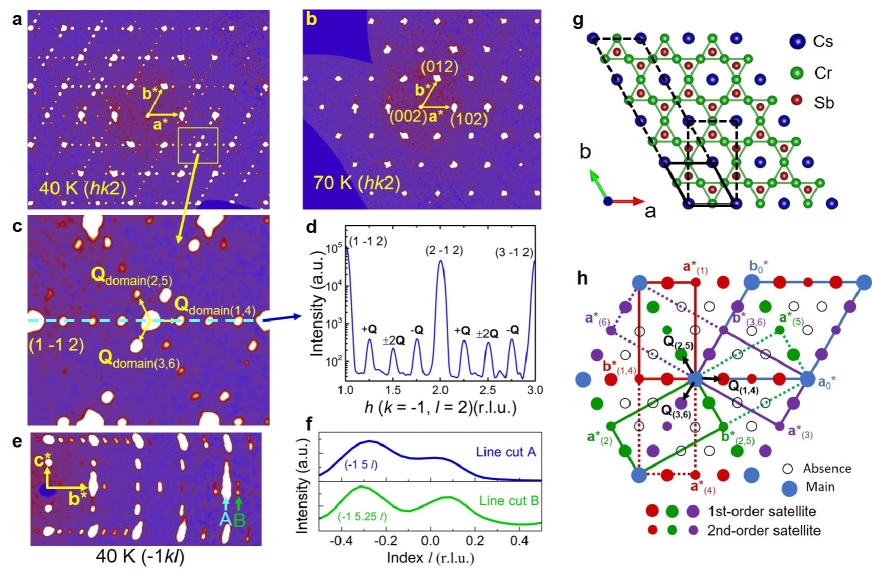
- 在~54 K和~52.7 K处的连续相变归因于条纹状4a₀结构调制,表明电荷密度波(CDW)和反铁磁自旋密度波(SDW)序共存。
- 在高压(4–8 GPa)下,密度波序被抑制,超导性出现,其最大转变温度Tc为6.4 K。
- 在P ≈ 4 GPa处识别出量子临界点,非费米液体行为出现,表明体系接近量子相变。
- 电子结构计算表明,电子填充接近kagome晶格的范霍夫奇点,与平带和增强关联性一致。
- 上临界场Hc2,max在零温下达到14.34 T,显著超过泡利极限,表明超导态中可能存在自旋三重态或强自旋-轨道耦合。
更好的研究,从现在开始
从阅读论文到最终审阅,大幅缩短您的研究时间。
无需绑定信用卡
本解读由 AI 生成,并经人工编辑审核。