
[论文解读] Survey of Gravitationally lensed Objects in HSC Imaging (SuGOHI) $-$ X. Strong Lens Finding in The HSC-SSP using Convolutional Neural Networks
本研究将卷积神经网络(CNN)应用于昴神望远镜超新星巡天计划(HSC-SSP)巡天,以在多波段成像中检测强引力透镜。该模型从235万颗星系中识别出43个确定的和269个可能的透镜系统,包括97个新发现,显著提升了透镜检测效率,并为未来的宇宙学建模提供了光谱后续观测的候选目标。
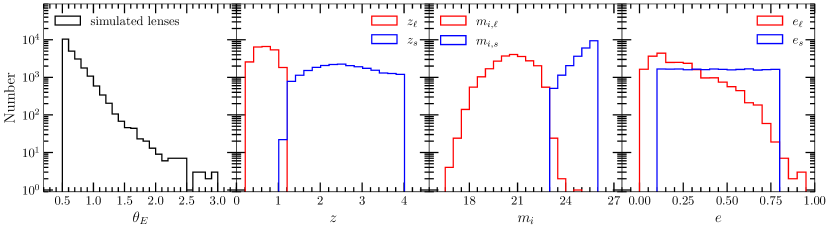
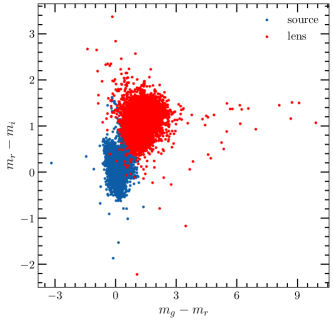
We apply a novel model based on convolutional neural networks (CNNs) to identify gravitationally-lensed galaxies in multi-band imaging of the Hyper Suprime Cam Subaru Strategic Program (HSC-SSP) Survey. The trained model is applied to a parent sample of 2 350 061 galaxies selected from the $\sim$ 800 deg$^2$ Wide area of the HSC-SSP Public Data Release 2. The galaxies in HSC Wide are selected based on stringent pre-selection criteria, such as multiband magnitudes, stellar mass, star formation rate, extendedness limit, photometric redshift range, etc. Initially, the CNNs provide a total of 20 241 cutouts with a score greater than 0.9, but this number is subsequently reduced to 1 522 cutouts by removing definite non-lenses for further inspection by human eyes. We discover 43 definite and 269 probable lenses, of which 97 are completely new. In addition, out of 880 potential lenses, we recovered 289 known systems in the literature. We identify 143 candidates from the known systems that had higher confidence in previous searches. Our model can also recover 285 candidate galaxy-scale lenses from the Survey of Gravitationally lensed Objects in HSC Imaging (SuGOHI), where a single foreground galaxy acts as the deflector. Even though group-scale and cluster-scale lens systems were not included in the training, a sample of 32 SuGOHI-c (i.e., group/cluster-scale systems) lens candidates was retrieved. Our discoveries will be useful for ongoing and planned spectroscopic surveys, such as the Subaru Prime Focus Spectrograph project, to measure lens and source redshifts in order to enable detailed lens modelling.
研究动机与目标
- 开发并应用一种深度学习模型,用于在大范围光学成像中实现强引力透镜的自动化检测。
- 通过利用卷积神经网络(CNN)提升准确率与可扩展性,改进传统透镜搜寻方法。
- 在HSC-SSP巡天中识别新的透镜系统,特别是星系尺度透镜,并以更高置信度恢复已知系统。
- 通过提供一份经过筛选的高优先级透镜候选列表,支持未来光谱后续观测项目(如主焦点光谱仪项目)。
- 通过检测训练集中未包含的集团和星系团尺度透镜,评估模型的泛化能力。
提出的方法
- 在HSC-SSP巡天中筛选出的透镜与非透镜星系剪辑图像组成的精选数据集上训练自定义卷积神经网络(CNN)。
- 模型处理基于星等、恒星质量、恒星形成率、扩展性及光度红移预选的2,350,061颗星系的多波段成像剪辑(g, r, i, z, y)。
- 将CNN置信度分数大于0.9的剪辑选为后续分析对象,经人工排除明显非透镜对象后,初始候选池从20,241个减少至1,522个。
- 人类专家对剩余候选体进行目视检查,根据透镜形态分配A级(确定)、B级(可能)或C级(可能)评分。
- 将模型预测结果与现有透镜星表交叉比对,识别重复项并重新分类先前已评分的系统。
- 在已知系统上测试该方法,包括来自SuGOHI巡天的285个星系尺度透镜和来自文献的289个已知系统。
实验结果
研究问题
- RQ1基于CNN的深度学习模型能否在大规模多波段光学巡天(如HSC-SSP)中有效检测强引力透镜?
- RQ2与以往的自动化方法和人工检查方法相比,CNN方法在发现率和置信度方面表现如何?
- RQ3在仅以星系尺度透镜进行训练的模型,其泛化能力在多大程度上可扩展至检测集团和星系团尺度透镜系统?
- RQ4新发现的透镜候选体中有多少比例是真正新颖的?又有多少此前被误判或遗漏?
- RQ5该模型能否以高于以往搜索的置信度恢复已知透镜系统?
主要发现
- CNN识别出20,241个置信度分数大于0.9的剪辑,经人工目视排除明显非透镜后减少至1,522个。
- 最终样本包含43个确定(A级)和269个可能(B级)的强透镜候选体,其中97个为全新发现。
- 在880个C级候选体中,143个此前在文献中被评定为A级或B级,表明检测置信度得到提升。
- 该模型成功恢复了来自SuGOHI巡天的285个已知星系尺度透镜候选体,显示出强大的泛化能力。
- 尽管训练数据中未包含集团或星系团尺度透镜,模型仍从SuGOHI-c样本中检索出32个候选体,表明其具备潜在的泛化能力。
- 候选体中透镜星系的光度红移范围为0.2至1.2,支持其适配后续光谱观测与透镜建模。
更好的研究,从现在开始
从阅读论文到最终审阅,大幅缩短您的研究时间。
无需绑定信用卡
本解读由 AI 生成,并经人工编辑审核。