
[论文解读] Surviving the Waves: evidence for a Dark Matter cusp in the tidally disrupting Small Magellanic Cloud
本研究利用盖亚 EDR3 的 6,000 颗红巨星分支恒星的自行数据,采用一种新颖的去污染方法(Binulator)和 Jeans 模型(GravSphere),对正在经历潮汐撕裂的大麦哲伦云(SMC)进行了稳健的质量建模。研究发现,在 150 pc 处存在强烈的暗物质核状分布证据,ρ_DM(150 pc) = 2.81⁺⁰.⁷²₋₁.₀₇ × 10⁸ M⊙ kpc⁻³,与 ΛCDM 模型一致;同时,由于其具有较高的 J 因子(19.22 ± 0.14 GeV² cm⁻⁵),SMC 被确认为暗物质湮灭/衰变探测的优选目标。
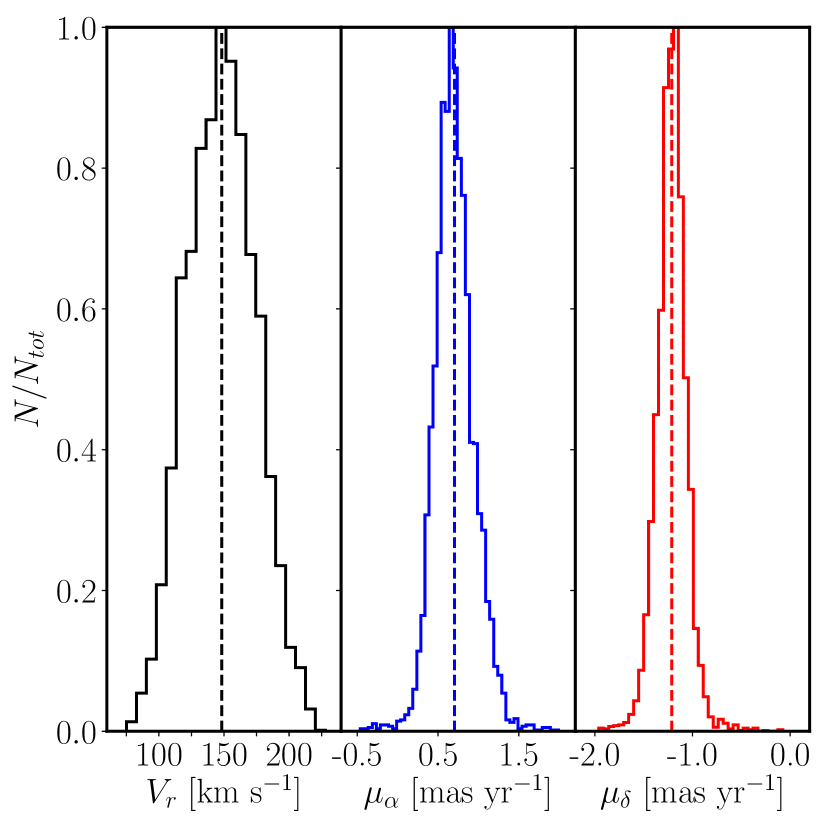
We use spectroscopic data for ${\sim}6,000$ Red Giant Branch (RGB) stars in the Small Magellanic Cloud (SMC), together with proper motion data from extit{Gaia} Early Data Release 3 (EDR3), to build a mass model of the SMC. We test our Jeans mass modelling method ( extsc{Binulator}+ extsc{GravSphere}) on mock data for an SMC-like dwarf undergoing severe tidal disruption, showing that we are able to successfully remove tidally unbound interlopers, recovering the Dark Matter density and stellar velocity anisotropy profiles within our 95\% confidence intervals. We then apply our method to real SMC data, finding that the stars of the cleaned sample are isotropic at all radii (at 95\% confidence), and that the inner Dark Matter density profile is dense, $ρ_{ m DM}(150\,{ m pc}) = 2.81_{-1.07}^{+0.72} imes 10^8 M_{\odot} m kpc^{-3} $, consistent with a $Λ$ Cold Dark Matter ($Λ$CDM) cusp at least down to 400\,pc from the SMC's centre. Our model gives a new estimate of the SMC's total mass within 3\,kpc ($M_{ m tot} \leq 3\,{ m kpc})$ of $2.34\pm0.46 imes 10^9 M_{\odot}$. We also derive an astrophysical extquote{$J$-factor} of $19.22\pm0.14$\, GeV$^2$\,cm$^{-5}$ and a extquote{$D$-factor} of $18.80\pm0.03$\, GeV$^2$\,cm$^{-5}$, making the SMC a promising target for Dark Matter annihilation and decay searches. Finally, we combine our findings with literature measurements to test models in which Dark Matter is extquote{heated up} by baryonic effects. We find good qualitative agreement with the Di Cintio et al. 2014 model but we deviate from the Lazar et al. 2020 model at high $M_*/M_{200} > 10^{-2}$. We provide a new, analytic, density profile that reproduces Dark Matter heating behaviour over the range $10^{-5} < M_*/M_{200} < 10^{-1}$.
研究动机与目标
- 开发一种方法,以准确建模经历严重潮汐撕裂的矮星系的质量分布,此时传统平衡假设不再适用。
- 检验 SMC 尽管经历了潮汐剥离,是否仍保留核状暗物质分布,从而挑战 ΛCDM 框架下的核-晕问题。
- 利用运动学数据,在考虑潮汐碎片污染的前提下,对 SMC 的总质量与暗物质密度分布提供稳健估计。
- 通过 J 因子与 D 因子评估 SMC 作为暗物质湮灭与衰变探测目标的潜力。
- 通过将 SMC 的观测特性与不同恒星-晕质量比下的理论预测进行比较,检验恒星反馈模型对暗物质加热的影响。
提出的方法
- 引入 Binulator 方法,通过识别并剔除来自 SMC 潮汐碎片的潮汐非束缚恒星,对视线方向的恒星运动学数据进行去污染。
- 该方法利用相空间信息(径向速度与自行)在模拟与真实数据中区分束缚恒星与非束缚干扰星。
- 对净化后的恒星样本应用 GravSphere 进行 Jeans 建模,在球对称假设下恢复总质量与暗物质密度分布。
- Jeans 建模整合了完整的视线速度弥散与自行数据,以增强动力学约束并减少参数退化。
- 推导出一种新的解析暗物质密度分布形式,以拟合观测到的 SMC 数据,并描述在恒星-晕质量比范围 10⁻⁵ < M_*/M_200 < 10⁻¹ 内的暗物质加热行为。
- 从推断出的暗物质密度分布计算 J 因子与 D 因子,以评估 SMC 在伽马射线与 X 射线观测中的可探测性。
实验结果
研究问题
- RQ1对于像 SMC 这类经历强烈潮汐撕裂的矮星系,是否仍能通过标准 Jeans 建模恢复出核状暗物质分布?
- RQ2SMC 的真实中心暗物质密度是多少?其是否支持 ΛCDM 模拟所预测的核状分布?
- RQ3SMC 的暗物质分布如何与不同 M_*/M_200 下的理论恒星反馈模型(如 Di Cintio et al. 2014;Lazar et al. 2020)相比较?
- RQ4SMC 的 J 因子与 D 因子分别是多少?与其他已知暗物质目标相比如何?
- RQ5能否构建一种新的解析暗物质密度分布,以准确捕捉在广泛 M_*/M_200 范围(10⁻⁵ < M_*/M_200 < 10⁻¹)内观测到的矮星系暗物质加热行为?
主要发现
- SMC 在 150 pc 处的暗物质密度为 ρ_DM(150 pc) = 2.81⁺⁰.⁷²₋₁.₀₇ × 10⁸ M⊙ kpc⁻³,与 ΛCDM 模型预测的核状分布一致,且可延伸至距中心至少 400 pc 的范围。
- 在 3 kpc 内的总质量估计为 M_tot(≤3 kpc) = 2.34 ± 0.46 × 10⁹ M⊙,与以往的 virial 估计下限一致,但已校正潮汐碎片影响。
- 在 95% 置信区间内,恒星速度各向异性在所有半径上均为各向同性,表明束缚成分中无显著径向或切向流体运动。
- 推导出的 J 因子为 19.22 ± 0.14 GeV² cm⁻⁵,D 因子为 18.80 ± 0.03 GeV² cm⁻⁵,表明 SMC 是暗物质湮灭与衰变探测中最具前景的目标之一。
- 数据与 Di Cintio et al. (2014) 的暗物质加热模型在定性上吻合良好,但在高 M_*/M_200 > 10⁻² 时偏离 Lazar et al. (2020) 的模型。
- 提出一种新的解析暗物质密度分布,能准确再现观测到的在 10⁻⁵ < M_*/M_200 < 10⁻¹ 范围内的暗物质加热行为。
更好的研究,从现在开始
从阅读论文到最终审阅,大幅缩短您的研究时间。
无需绑定信用卡
本解读由 AI 生成,并经人工编辑审核。