
[论文解读] Symmetric Kondo Lattice States in Doped Strained Twisted Bilayer Graphene
论文在掺杂的扭曲双层石墨烯中 using topological heavy fermion 模型及其 Kondo 链极限研究对称 Kondo 晶格态,揭示在整数填充下对称 Kondo 相被抑制,且通过掺杂或应变可能稳定这一态。
We use the topological heavy fermion (THF) model and its Kondo Lattice (KL) formulation to study the symmetric Kondo state in twisted bilayer graphene. Via a large-N approximation, we find a symmetric Kondo (SK) state in KL mode at fillings $ν=0,\pm 1,\pm 2$. In the SK state, all symmetries are preserved and the local moments are Kondo screened by the conduction electrons. At the mean-field level of the THF model at $ν=0,\pm 1, \pm 2, \pm 3$, we also find a similar symmetric state. We study the stability of the symmetric state by comparing its energy with the ordered states and find the ordered states to have lower energy. However, moving away from integer fillings by doping holes to the light bands, we find the energy difference is reduced, which suggests the loss of ordering and a tendency towards Kondo screening. In order to include many-body effects beyond the mean-field approximation, we perform dynamical mean-field theory (DMFT) calculations on the THF model. We find the spin susceptibility follows a Curie behavior at $ν=0, \pm 1,\pm 2$ down to $\sim 2 ext{K}$ where the onset of screening of the local moment becomes visible. This hints to very low Kondo temperatures at these fillings, in agreement with the outcome of our mean-field calculations. At non-integer filling $ν=\pm 0.5,\pm 0.8,\pm 1.2$ DMFT shows deviations from a $1/T$-susceptibility at much higher temperatures, suggesting a more effective screening of local moments with doping. Finally, we study the effect of a $C_{3z}$-rotational-symmetry-breaking strain via mean-field approaches and find that a symmetric phase (that only breaks $C_{3z}$ symmetry) can be stabilized at sufficiently large strain at $ν=0,\pm 1, \pm 2$. Our results suggest that a symmetric Kondo phase is strongly suppressed at integer fillings, but could be stabilized either at non-integer fillings or by applying strain.
研究动机与目标
- 理解 MATBLG 中局部磁矩如何通过 Kondo 机制被传导电子屏蔽的过程。
- 研究在 THF 与 KL 框架内,是否存在整数填充下的对称 Kondo 相。
- 比较平均场(mean-field)与动态平均场理论(DMFT)的结果,评估对称态与有序态的稳定性。
- 考察掺杂和应变如何影响 Kondo 屏蔽与对称破缺序之间的竞争。
提出的方法
- 利用拓扑重费米子(THF)模型及其 Kondo 链(KL)表述来描述 MATBLG 的 c 电子与局部 f 电子。
- 对 KL 模型进行大-N 平均场分析,识别在整数填充 ν=0、±1、±2 时的对称 Kondo(SK)态。
- 推导平均场哈密顿量,通过自洽场 V1*、V2*、V3*、V4* 重整 f–c 杂化,并引入拉格朗日乘子固定 f 电子填充。
- 将 KL 模型映射到类似于平均场周期性之间隙模型的框架,包括 Hartree 项与一个 k 依赖的 c 电子散射项 H_cc。
- 使用 DMFT 研究 THF 模型的超越平均场效应,聚焦自旋易感性与 Kondo 屏蔽倾向。
- 通过加入应变项来研究对称性被 C3z 破坏时的影响,并评估对称态与有序态的稳定性。

实验结果
研究问题
- RQ1KL 模型在整数填充 ν=0、±1、±2 是否存在对称 Kondo 相?
- RQ2对称相是否与 THF 模型中的任一对称相在滑移上具有微分同胚连接?
- RQ3掺杂(非整数填充)如何影响 Kondo 屏蔽与对称破缺序之间的竞争?
- RQ4破坏 C3z 对称性的应变对对称态与有序态的稳定性有何影响?
- RQ5DMFT 结果是否支持或质疑关于 Kondo 屏蔽温度和局部磁矩行为的平均场预测?
主要发现
- 在 KL 模型中,在 ν=0、−1、−2 时发现对称 Kondo 状态,所有对称性保持,局部磁矩被 Kondo 屏蔽。
- 平均场 THF 计算表明,在整数填充下,对称态的能量高于有序、破坏对称性的态,暗示有序化在能量上更有利。
- DMFT 显示在整数填充下直到约 2 K 的居里样自旋易感性,表明 Kondo 温度非常低,支持在这些填充下抑制 Kondo 屏蔽。
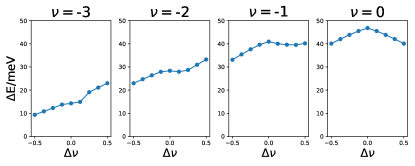
- 掺杂(接近整数填充的空穴掺杂)降低对称态与有序态之间的能量差,指示在非整数填充时对 Kondo 屏蔽的趋向增强。
- 对称性被 C3z 破坏的应变可以在足够大应变下稳定对称相,ΔE-strain 表明在 ν=0、−1、−2 附近在强应变下可能稳定。
- 总体而言,在整数填充下完全对称的 Kondo 相不太可能出现,但在非整数填充或强应变下可能出现。
更好的研究,从现在开始
从论文设计到论文写作,大幅缩短您的研究时间。
无需绑定信用卡
本解读由 AI 生成,并经人工编辑审核。