
[论文解读] Symmetry constraints on superconductivity in twisted bilayer graphene: Fractional vortices, $4e$ condensates or non-unitary pairing
本文推导了扭曲双层石墨烯(TBG)中对称性强制的超导约束,表明在无风味极化的情况下,任何超导态必为非幺正配对、电荷 $4e$ 超导体,或携带 $h/4e$ 通量的分数涡旋的幺正 $2e$ 超导体。这些奇异态源于 TBG 的 $\mathrm{SU}(4)$ 风味对称性,且无论配对机制如何均具有鲁棒性。
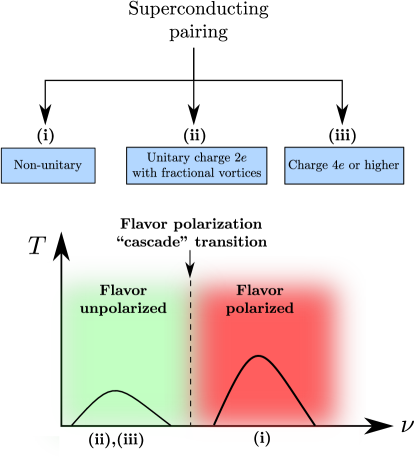
When two graphene sheets are twisted relative to each other by a small angle, enhanced correlations lead to superconductivity whose origin remains under debate. Here, we derive some general constraints on superconductivity in twisted bilayer graphene (TBG), independent of its underlying mechanism. Neglecting weak coupling between valleys, the global symmetry group of TBG consists of independent spin rotations in each valley in addition to valley charge rotations, $ { m SU}(2) imes { m SU}(2) imes { m U}_V(1) $. This symmetry is further enhanced to a full ${ m SU}(4)$ in the idealized chiral limit. In both cases, we show that any charge $2e$ pairing must break the global symmetry. Additionally, if the pairing is unitary the resulting superconductor admits fractional vortices. This leads to the following general statement: Any superconducting condensate in either symmetry class has to satisfy one of three possibilities: (i) the superconducting pairing is non-unitary, (ii) the superconducting condensate has charge $2e$ but admits at least half quantum vortices which carry a flux of $h/4e$, or (iii) the superconducting condensate has charge $2me$, $m>1$, with vortices carrying $h/2me$ flux. The latter possibility can be realized by a symmetric charge $4e$ superconductor ($m=2$). Non-unitary pairing (i) is expected in TBG for superconductors observed in the vicinity of flavor polarized states. On the other hand, in the absence of flavor polarization, e.g. in the vicinity of charge neutrality, one of the two exotic possibilities (ii) and (iii) is expected. We sketch how all three scenarios can be realized in different limits within a strong coupling theory of superconductivity based on skyrmions. Finally we discuss the effect of symmetry lowering anisotropies and experimental implications of these scenarios.
研究动机与目标
- 确定扭曲双层石墨烯(TBG)中超导性的普遍对称性约束,且独立于微观配对机制。
- 确定 $\mathrm{SU}(4)$ 风味对称性(或其子群)对超导序参量性质的影响。
- 基于对称性对 TBG 中可能的超导态进行分类,特别是在无风味极化区域。
- 将这些对称性保护的态与实验可观测的特征(如分数涡旋和修改的弗劳恩霍费尔条纹)联系起来。
- 探讨 Hunds 耦合和对称性降低的微扰在稳定或改变这些奇异超导相中的作用。
提出的方法
- 将 TBG 的全局对称群推导为 $\mathrm{SU}(2)_S \times \mathrm{U}_V(1)$(低能情形)或 $\mathrm{SU}(4)$(手征极限),将自旋和谷自由度视为风味指标。
- 分析配对矩阵在完整风味对称群下的变换性质,以确定哪些配对态保持或破缺对称性。
- 利用群论证明,任何幺正 $2e$ 配对必然破缺全局对称性,从而导致具有 $h/4e$ 通量的分数涡旋。
- 建立唯一允许的 $2e$ 超导态为非幺正态或允许分数涡旋,否则必须存在更高电荷的凝结态($2me$,$m>1$)。
- 构建基于 Skyrmion 的强耦合理论,以实现三种情形:非幺正配对、$4e$ 超导性和分数涡旋。
- 分析实验信号,包括弗劳恩霍费尔条纹中周期性被修改,以及在介观环形约瑟夫森结中可探测的 $h/4e$ 通量跃迁。
实验结果
研究问题
- RQ1在独立于配对机制的前提下,扭曲双层石墨烯中超导序参量的普遍对称性约束是什么?
- RQ2为何 TBG 中任何幺正 $2e$ 超导体必然包含具有 $h/4e$ 通量的分数涡旋?
- RQ3在何种条件下,$4e$ 超导凝结态可作为对称性允许的态在 TBG 中出现?
- RQ4如 Hunds 耦合等对称性降低效应如何影响分数涡旋和非幺正配对的稳定性?
- RQ5这些奇异超导态的可测量实验信号是什么,特别是在约瑟夫森结和介观环中的表现?
主要发现
- TBG 中任何幺正 $2e$ 超导体必须破缺全局 $\mathrm{SU}(4)$ 风味对称性,从而导致具有 $h/4e$ 通量的分数涡旋出现。
- 在无风味极化的情况下,TBG 中的超导性必为非幺正态、电荷 $4e$ 凝结态,或具有分数涡旋的幺正 $2e$ 超导体。
- 该 $4e$ 超导态是对称性允许的,且可在基于 Skyrmion 的强耦合理论中实现,其涡旋携带 $h/8e$ 通量。
- 在 $2e$ 超导体中,分数涡旋可通过修改后的弗劳恩霍费尔条纹探测,其周期性为 $2\pi/m$($m=2$),在介观结中可观测。
- 在介观环形几何中,$h/4e$ 通量跃迁可直接表征半量子涡旋的存在,避免了大系统中对数发散的能量问题。
- 存在一个温度窗口,其中 Hunds 耦合已熔化(偏好单重态配对),但 $4e$ 凝结态仍保持稳定,从而可实现分数涡旋的观测。
更好的研究,从现在开始
从阅读论文到最终审阅,大幅缩短您的研究时间。
无需绑定信用卡
本解读由 AI 生成,并经人工编辑审核。