
[论文解读] TACOS: Task Agnostic Continual Learning in Spiking Neural Networks
TACOS 提出了一种面向脉冲神经网络的、与任务无关的持续学习框架,采用活动依赖型元可塑性、突触巩固和异突触衰减机制,实现了无需任务边界划分且内存大小不随任务增加的稳定知识保留。在领域增量学习中,其性能优于正则化基线方法,灾难性遗忘减少至原来的1/5,且平均准确率比基线脉冲神经网络高出22%。
Catastrophic interference, the loss of previously learned information when learning new information, remains a major challenge in machine learning. Since living organisms do not seem to suffer from this problem, researchers have taken inspiration from biology to improve memory retention in artificial intelligence systems. However, previous attempts to use bio-inspired mechanisms have typically resulted in systems that rely on task boundary information during training and/or explicit task identification during inference, information that is not available in real-world scenarios. Here, we show that neuro-inspired mechanisms such as synaptic consolidation and metaplasticity can mitigate catastrophic interference in a spiking neural network, using only synapse-local information, with no need for task awareness, and with a fixed memory size that does not need to be increased when training on new tasks. Our model, TACOS, combines neuromodulation with complex synaptic dynamics to enable new learning while protecting previous information. We evaluate TACOS on sequential image recognition tasks and demonstrate its effectiveness in reducing catastrophic interference. Our results show that TACOS outperforms existing regularization techniques in domain-incremental learning scenarios. We also report the results of an ablation study to elucidate the contribution of each neuro-inspired mechanism separately.
研究动机与目标
- 解决持续学习中灾难性遗忘问题,且在训练或推理阶段无需使用任务身份信息。
- 开发一种可扩展、能效高效的持续学习框架,用于脉冲神经网络,以模拟生物突触机制。
- 在固定内存预算下实现稳定的知识保留,且该预算不随任务数量增加而扩展。
- 探究活动依赖型元可塑性与突触巩固在平衡稳定性与可塑性中的作用。
- 在具有局部学习规则的多层、监督式脉冲神经网络中,验证神经启发机制的有效性。
提出的方法
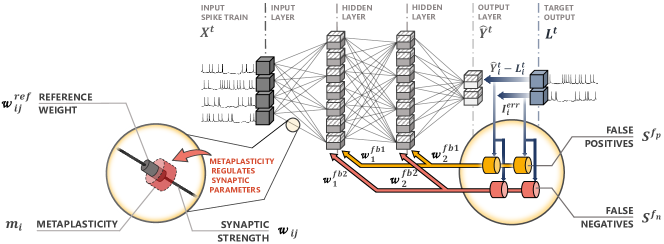
- TACOS 采用复杂的突触模型,利用活动依赖型元可塑性,根据突触前与突触后活动动态调节突触强度。
- 引入突触巩固机制,降低强化突触的自发衰减,从而增强长期记忆保留。
- 应用异突触衰减机制,削弱不活跃突触,促进选择性可塑性并减少干扰。
- 误差驱动的神经调制仅在预测误差出现时触发学习更新,实现高效、精准的可塑性。
- 所有学习规则均为突触局部化,无需全局任务信息或外部监督。
- 模型使用固定数量的参数和内存大小,与所学习任务的数量无关。
实验结果
研究问题
- RQ1神经启发机制(如元可塑性和突触巩固)是否能在无任务边界信息的情况下,减少脉冲神经网络中的灾难性遗忘?
- RQ2活动依赖型元可塑性与固定元可塑态状态相比,在平衡稳定性与可塑性方面表现如何?
- RQ3在有限训练数据条件下,TACOS 能在大量顺序任务中保持多高的性能?
- RQ4在持续学习中,不同元可塑性水平下,可塑性与稳定性的权衡关系如何变化?
- RQ5该模型能否在具有挑战性的现实持续学习场景(如 Omniglot 数据集上的少样本、领域增量学习)中实现良好泛化?
主要发现
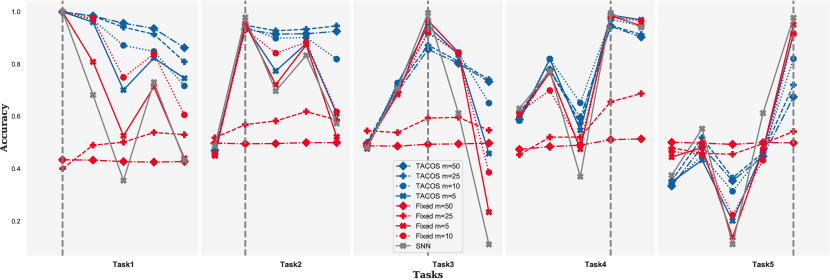
- 在 split-MNIST 和 split-FMNIST 任务中,TACOS 相较于基线脉冲神经网络,将灾难性遗忘减少了约5倍。
- 尽管其可塑性约为基线的1/3,TACOS 在所有任务上的平均准确率仍高出22%。
- 在50个任务的 split-Omniglot 基准测试中,低元可塑性(m=25)使最终平均准确率比基线脉冲神经网络高出6%。
- 当最大元可塑态达到 m=25 时,模型性能出现拐点,表明此时稳定性与可塑性达到最优平衡。
- 消融实验表明,元可塑性和突触巩固均能独立降低遗忘并提升记忆保留。
- 通过根据任务持续时间调整元可塑性和巩固参数,可有效缓解因训练数据减少导致的性能下降。
更好的研究,从现在开始
从阅读论文到最终审阅,大幅缩短您的研究时间。
无需绑定信用卡
本解读由 AI 生成,并经人工编辑审核。