
[论文解读] Target Sensing with Intelligent Reflecting Surface: Architecture and Performance
本文提出了一种新颖的自感知智能反射表面(IRS)架构,通过利用直达信号与IRS反射回波信号,实现目标定位。通过优化无源反射以最大化回波功率,并推导出角度估计的Cramér-Rao界(CRB),该IRS在无专用发射机的情况下实现了高精度感知,在路径损耗和遮挡条件下表现出优于传统系统的精度与鲁棒性。
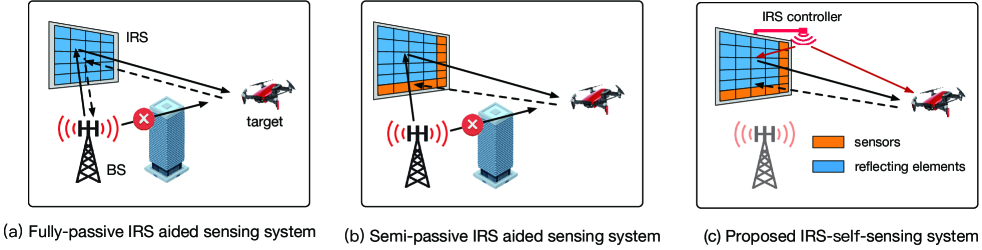
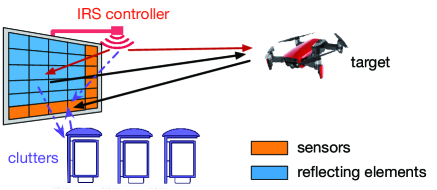
Intelligent reflecting surface (IRS) has emerged as a promising technology to reconfigure the radio propagation environment by dynamically controlling wireless signal's amplitude and/or phase via a large number of reflecting elements. In contrast to the vast literature on studying IRS's performance gains in wireless communications, we study in this paper a new application of IRS for sensing/localizing targets in wireless networks. Specifically, we propose a new self-sensing IRS architecture where the IRS controller is capable of transmitting probing signals that are not only directly reflected by the target (referred to as the direct echo link), but also consecutively reflected by the IRS and then the target (referred to as the IRS-reflected echo link). Moreover, dedicated sensors are installed at the IRS for receiving both the direct and IRS-reflected echo signals from the target, such that the IRS can sense the direction of its nearby target by applying a customized multiple signal classification (MUSIC) algorithm. However, since the angle estimation mean square error (MSE) by the MUSIC algorithm is intractable, we propose to optimize the IRS passive reflection for maximizing the average echo signals' total power at the IRS sensors and derive the resultant Cramer-Rao bound (CRB) of the angle estimation MSE. Last, numerical results are presented to show the effectiveness of the proposed new IRS sensing architecture and algorithm, as compared to other benchmark sensing systems/algorithms.
研究动机与目标
- 为解决6G无线网络中在严重路径损耗和遮挡条件下对高精度、低成本目标感知的需求。
- 克服传统单基地与双基地感知系统局限,使IRS兼具反射与感知平台功能。
- 开发一种自感知IRS架构,能够利用直达信号与IRS反射回波信号联合估计目标方向。
- 优化无源反射系数,以最大化IRS传感器接收到的总回波功率,从而提升角度估计精度。
- 推导角度估计均方误差(MSE)的Cramér-Rao界(CRB),为所提出的感知框架提供理论性能极限。
提出的方法
- IRS配备专用传感器,用于接收来自目标的直达信号与IRS反射回波信号。
- 应用定制化的多重信号分类(MUSIC)算法,基于组合回波信号估计目标的到达方向(DOA)。
- 优化IRS的无源反射系数,以最大化IRS传感器接收到的总回波信号功率。
- 基于优化后的信号模型与回波信号的统计特性,推导角度估计均方误差(MSE)的Cramér-Rao界(CRB)。
- 通过Fisher信息矩阵,以闭式表达CRB,包含信噪比、阵列响应向量以及IRS到目标及返回的有效信道增益。
- 理论分析考虑了IRS单元配置、信号相关性及阵列几何结构对估计精度的影响。
实验结果
研究问题
- RQ1能否设计一种IRS,使其在无需独立发射机的情况下,同时支持通信与目标感知?
- RQ2与传统系统相比,联合使用直达信号与IRS反射回波信号如何提升目标定位精度?
- RQ3何种最优无源反射波束成形设计可使IRS传感器处的回波功率最大化,从而提升感知性能?
- RQ4所提出的IRS感知架构在角度估计MSE上的理论下限是多少?
- RQ5角度估计的CRB如何随IRS尺寸、信噪比及阵列几何结构变化?
主要发现
- 所提出的自感知IRS架构通过利用直达信号与IRS反射回波信号,实现了高精度目标定位,无需额外雷达发射机。
- 通过优化无源反射系数以最大化总回波功率,显著提升了IRS传感器处的信噪比,从而增强了估计精度。
- 推导出的角度估计MSE的Cramér-Rao界(CRB)以闭式表达,表明该界与有效信道增益的平方及IRS单元数成反比。
- 数值结果表明,与传统单基地与双基地感知系统相比,所提系统在定位精度方面表现更优,尤其在高路径损耗与遮挡条件下优势显著。
- CRB分析表明,当IRS与目标对齐良好且通过最优相位偏移最大化信号相关性时,估计误差最小。
- 当IRS靠近目标部署时性能增益最为显著,因为这可减少往返路径损耗并增强IRS反射回波的强度。
更好的研究,从现在开始
从阅读论文到最终审阅,大幅缩短您的研究时间。
无需绑定信用卡
本解读由 AI 生成,并经人工编辑审核。