
[论文解读] TASRA: a Taxonomy and Analysis of Societal-Scale Risks from AI
论文提出了一个基于问责制的社会规模AI风险的全面分类体系,用故事进行说明,并讨论监管、监督与技术方法以缓解它们。
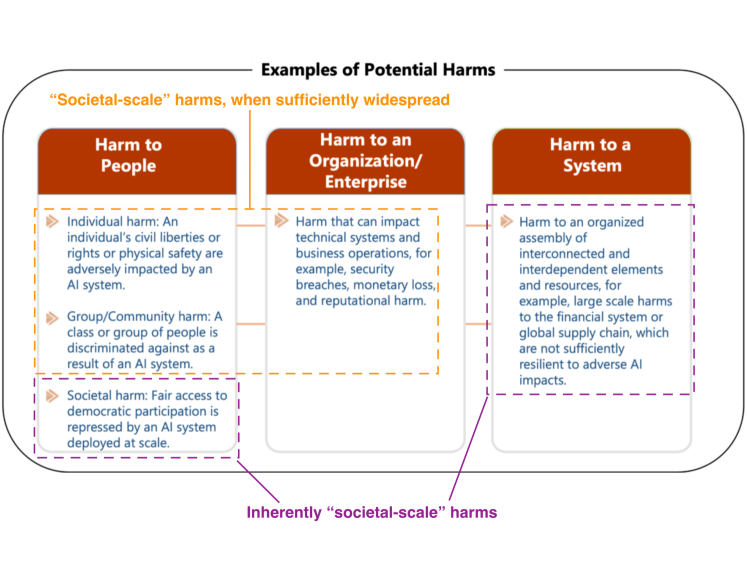
While several recent works have identified societal-scale and extinction-level risks to humanity arising from artificial intelligence, few have attempted an {\em exhaustive taxonomy} of such risks. Many exhaustive taxonomies are possible, and some are useful -- particularly if they reveal new risks or practical approaches to safety. This paper explores a taxonomy based on accountability: whose actions lead to the risk, are the actors unified, and are they deliberate? We also provide stories to illustrate how the various risk types could each play out, including risks arising from unanticipated interactions of many AI systems, as well as risks from deliberate misuse, for which combined technical and policy solutions are indicated.
研究动机与目标
- Develop an exhaustive taxonomy of societal-scale harms from AI.
- ground the taxonomy in accountability: who is responsible, are they unified, and are actions deliberate.
- Illustrate risk types with narrative stories highlighting interactions among multiple AI systems and misuse.
- Propose regulatory foresight, oversight mechanisms, and a new interdisciplinary technical discipline for analysis.
- Highlight the need for both technical and policy interventions to mitigate diffusion of responsibility and large-scale impacts.
提出的方法
- Propose an exhaustive decision-tree taxonomy to classify societal-scale harms based on accountability.
- Define six risk types and map them onto potential real-world scenarios.
- Use narrative stories to illustrate how risks can arise from interactions of many AI systems or from deliberate misuse.
- Discuss regulatory and oversight needs, including global-scale monitoring of the algorithmic economy.
- Discuss technical concepts like impact control, scope sensitivity, and model-based vs model-free regulation to constrain AI impact.
- Suggest a framework for a unified discipline combining control theory, operations research, economics, law, and political theory for sociotechnical analysis.
实验结果
研究问题
- RQ1What are the types of societal-scale harms from AI and how can they be exhaustively categorized?
- RQ2How do interactions among multiple AI systems and diffusion of responsibility contribute to risk?
- RQ3What regulatory, oversight, and technical approaches are needed to prevent or mitigate these risks?
- RQ4How can impact control and scope sensitivity be used to limit unintended large-scale consequences?
主要发现
- An exhaustive taxonomy of six risk types is proposed, organized around accountability and actor coordination.
- Risks can arise from interactions among many AI systems and from deliberate misuse, not just from single misaligned systems.
- Regulatory foresight, global oversight, and a new interdisciplinary discipline are needed to monitor and manage the algorithmic economy at societal scale.
- Examples and stories illustrate diffusion of responsibility, production webs, and larger-than-expected or worse-than-expected impacts.
- Technical concepts like impact control, scope sensitivity, and both model-based and model-free approaches are discussed as mechanisms to constrain risk.
- The paper argues for combining technical, policy, and governance perspectives to address societal-scale AI risks.
更好的研究,从现在开始
从论文设计到论文写作,大幅缩短您的研究时间。
无需绑定信用卡
本解读由 AI 生成,并经人工编辑审核。