
[论文解读] Tensor Network Methods for Extracting CFT Data from Fixed-Point Tensors and Defect Coarse Graining
本文提出一种张量网络方法,利用线性化张量重整化群(lTRG)和图无关局部截断(GILT),从二维经典伊辛模型的固定点张量中提取共形场论(CFT)数据——如标度维数和结构常数。结果表明,在晶格中插入缺陷可生成与lTRG本征向量匹配的共形态,且在受控条件下,HOTRG+GILT能实现精确的两体和四体关联函数,通过最小规范形式进一步提升了稳定性。
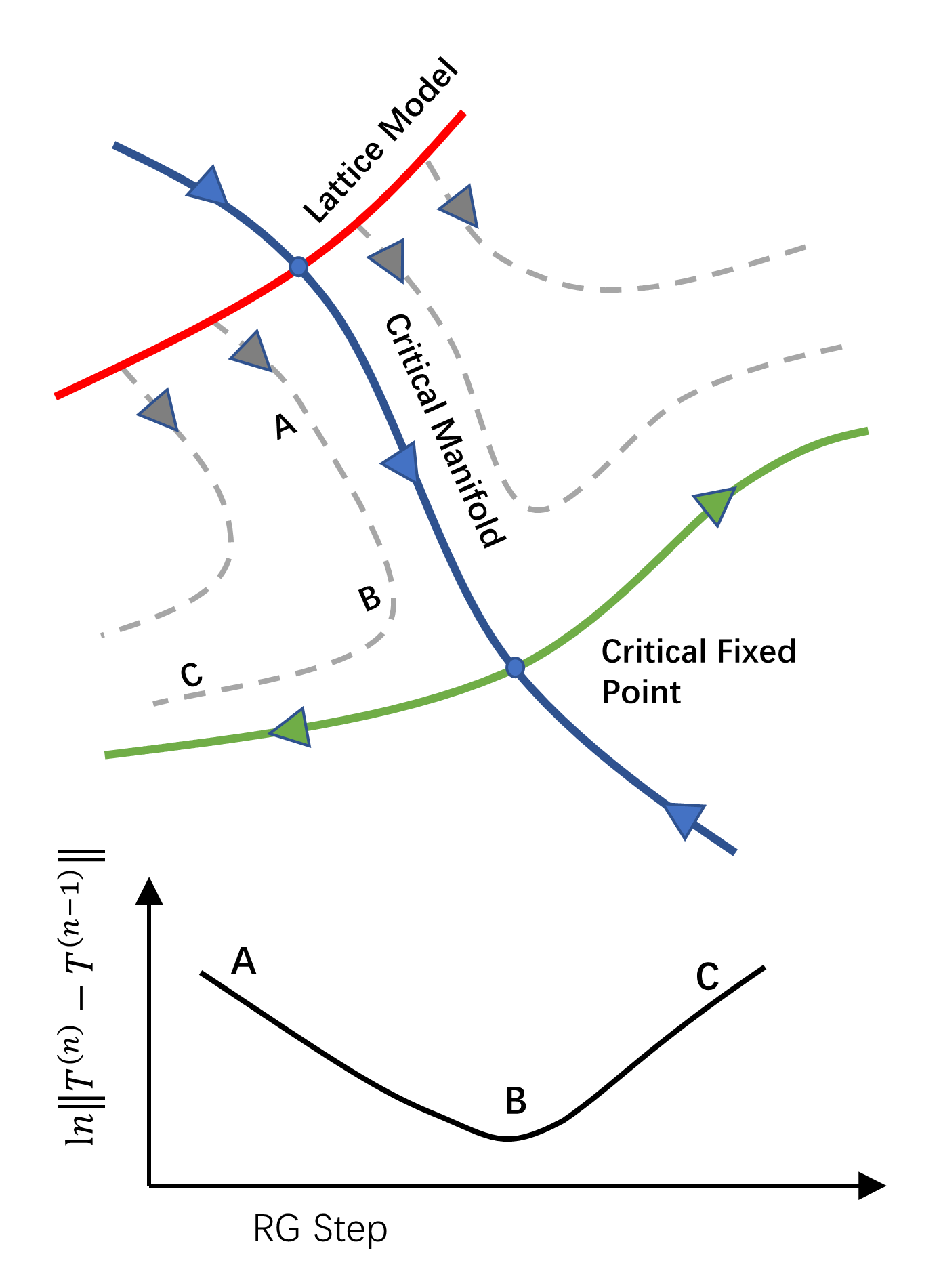
We present a comprehensive study on the extraction of CFT data using tensor network methods, specially, from the fixed-point tensor of the linearized tensor renormalization group (lTRG) for the 2D classical Ising model near the critical temperature. Utilizing two different methods, we extract operator scaling dimensions and operator-product-expansion (OPE) coefficients by introducing defects on the lattice and by employing the fixed-point tensor. We also explore the effects of point-like defects in the lattice on the coarse-graining process. We find that there is a correspondence between coarse-grained defect tensors and conformal states obtained from lTRG fixed-point equation. We also analyze the capabilities and limitations of our proposed coarse-graining scheme for tensor networks with point-like defects, which includes graph independent local truncation (GILT) and higher-order tensor renormalization group (HOTRG). Our results provide a better understanding of the capacity and limitations of the tenor renormalization group scheme in coarse-graining defect tensors, and we show that GILT+HOTRG can be used to give accurate two- and four-point functions under specific conditions. We also find that employing the minimal canonical form further improves the stability of the RG flow.
研究动机与目标
- 开发一种从临界格点模型的固定点张量中提取CFT数据(包括标度维数和结构常数)的方法。
- 研究晶格中点缺陷对张量网络粗粒化的影响,以及其是否可用于构建共形态。
- 评估HOTRG和GILT在缺陷存在下保持关联函数和RG流稳定性的性能与局限性。
- 建立粗粒化缺陷张量与由lTRG固定点方程导出的共形态之间的对应关系。
- 探索从CFT数据反向构建固定点张量的可行性,作为反向共形 bootstrap 方法。
提出的方法
- 本研究使用线性化张量重整化群(lTRG)从二维伊辛模型固定点张量中提取标度维数和结构常数。
- 通过修改局部张量在晶格中引入缺陷,以模拟共形算符的插入,从而构建共形态。
- 应用图无关局部截断(GILT)以去除虚假相关性(CDL张量),并在粗粒化过程中稳定RG流。
- 使用高阶张量重整化群(HOTRG)实现晶格的高效粗粒化,每一步均应用截断与滤波。
- 将lTRG固定点方程的本征向量与粗粒化缺陷张量进行比较,以验证其与共形态的对应关系。
- 采用最小规范形式以提高RG流的稳定性并减少数值伪影。
实验结果
研究问题
- RQ1能否利用lTRG和GILT从二维伊辛模型的固定点张量中高精度提取标度维数和结构常数?
- RQ2粗粒化缺陷张量与由lTRG固定点方程获得的共形态之间是否存在直接对应关系?
- RQ3点缺陷在HOTRG和GILT粗粒化下的行为如何?其对关联函数有何影响?
- RQ4在缺陷存在的情况下,GILT+HOTRG在多大程度上能保持两体和四体关联函数的准确性?
- RQ5最小规范形式是否能增强缺陷系统中张量网络RG流的稳定性和准确性?
主要发现
- 在临界二维伊辛模型中,利用lTRG和转移矩阵方法对Δ < 3的共形态标度维数实现了高精度提取,结果与解析解一致。
- 通过lTRG本征向量成功计算出结构常数Cσσε,证实其与已知CFT数据的一致性。
- 在临界点附近计算了两体自旋-自旋关联函数,提取的指数与标度维数高度吻合。
- 四体关联函数得以计算,尽管质量较低,但仍能有效提取标度维数和结构常数。
- 在粗粒化过程中,缺陷被展宽为“准粒子云”,尤其在角点和边缘区域展宽更明显,但该效应可通过方法缓解以恢复准确的关联函数。
- lTRG固定点方程的本征向量被证明与粗粒化缺陷张量精确对应,验证了从格点算符插入构建共形态的有效性。

更好的研究,从现在开始
从阅读论文到最终审阅,大幅缩短您的研究时间。
无需绑定信用卡
本解读由 AI 生成,并经人工编辑审核。