
[论文解读] Terracorder: Sense Long and Prosper
Terracorder 展示了一种在设备端实现的强化学习调度器,用于低功耗生物多样性传感器,在显著减少触发次数的同时实现更高的事件检测,并延长电池寿命,同时包括面向鲁棒性的协作网络调度。
In-situ sensing devices need to be deployed in remote environments for long periods of time; minimizing their power consumption is vital for maximising both their operational lifetime and coverage. We introduce Terracorder -- a versatile multi-sensor device -- and showcase its exceptionally low power consumption using an on-device reinforcement learning scheduler. We prototype a unique device setup for biodiversity monitoring and compare its battery life using our scheduler against a number of fixed schedules; the scheduler captures more than 80% of events at less than 50% of the number of activations of the best-performing fixed schedule. We then explore how a collaborative scheduler can maximise the useful operation of a network of devices, improving overall network power consumption and robustness.
研究动机与目标
- Develop a low-power, multi-sensor device for biodiversity monitoring with long deployment lifetimes.
- Introduce an on-device reinforcement learning scheduler to optimize event-driven sensor activations under power constraints.
- Evaluate isolated and collaborative scheduling to maximize useful active time and network robustness.
提出的方法
- Use ESP32s3-based PowerFeather hardware with deep-sleep and low-power I/O to build Terracorder.
- Implement an on-device Q-learning scheduler with a quantized action/state space to minimize activations while maximizing detections.
- Define a reward R_t = N_p_t - w1 * N_n_t to balance positive/negative activations for isolated scheduling.
- Extend the reward for network-wide collaboration to include overlaps and battery balance: R_t = N_p_t - w1*N_n_t - w2*sum_i(N_o_ti-1) - w3*B_sigma_t.
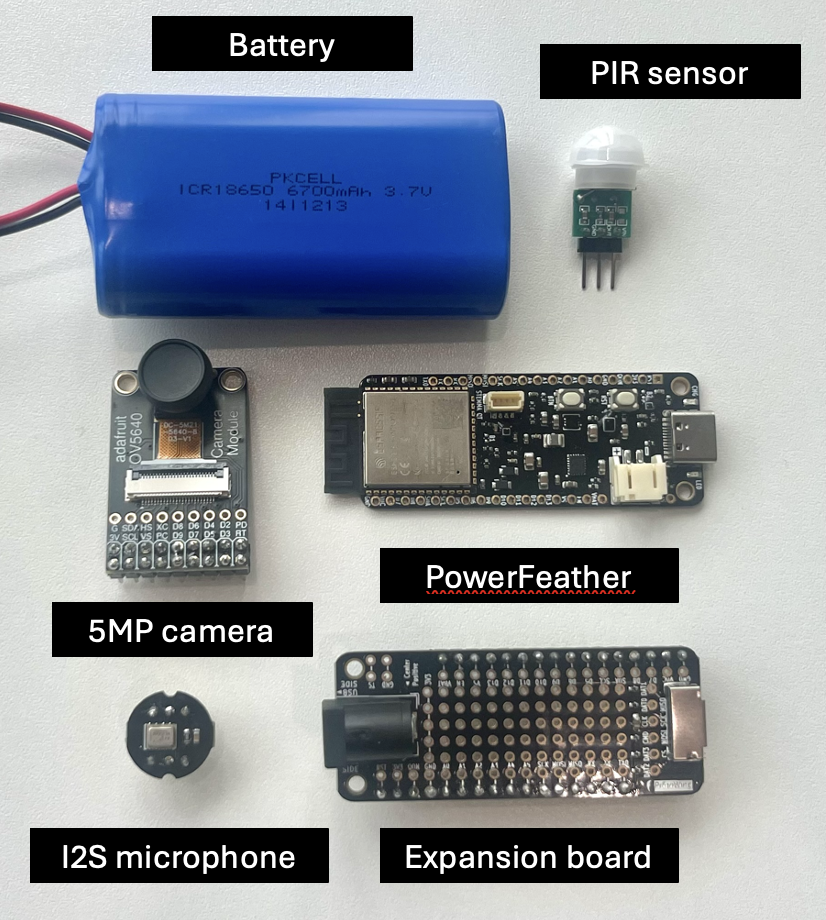
- Prototype with a 5MP camera, omnidirectional microphone, and PIR sensor; evaluate Goertzel filtering and a one-layer CNN on-device for event detection.
- Demonstrate practical on-device learning with a 24x7 Q-table (~3KB) and negligible overhead for Q-learning inference/update.
实验结果
研究问题
- RQ1Can an on-device reinforcement learning scheduler optimize event-driven sensing to extend device lifetime under power constraints?
- RQ2How does a collaborative, network-aware scheduling strategy reduce redundant activations and improve overall network robustness and efficiency?
- RQ3What are the practical performance and energy trade-offs of Goertzel filtering versus on-device CNN-based event detection in this architecture?
主要发现
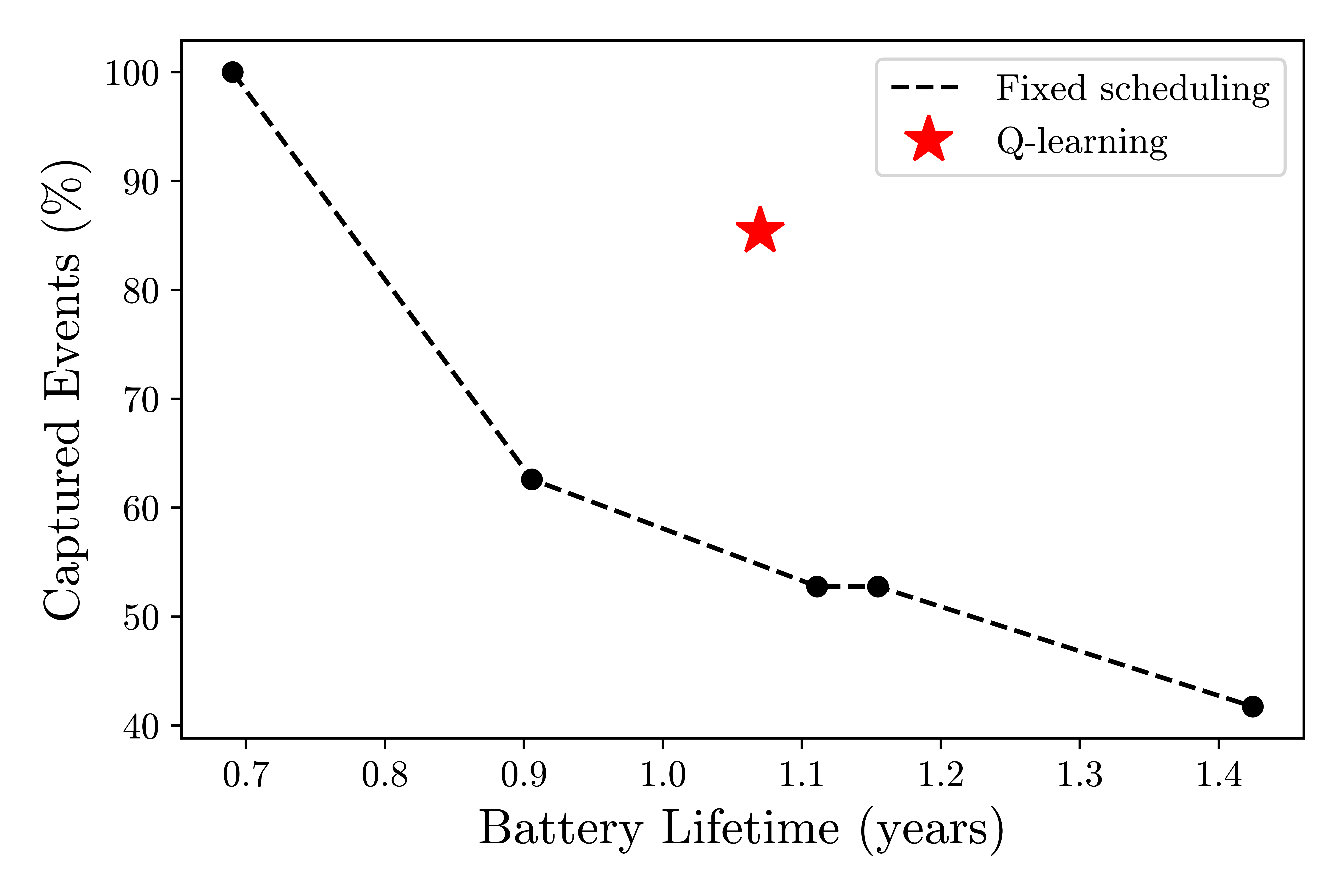
- Isolated scheduling with Q-learning detects 85.3% of events, extending battery life by 55.1% over a fixed 3s baseline.
- Q-learning inference uses ~30 μA and updates ~70 μA with <0.1 s latency; Goertzel ~33.3 mA and TFLite ~33.1 mA with similar latency.
- Battery life extends from 0.69 to 1.07 years with Goertzel, and to ~1.05 years with TFLite-based event detection.
- The device achieves a deep-sleep current of ~100 μA while maintaining attached sensors and RTC; WiFi remains the largest power consumer for transmissions.
- Collaborative scheduling introduces a network-wide reward to minimize overlaps and balance battery life, enabling distributed, low-overhead coordination across nearby devices.
- A 24x7 Q-table (~3 KB) supports scheduling across 7 activation frequencies across 24 hours.
更好的研究,从现在开始
从论文设计到论文写作,大幅缩短您的研究时间。
无需绑定信用卡
本解读由 AI 生成,并经人工编辑审核。