
[论文解读] The ALMA Survey of 70 μm Dark High-mass Clumps in Early Stages (ASHES). VIII. Dynamics of Embedded Dense Cores
本研究利用ALMA观测,分析了12个红外暗云(IRDCs)中294个致密核的动力学特性,以评估大质量恒星形成机制。结果表明,原恒星核比预恒星核具有更强的引力束缚,且从预恒星相到原恒星相,湍流未见显著增加,支持‘团块供给’模型而非‘核供给’情景。
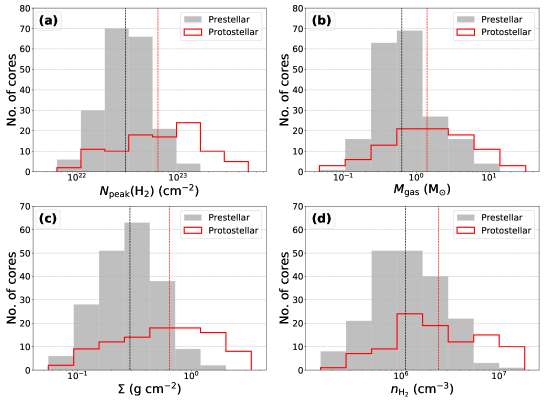
We present the dynamical properties of 294 cores embedded in twelve IRDCs observed as part of the ASHES Survey. Protostellar cores have higher gas masses, surface densities, column densities, and volume densities than prestellar cores, indicating core mass growth from the prestellar to the protostellar phase. We find that ~80% of cores with virial parameter ($α$) measurements are gravitationally bound ($α$< 2). We also find an anti-correlation between the mass and the virial parameter of cores, with massive cores having on average lower virial parameters. Protostellar cores are more gravitationally bound than prestellar cores, with an average virial parameter of 1.2 and 1.5, respectively. The observed non-thermal velocity dispersion (from N$_{2}$D$^{+}$ or DCO$^{+}$) is consistent with simulations in which turbulence is continuously injected, whereas the core-to-core velocity dispersion is neither in agreement with driven nor decaying turbulence simulations. We find no significant increment in the line velocity dispersion from prestellar to protostellar cores, suggesting that dense gas within the core traced by these deuterated molecules is not yet severely affected by turbulence injected from outflow activity at the early evolutionary stages traced in ASHES. The most massive cores are strongly self-gravitating and have greater surface density, Mach number, and velocity dispersion than cores with lower masses. Dense cores have not significant velocity shifts relative to their low-density envelopes, suggesting that dense cores are co-moving with their envelopes. We conclude that the observed core properties are more in line with predictions of ``clump-fed" scenarios rather than with ``core-fed" scenarios.
研究动机与目标
- 研究早期大质量恒星形成区中嵌入致密核的动力学特性。
- 确定核的性质是否符合‘核供给’或‘团块供给’的大质量恒星形成模型。
- 评估湍流、引力坍缩及核-包层运动学在早期核演化中的作用。
- 将观测到的核动力学与驱动湍流和衰减湍流的理论模拟进行比较。
- 评估吸积与反馈在核演化最早阶段对核速度 dispersion 的影响。
提出的方法
- 获取70 μm暗IRDCs的高分辨率ALMA数据,以识别并表征嵌入的致密核。
- 利用N2D+和DCO+谱线辐射的气体质量、大小和速度 dispersion 计算核的维里参数(α)。
- 从非热速度 dispersion 和核大小计算湍流马赫数。
- 将核间速度 dispersion 与团块尺度的C18O数据进行比较,以评估运动学解耦。
- 应用统计工具(如LINMIX)分析质量、面密度与速度 dispersion 之间的相关性。
- 检验线宽随半径的标度关系,以在不同尺度上验证第一Larson关系。
实验结果
研究问题
- RQ1原恒星核是否比预恒星核具有更强的引力束缚?其随质量的变化如何?
- RQ2从预恒星相到原恒星相,湍流是否显著增加,表明喷流反馈的存在?
- RQ3致密核是否与低密度包层运动学上共动,还是呈弹道运动?
- RQ4观测到的核动力学与‘核供给’和‘团块供给’大质量恒星形成模型的预测相比如何?
- RQ5引力坍缩是否是原恒星核中线宽的主要贡献者?
主要发现
- 约80%具有维里参数测量值的核处于引力束缚状态(α < 2),其中原恒星核的平均α = 1.2,预恒星核的平均α = 1.5。
- 大质量核的维里参数平均更低,表明自引力更强,且其面密度、马赫数和速度 dispersion 均高于低质量核。
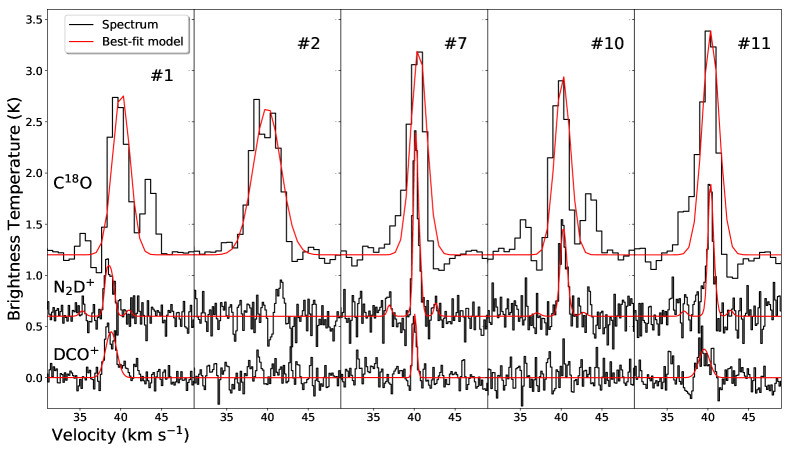
- 从预恒星核到原恒星核,谱线速度 dispersion 无显著增加,表明氘化分子所追踪的气体尚未受到喷流驱动湍流的显著影响。
- 核间速度 dispersion 与持续注入湍流的模拟一致,而核内速度 dispersion 与驱动或衰减湍流模型不匹配。
- 致密核相对于其低密度包层(C18O)表现出较小的速度偏移,表明其为共动运动而非弹道运动。
- 第一Larson关系(速度 dispersion 与尺度的关系)在从分子云到核的尺度上均成立,且观测动力学与‘核供给’湍流吸积模型不一致,但与‘团块供给’模型(如竞争性吸积和全局分层坍缩)部分一致。
更好的研究,从现在开始
从阅读论文到最终审阅,大幅缩短您的研究时间。
无需绑定信用卡
本解读由 AI 生成,并经人工编辑审核。