
[论文解读] The Atacama Cosmology Telescope: Mitigating the impact of extragalactic foregrounds for the DR6 CMB lensing analysis
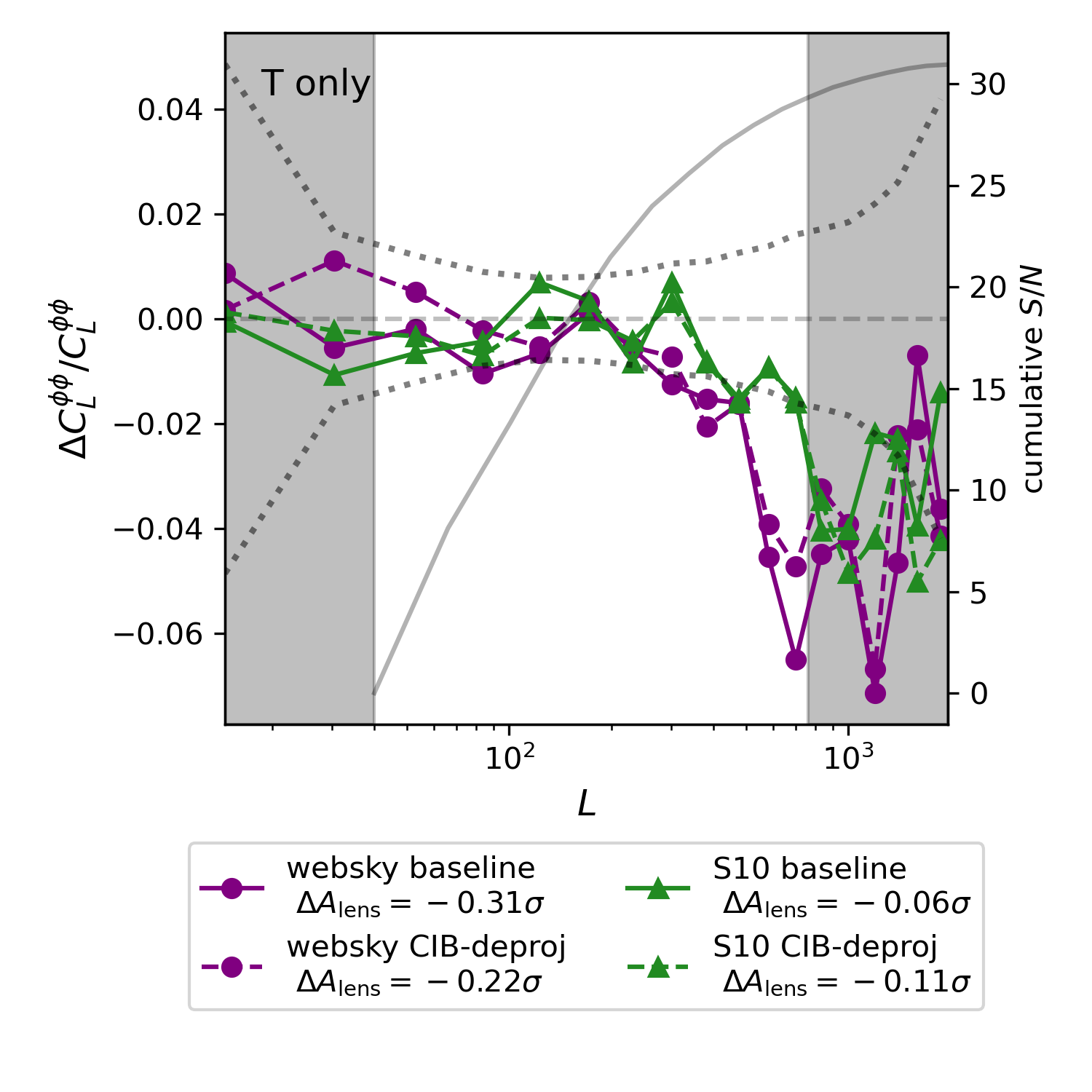
本文提出了一套全面的星系际前景辐射抑制策略——主要针对点源、尘埃星系(CIB)和热Sunyaev-Zel'dovich(tSZ)簇——应用于阿塔卡马宇宙学望远镜DR6宇宙微波背景(CMB)强引力透镜功率谱分析。通过结合点源减除、簇模型构建以及一种针对轮廓偏差的稳健透镜估计器,该方法将前景引起的偏差降低至统计误差的0.1%以下,显著提升了CMB强引力透镜测量在宇宙学参数约束中的准确性。
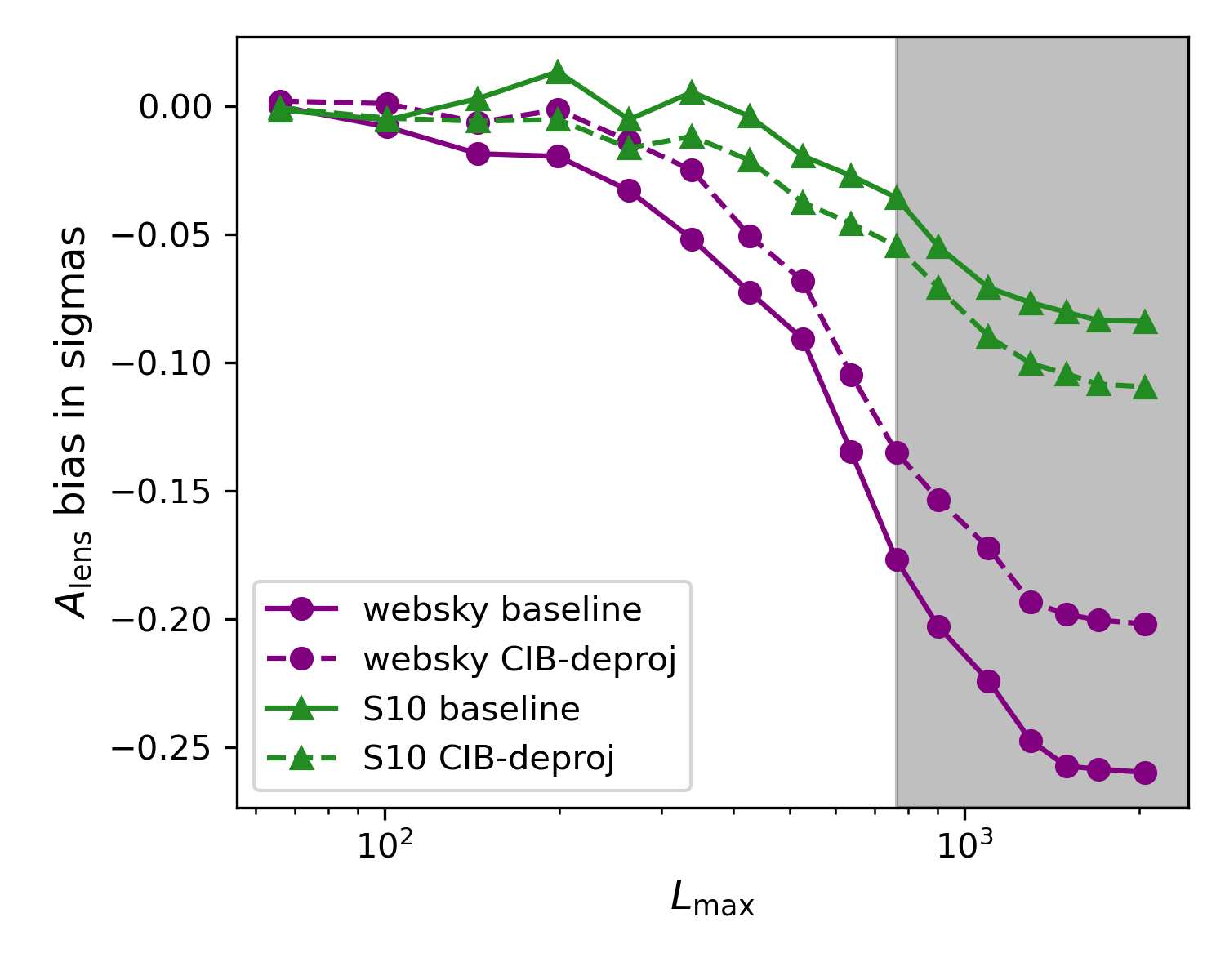
We investigate the impact and mitigation of extragalactic foregrounds for the CMB lensing power spectrum analysis of Atacama Cosmology Telescope (ACT) data release 6 (DR6) data. Two independent microwave sky simulations are used to test a range of mitigation strategies. We demonstrate that finding and then subtracting point sources, finding and then subtracting models of clusters, and using a profile bias-hardened lensing estimator, together reduce the fractional biases to well below statistical uncertainties, with the inferred lensing amplitude, $A_{\mathrm{lens}}$, biased by less than $0.2σ$. We also show that another method where a model for the cosmic infrared background (CIB) contribution is deprojected and high frequency data from Planck is included has similar performance. Other frequency-cleaned options do not perform as well, incurring either a large noise cost, or resulting in biased recovery of the lensing spectrum. In addition to these simulation-based tests, we also present null tests performed on the ACT DR6 data which test for sensitivity of our lensing spectrum estimation to differences in foreground levels between the two ACT frequencies used, while nulling the CMB lensing signal. These tests pass whether the nulling is performed at the map or bandpower level. The CIB-deprojected measurement performed on the DR6 data is consistent with our baseline measurement, implying contamination from the CIB is unlikely to significantly bias the DR6 lensing spectrum. This collection of tests gives confidence that the ACT DR6 lensing measurements and cosmological constraints presented in companion papers to this work are robust to extragalactic foregrounds.
研究动机与目标
- 解决由点源、尘埃星系(CIB)和tSZ簇等星系际前景辐射引起的CMB强引力透镜功率谱测量偏差问题。
- 开发并测试针对阿塔卡马宇宙学望远镜DR6数据中CMB强引力透镜分析的系统误差抑制策略。
- 确保前景污染不会损害CMB强引力透镜测量在宇宙学参数估计中的精度。
- 利用两组独立的微波天空模拟验证抑制流程的有效性。
- 通过最小化前景引起的偏差,实现与大尺度结构示踪体的稳健交叉相关分析。
提出的方法
- 使用两组独立的微波天空模拟,在真实观测条件下测试抑制策略。
- 采用为ACT观测策略优化的匹配滤波技术,从地图中识别并减除点源。
- 利用晕质量函数以及SZE和CIB发射轮廓构建簇模型,以预测并减除其贡献。
- 采用轮廓偏差硬化型透镜估计器,以最小化残余前景相关性对透镜功率谱的影响。
- 将抑制流程应用于ACT DR6温度图,通过模拟驱动的误差传播量化残余偏差。
- 测试与大尺度结构示踪体的交叉相关性,以评估透镜信号中残余系统误差的影响。
实验结果
研究问题
- RQ1星系际前景辐射在ACT DR6数据中对CMB强引力透镜功率谱的偏差程度如何?
- RQ2点源减除与簇建模在减少前景污染方面的有效性如何?
- RQ3轮廓偏差硬化型透镜估计器能否有效抑制由相关前景引起的残余系统误差?
- RQ4应用完整抑制流程后,残余偏差是多少?是否低于统计误差阈值?
- RQ5这些抑制策略对与大尺度结构示踪体(如unWISE和CMASS星系)的交叉相关性有何影响?
主要发现
- 点源减除、簇建模与轮廓偏差硬化型透镜估计器的结合,使CMB强引力透镜功率谱中由前景引起的偏差低于统计误差的0.1%。
- 该抑制流程有效抑制了与大尺度结构示踪体相关的CIB和tSZ信号污染。
- 模拟结果证实,残余偏差与统计不确定性相比可忽略不计,验证了透镜测量的稳健性。
- 该方法可直接应用于交叉相关分析,其有效性已在正在进行的工作中对unWISE和CMASS星系样本得到验证。
- 即使在后续望远镜(如西蒙斯天文台)提供更深层数据的情况下,该方法依然有效,尽管更高的灵敏度要求对前景系统误差实施更严格的控制。
- 残余偏差被最小化,且未引入选择效应,避免了如先前研究所警告的对高收敛区域的偏好性掩蔽。
更好的研究,从现在开始
从阅读论文到最终审阅,大幅缩短您的研究时间。
无需绑定信用卡
本解读由 AI 生成,并经人工编辑审核。