
[论文解读] The baryon cycle in modern cosmological hydrodynamical simulations
本文通过统一的欧拉方法在三个公开的宇宙学流体动力学模拟(EAGLE、IllustrisTNG、SIMBA)中比较重子循环,测量气体流动,揭示不同模型的外流范围和循环行为。
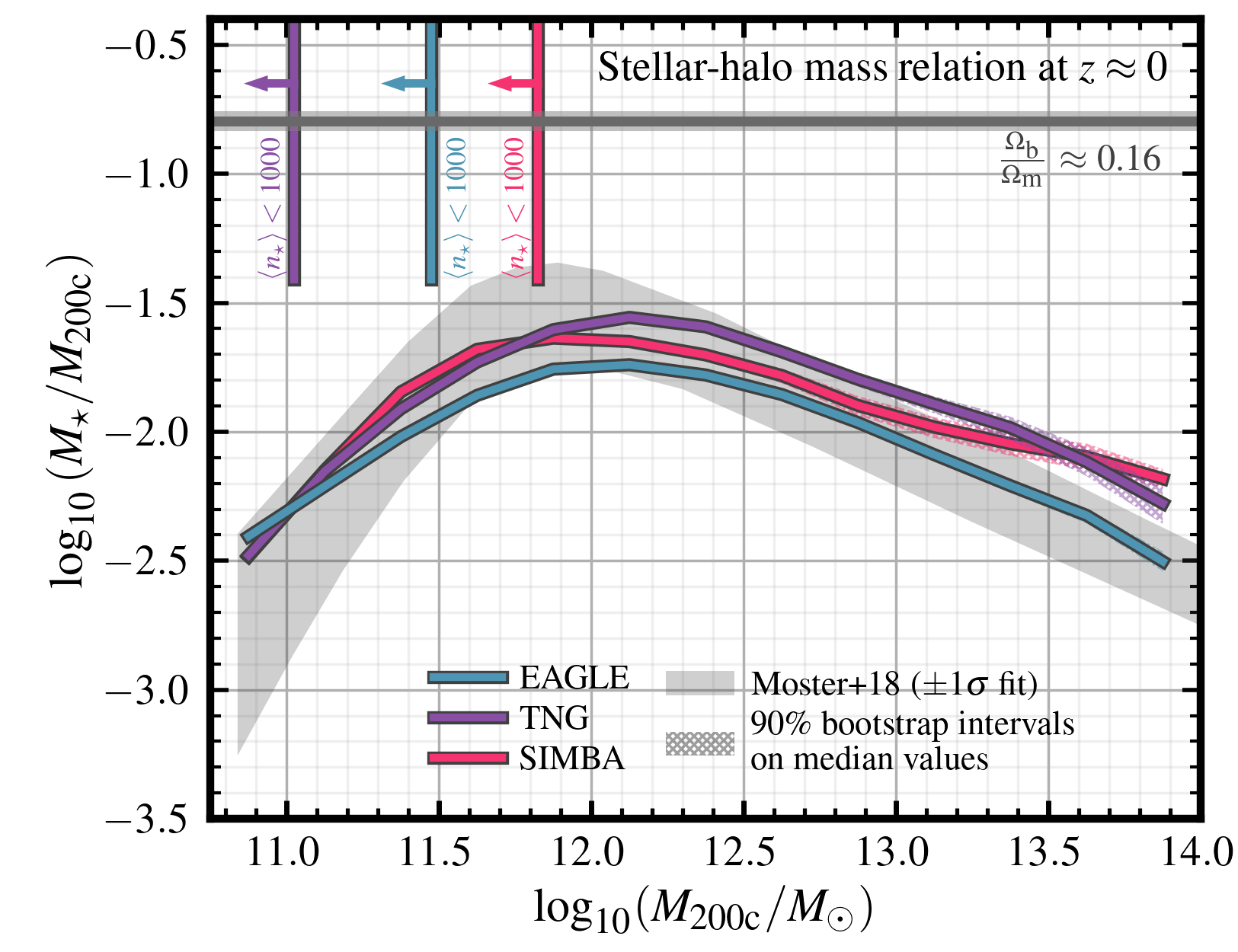
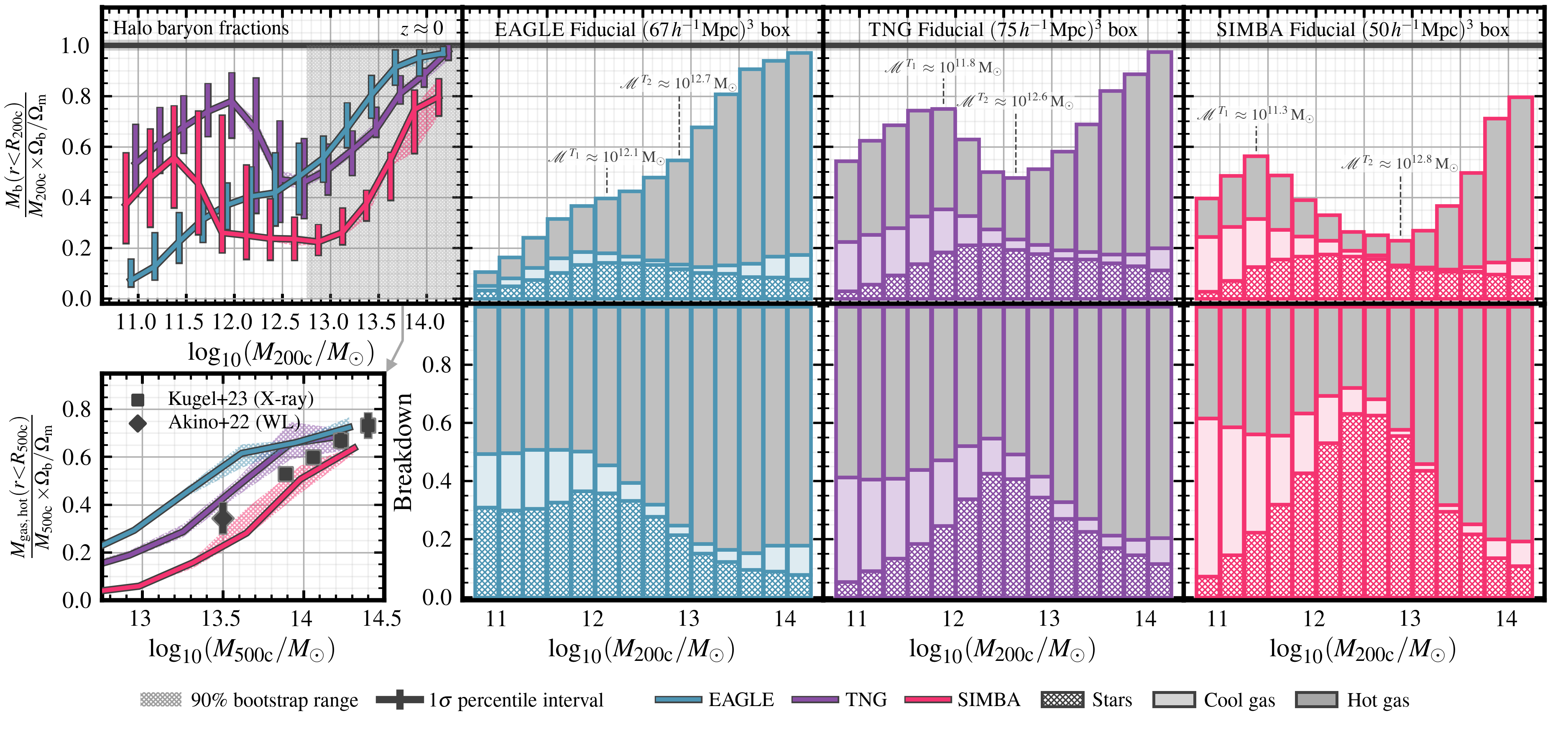
In recent years, cosmological hydrodynamical simulations have proven their utility as key interpretative tools in the study of galaxy formation and evolution. In this work, we present a like-for-like comparison between the baryon cycle in three publicly available, leading cosmological simulation suites: EAGLE, IllustrisTNG, and SIMBA. While these simulations broadly agree in terms of their predictions for the stellar mass content and star formation rates of galaxies at $z\approx0$, they achieve this result for markedly different reasons. In EAGLE and SIMBA, we demonstrate that at low halo masses ($M_{ m 200c}\lesssim 10^{11.5}\, M_{\odot}$), stellar feedback (SF)-driven outflows can reach far beyond the scale of the halo, extending up to $2-3 imes R_{ m 200c}$. In contrast, in TNG, SF-driven outflows, while stronger at the scale of the ISM, recycle within the CGM (within $R_{ m 200c}$). We find that AGN-driven outflows in SIMBA are notably potent, reaching several times $R_{ m 200c}$ even at halo masses up to $M_{ m 200c}\approx10^{13.5}\, M_{\odot}$. In both TNG and EAGLE, AGN feedback can eject gas beyond $R_{ m 200c}$ at this mass scale, but seldom beyond $2-3 imes R_{ m 200c}$. We find that the scale of feedback-driven outflows can be directly linked with the prevention of cosmological inflow, as well as the total baryon fraction of haloes within $R_{ m 200c}$. This work lays the foundation to develop targeted observational tests that can discriminate between feedback scenarios, and inform sub-grid feedback models in the next generation of simulations.
研究动机与目标
- 了解不同亚网格反馈实现如何影响现代模拟中的重子循环。
- 量化在晕质量范围内由恒星和AGN驱动的外流的空间尺度。
- 评估外流尺度如何影响晕中气体含量与重子保留。
- 为观测测试提供一个框架,以区分这些模拟中的反馈模型。
提出的方法
- 在 EAGLE、IllustrisTNG 和 SIMBA 中,使用围绕中心星系的球形壳的欧拉气体流动测量。
- 在 r = R 的壳以及宽 Δr=0.2R 的边界气元素中识别边界区域,按径向速度 класси inflows 和 outflows。
- 通过公式 ot{M}_{k}(r=R) = (1/Δr) sum_i (m_i v_{r,i}) 计算边界处的质量流量,其中 v_{r,i} 是径向速度分量。
- 通过 FOF + SUBFIND(EAGLE/TNG)或 ROCKSTAR(SIMBA)构建晕目录,以定义晕中心、质量和半径(R_{200c})。
- 比较在 R_{200c} 内的静态重子含量和不同模拟的相态分布,以解读流动测量。
- 在一致定义的基础上进行分析,以实现对反馈范式的同类比较。
实验结果
研究问题
- RQ1恒星与AGN驱动的外流在空间尺度和循环行为上在 EAGLE、IllustrisTNG 与 SIMBA 之间有何差异?
- RQ2反馈驱动外流的尺度与晕内宇宙学物质注入的抑制之间有什么关系?
- RQ3外流覆盖范围的差异对晕内总重子分数以及星系内的恒星、冷气体和热气体之间的分配有何影响?
- RQ4是否可以通过统一的观测框架来区分这些模拟中实现的反馈实现?
主要发现
- 在低晕质量(M200c ≲ 10^11.5 M⊙)下,EAGLE 和 SIMBA 的恒星驱动外流超出晕半径,达到 2-3 R200c。
- 在 IllustrisTNG 中,恒星驱动风在 ISM 尺度最强并在 CGM 内循环(在 R200c 内)。
- SIMBA 的AGN驱动外流极具强度,达到多倍于 R200c,直至晕质量 M200c ≈ 10^13.5 M⊙。
- 在 TNG 与 EAGLE 中,AGN 反馈可以在这些质量范围将气体排出至 R200c 之外,但很少超过 2-3 R200c。
- 反馈驱动外流的尺度直接与阻止宇宙学进 inflow 和在 R200c 内的总晕重子分数相关。
- 该研究为针对性的观测测试提供基础,以区分不同反馈情景,并为未来模拟的亚网格反馈模型提供指导。
更好的研究,从现在开始
从论文设计到论文写作,大幅缩短您的研究时间。
无需绑定信用卡
本解读由 AI 生成,并经人工编辑审核。