
[论文解读] The Brain Tumor Segmentation (BraTS) Challenge 2023: Focus on Pediatrics (CBTN-CONNECT-DIPGR-ASNR-MICCAI BraTS-PEDs)
本论文介绍 BraTS-PEDs 2023,首个 BraTS 儿科脑肿瘤分割基准,详细说明多机构基于 mpMRI 的儿科高等级胶质瘤分割的数据收集、地面真相注释、预处理和评估框架。它概述了参与、基线方法和评估流程。
Pediatric tumors of the central nervous system are the most common cause of cancer-related death in children. The five-year survival rate for high-grade gliomas in children is less than 20\%. Due to their rarity, the diagnosis of these entities is often delayed, their treatment is mainly based on historic treatment concepts, and clinical trials require multi-institutional collaborations. The MICCAI Brain Tumor Segmentation (BraTS) Challenge is a landmark community benchmark event with a successful history of 12 years of resource creation for the segmentation and analysis of adult glioma. Here we present the CBTN-CONNECT-DIPGR-ASNR-MICCAI BraTS-PEDs 2023 challenge, which represents the first BraTS challenge focused on pediatric brain tumors with data acquired across multiple international consortia dedicated to pediatric neuro-oncology and clinical trials. The BraTS-PEDs 2023 challenge focuses on benchmarking the development of volumentric segmentation algorithms for pediatric brain glioma through standardized quantitative performance evaluation metrics utilized across the BraTS 2023 cluster of challenges. Models gaining knowledge from the BraTS-PEDs multi-parametric structural MRI (mpMRI) training data will be evaluated on separate validation and unseen test mpMRI dataof high-grade pediatric glioma. The CBTN-CONNECT-DIPGR-ASNR-MICCAI BraTS-PEDs 2023 challenge brings together clinicians and AI/imaging scientists to lead to faster development of automated segmentation techniques that could benefit clinical trials, and ultimately the care of children with brain tumors.
研究动机与目标
- 提供一个回顾性的多机构儿科 mpMRI 高级别胶质瘤数据集(astrocytoma 和 DMG/DIPG)。
- 在标准化度量下对儿科脑肿瘤的体积分割算法进行基准测试。
- 通过将训练数据限定为 BraTS-PEDs 2023 数据并对未见数据进行评估的容器化提交,确保公平比较。
- 促进用于儿科临床试验和治疗计划的自动分割工具的快速开发。
提出的方法
- 汇集包含四个 mpMRI 序列(T1、T1CE、T2、T2-FLAIR)的儿科高等级胶质瘤回顾性多机构数据集。
- 对图像进行 DICOM-to-NIfTI 转换、与 SRI24 的共登记以及等方像素重采样(1 mm^3)。
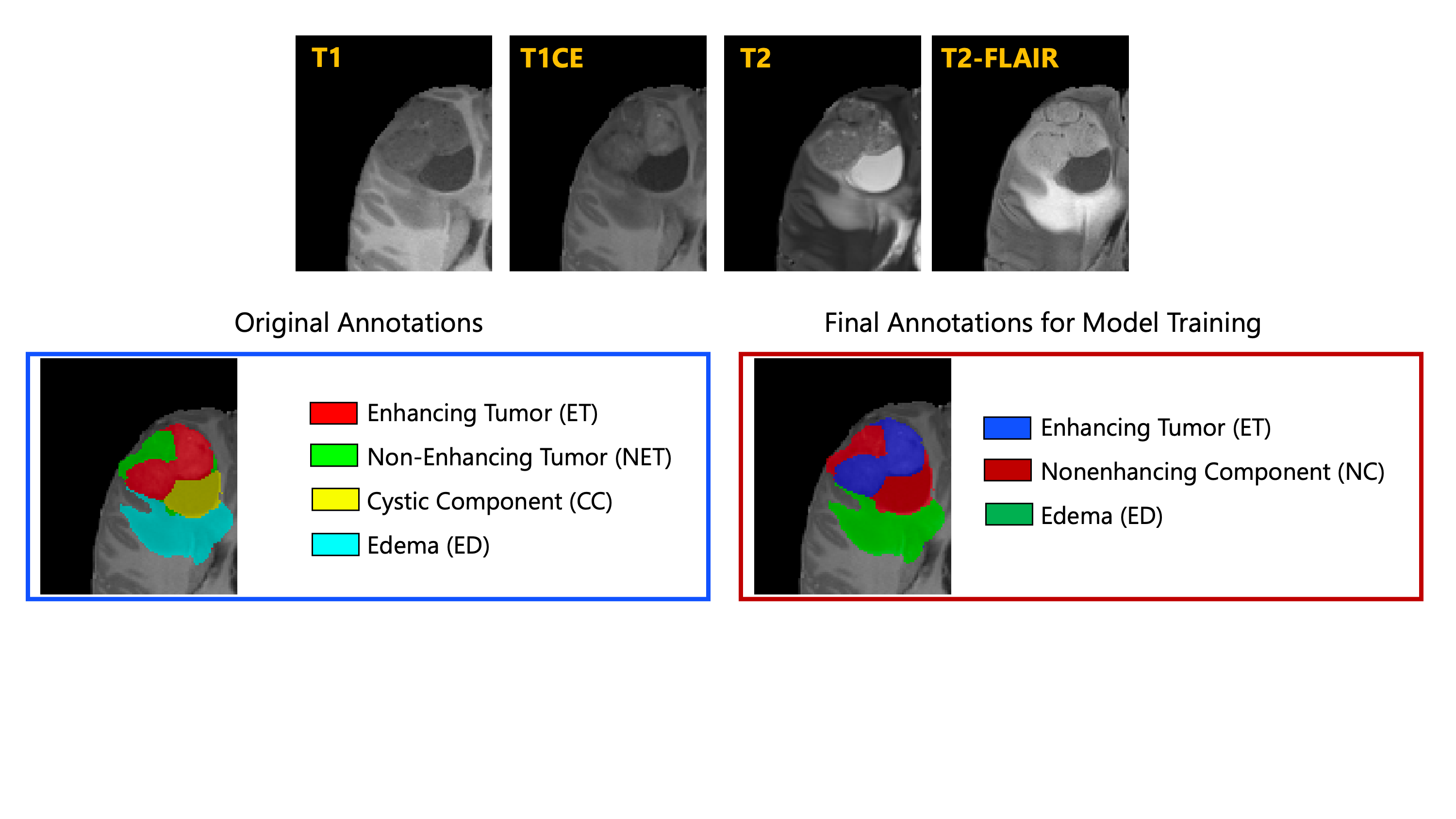
- 提供地面真相的肿瘤子区域标签(ET、NET/NC、CC、ED),由神经放射学专家和主治放射科医师精心完善。
- 为参与者提供用于标注的三个目标标签(ET、NC、ED),以及不用于评分的第四个子区域(CC),以帮助训练。
- 以 GaNDLF 作为参与者的基线框架,并通过 MLCube 和 MedPerf Synapse 平台实现容器化提交。
实验结果
研究问题
- RQ1儿童脑肿瘤子区域是否能够在多机构数据集上使用多参数 MRI 体积分割实现可靠分割?
- RQ2在 BraTS-PEDs 上训练的儿科肿瘤分割模型对跨中心的未见儿科数据的泛化能力有多好?
- RQ3使用儿科注释的地面真相与面向成人的注释对分割性能有何影响?
- RQ4将训练数据限定为 BraTS-PEDs 数据是否能够实现对参与者的公平、可重复的基准评估?
主要发现
- BraTS-PEDs 2023 建立了首个关注儿科的 BraTS 基准,具有多机构数据和地面真相注释。
- 数据集包含 228 例儿科高等级胶质瘤病例,含四个 mpMRI 序列并进行标准化预处理。
- 参与者在未见数据上对增强肿瘤(ET)、NC(增强/囊性/坏死)和全肿瘤(WT)区域进行评估。
- 评估依赖于通过 MedPerf 平台提交的容器化方法,以及在训练和验证阶段使用 CaPTk/FeTS 工具。
更好的研究,从现在开始
从论文设计到论文写作,大幅缩短您的研究时间。
无需绑定信用卡
本解读由 AI 生成,并经人工编辑审核。