
[论文解读] The Close AGN Reference Survey (CARS). A massive multi-phase outflow impacting the edge-on galaxy HE1353-1917
本研究利用甚大望远镜/MUSE、凯克望远镜/NIFS、ALMA 和 VLA 的多波段观测,调查了边缘朝向星系 HE1353-1917 中活动星系核驱动的外流。研究揭示了一道由低功率射电喷流驱动的快速、多相外流,速度高达 1000 km/s,且存在轻微的、局部的反馈效应,抑制了中心 1 kpc 范围内的恒星形成,凸显了即使在射电宁静活动星系核中,射电喷流在塑造星系演化中的作用。
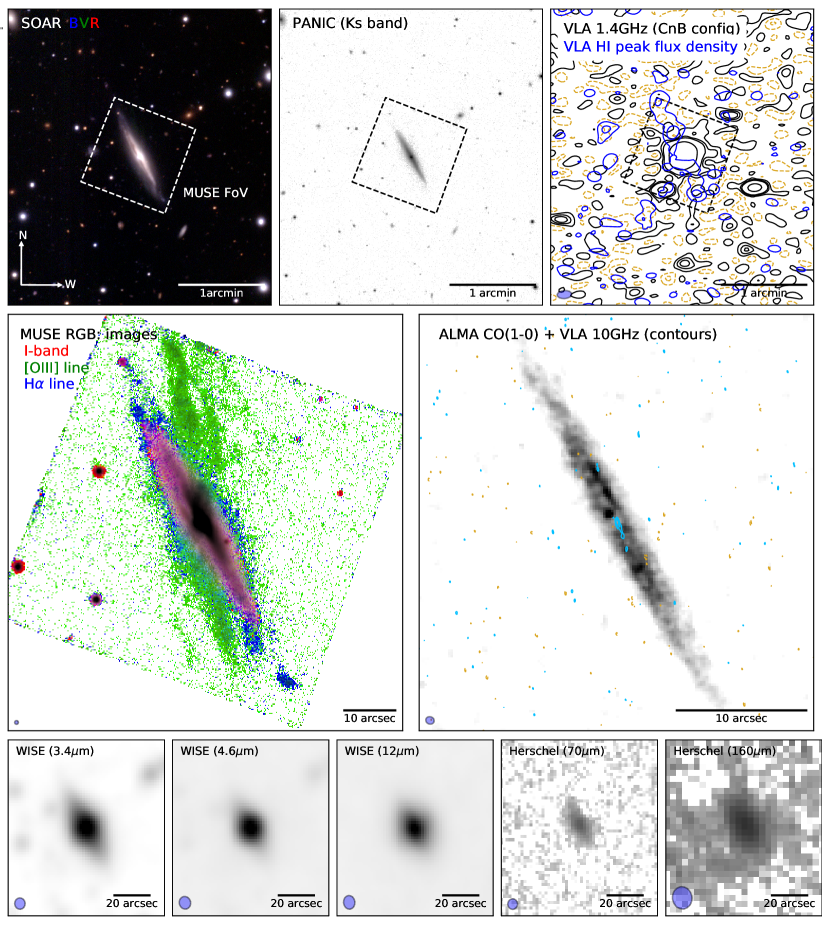
[Abridged] We combine extensive spatially-resolved multi-wavelength observations, taken as part of the Close AGN Reference Survey (CARS), for the edge-on disc galaxy HE1353-1917 to characterize the impact of the AGN on its host galaxy via outflows and radiation. Multi-color broad-band photometry is combined with spatially-resolved optical, NIR and sub-mm and radio observations taken with VLT/MUSE, Gemini-N/NIFS, ALMA and the VLA to map the physical properties and kinematics of the multi-phase inter-stellar medium (ISM). We detect a biconical extended narrow-line region (ENLR) ionized by the luminous AGN oriented nearly parallel to the galaxy disc, extending out to at least 25kpc. The extra-planar gas originates from galactic fountains initiated by star formation processes in the disc, rather than an AGN outflow, as shown by the kinematics and the metallicity of the gas. Nevertheless, a fast multi-phase AGN-driven outflow with speeds up to 1000km/s is detected close to the nucleus at 1kpc distance. A radio jet, in connection with the AGN radiation field, is likely responsible for driving the outflow as confirmed by the energetics and the spatial alignment of the jet and multi-phase outflow. Evidence for negative AGN feedback suppressing the star formation rate (SFR) is mild and restricted to the central kpc. But while any SFR suppression must have happened recently, the outflow has the potential to greatly impact the future evolution of the galaxy disc due to its geometrical orientation. Our observations reveal that low-power radio jets can play a major role in driving fast multi-phase galaxy-scale outflows even in radio-quiet AGN. Since the outflow energetics for HE1353-1917 are consistent with literature scaling relations of AGN-driven outflows the contribution of radio jets as the driving mechanisms still needs to be systematically explored.
研究动机与目标
- 通过在代表性、邻近的边缘朝向系统中研究多相外流,表征活动星系核反馈对星系演化的影响。
- 确定 HE1353-1917 中延伸电离气体外流的起源与驱动力机制,区分活动星系核驱动与恒星形成驱动的成分。
- 评估低功率射电喷流在驱动快速、星系尺度外流中的作用,特别是在射电宁静活动星系核中。
- 评估活动星系核反馈在抑制宿主星系恒星形成方面的范围与能量重要性。
- 检验该系统中外流的能量学是否符合既有的活动星系核驱动外流的标度关系。
提出的方法
- 结合来自甚大望远镜/MUSE、凯克望远镜/NIFS、ALMA 和 VLA 的空间分辨光学、近红外、亚毫米波与射电数据,绘制星际介质的运动学与物理条件。
- 利用发射线轮廓(例如 [O III] λ5007)识别蓝移成分,指示电离气体的外流。
- 通过分析金属丰度梯度与运动学结构,区分来自恒星形成的星系喷泉气体与活动星系核驱动的外流。
- 评估射电喷流与多相外流之间的对齐程度,以推断因果关系。
- 通过质量与速度测量估算外流能量学,并与理论标度关系进行比较。
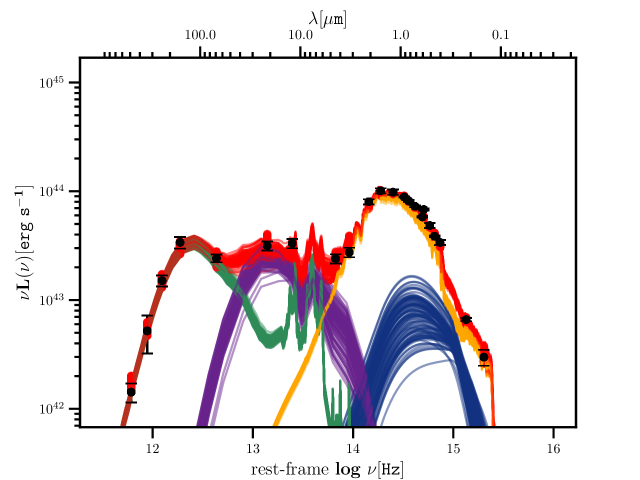
- 应用孔径测光与谱谱能量分布建模,推导恒星形成率与活动星系核光度。
实验结果
研究问题
- RQ1HE1353-1917 中的延伸窄线区(ENLR)的起源是什么——是活动星系核驱动的外流,还是恒星形成引发的星系喷泉?
- RQ2在核心 1 kpc 处检测到的快速多相外流由什么驱动——射电喷流、辐射压力,还是热膨胀?
- RQ3活动星系核反馈在多大程度上抑制了宿主星系的恒星形成,这种效应在多大的空间尺度上被观测到?
- RQ4观测到的外流能量学与既有的活动星系核驱动外流标度关系相比如何?
- RQ5在射电宁静活动星系核中,低功率射电喷流是否能显著影响星系尺度的外流与反馈过程?
主要发现
- 一个双锥形的延伸窄线区(ENLR)至少延伸至 25 kpc,由明亮的活动星系核电离,其取向几乎与星系盘平行。
- 星系盘外的电离气体起源于由恒星形成驱动的星系喷泉,而非活动星系核,这一结论得到与盘起源气体一致的运动学与金属丰度的证实。
- 在核心 1 kpc 范围内检测到速度高达 1000 km/s 的快速多相外流,其由与外流结构对齐的射电喷流驱动。
- 射电喷流是最可能的外流驱动力,其空间对齐与能量学特征与活动星系核反馈机制一致。
- 存在活动星系核负反馈抑制恒星形成的证据,但其影响轻微且局限于中心 1 kpc,表明为近期但局部的抑制。
- 尽管当前影响有限,但外流的几何形态与能量学表明,其具有显著影响星系盘未来演化的潜力。
更好的研究,从现在开始
从阅读论文到最终审阅,大幅缩短您的研究时间。
无需绑定信用卡
本解读由 AI 生成,并经人工编辑审核。