
[论文解读] The Commensal Real-time ASKAP Fast Transient incoherent-sum survey
该论文报道了通过对ASKAP天线强度的非相干求和,在CRAFT/ICS观测中检测到的43个FRB,其中对许多事件给出亚角秒级定位和主导识别,并概述了仪器、方法及科学含义。
With wide-field phased array feed technology,the Australian Square Kilometre Array Pathfinder (ASKAP) is ideally suited to search for seemingly rare radio transient sources that are difficult to discover previous-generation narrow-field telescopes. The Commensal Real-time ASKAP Fast Transient (CRAFT) Survey Science Project has developed instrumentation to continuously search for fast radio transients (duration < 1 second) with ASKAP, with a particular focus on finding and localising Fast Radio Bursts (FRBs). Since 2018, the CRAFT survey has been searching for FRBs and other fast transients by incoherently adding the intensities received by individual ASKAP antennas, and then correcting for the impact of frequency dispersion on these short-duration signals in the resultant incoherent sum (ICS) in real-time. This low-latency detection enables the triggering of voltage buffers, which facilitates the localisation of the transient source and the study of spectro-polarimetric properties at high time resolution. Here we report the sample of 43 FRBs discovered in this CRAFT/ICS survey to date. This includes 22 FRBs that had not previously been reported: 16 FRBs localised by ASKAP to < 1 arcsec and 6 FRBs localised to ~ 10 arcmin. Of the new arcsecond-localised FRBs, we have identified and characterised host galaxies (and measured redshifts) for 11. The median of all 30 measured host redshifts from the survey to date is z=0.23. We summarise results from the searches, in particular those contributing to our understanding of the burst progenitors and emission mechanisms, and on the use of bursts as probes of intervening media. We conclude by foreshadowing future FRB surveys with ASKAP using a coherent detection system that is currently being commissioned. This will increase the burst detection rate by a factor of approximately ten and also the distance to which ASKAP can localise FRBs.
研究动机与目标
- Explain the design and capabilities of the CRAFT/ICS FRB search system on ASKAP.
- Demonstrate real-time, low-latency FRB detection using incoherent summation of antenna intensities.
- Localise FRBs to arcsecond scales and identify host galaxies and redshifts.
- Assess survey performance and implications for FRB progenitors and intervening media.
- Outline future transitions to coherent detection for higher rate and localisation accuracy.
提出的方法
- Incoherently sum intensities from all ASKAP beams and antennas after dispersion-correcting short-duration signals in real time.
- Use the FREDDA GPU-based dispersion measure transform to detect FRB candidates across beams.
- Apply density-based clustering to group real-time candidates and distinguish FRBs from RFI.
- Trigger and download 3.1 s voltage buffers for high-resolution post-detection analysis and localisation.
- Employ the CELEBI pipeline to process voltage data for high time resolution spectro-polarimetric products.
- Utilise PATH formalism to associate FRBs with host galaxies using localisation regions and candidate galaxy magnitudes.
实验结果
研究问题
- RQ1如何评估ICS非相干求和方法在ASKAP条件下进行实时FRB检测与定位的有效性?
- RQ2在ICS和电压缓冲触发下,ASKAP检测到的FRB的定位精度可达到何种程度?
- RQ3检测到的FRBs与哪些宿主星系及红移分布相关,这对FRB的起源和环境意味着什么?
- RQ4调查的性能(探测率、DM范围、通量)与以往FRB调查相比如何,对未来的相干探测有何意义?
- RQ5从非相干到相干FRB探测系统的转变有哪些局限性与未来改进方向?
主要发现
- 到目前为止,CRAFT/ICS调查已检测到43个独立FRB,其中包括22个此前未报道的新事件。
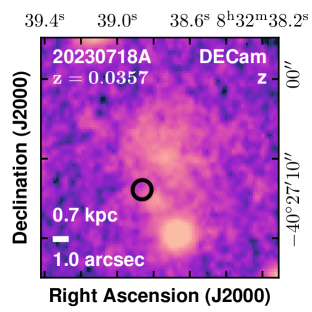
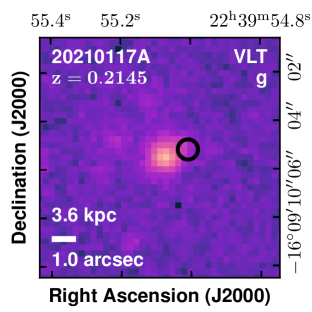
- 在新近亚角秒定位的FRB中,已识别并表征了11个主星系并具测量的红移。
- 样本中所有测得宿主的中位红shift为z = 0.23。
- bursts表现出从206到1780 pc cm-3的色散度量和从10到120 Jy ms的流量。
- 大约有30个FRB宿主星系已被识别,许多事件的位置测得亚角秒级精度。
- 该调查证明了实时、伴随式FRB搜索的可行性与科学价值,并为未来的相干探测升级奠定基础。
更好的研究,从现在开始
从论文设计到论文写作,大幅缩短您的研究时间。
无需绑定信用卡
本解读由 AI 生成,并经人工编辑审核。