
[论文解读] The discrete direct deconvolution model in the large eddy simulation of turbulence
本文提出了一种用于湍流大涡模拟(LES)的离散直接反卷积模型(D3M),通过离散近似逆高斯滤波器来重构亚网格尺度(SFS)应力。D3M-1 和 D3M-2 在相关系数方面优于动态Smagorinsky(DSM)和动态混合模型(DMM),相对误差更低,能够准确预测湍流混合层中的湍流统计量和空间结构。
The discrete direct deconvolution model (D3M) is developed for the large-eddy simulation (LES) of turbulence. The D3M is a discrete approximation of previous direct deconvolution model studied by Chang et al. ["The effect of sub-filter scale dynamics in large eddy simulation of turbulence," Phys. Fluids 34, 095104 (2022)]. For the first type model D3M-1, the original Gaussian filter is approximated by local discrete formulation of different orders, and direct inverse of the discrete filter is applied to reconstruct the unfiltered flow field. The inverse of original Gaussian filter can be also approximated by local discrete formulation, leading to a fully local model D3M-2. Compared to traditional models including the dynamic Smagorinsky model (DSM) and the dynamic mixed model (DMM), the D3M-1 and D3M-2 exhibit much larger correlation coefficients and smaller relative errors in the a priori studies. In the a posteriori validations, both D3M-1 and D3M-2 can accurately predict turbulence statistics, including velocity spectra, probability density functions (PDFs) of sub-filter scale (SFS) stresses and SFS energy flux, as well as time-evolving kinetic energy spectra, momentum thickness, and Reynolds stresses in turbulent mixing layer. Moreover, the proposed model can also well capture spatial structures of the Q-criterion iso surfaces. Thus, the D3M holds potential as an effective SFS modeling approach in turbulence simulations.
研究动机与目标
- 开发一种离散的、完全局部的替代方法,用于湍流大涡模拟(LES)中的连续直接反卷积模型。
- 通过使用局部离散格式近似高斯滤波器的逆,改进亚网格尺度(SFS)应力的重构。
- 在先验和后验研究中,评估所提出的D3M模型与现有动态模型(DSM和DMM)的性能表现。
- 在复杂流动(如湍流混合层)中,实现对湍流统计量(包括速度能谱、SFS能量通量和雷诺应力)的准确预测。
- 展示模型在捕捉湍流中相干空间结构(如Q准则等值面)方面的能力。
提出的方法
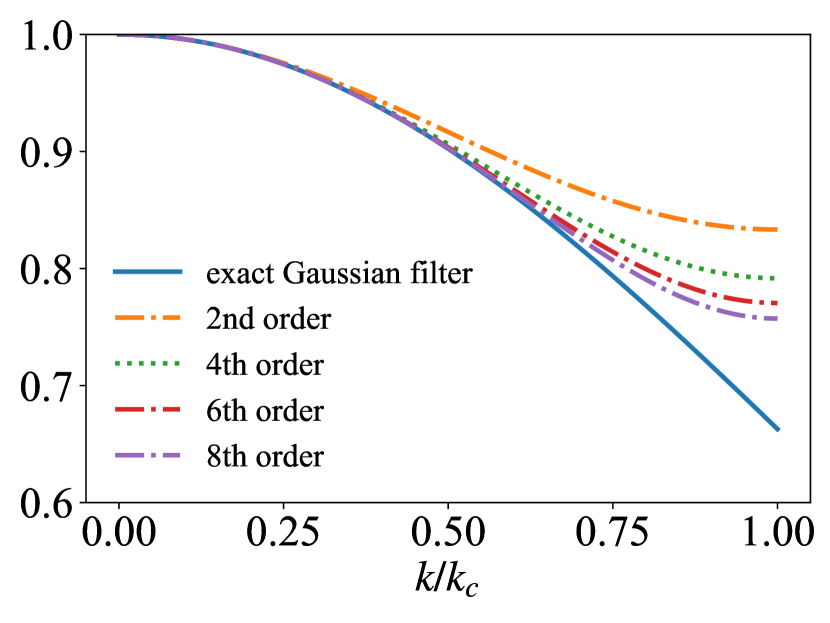
- D3M-1 使用局部离散格式近似原始高斯滤波器,并应用该离散滤波器的直接逆,以重构未过滤的流场。
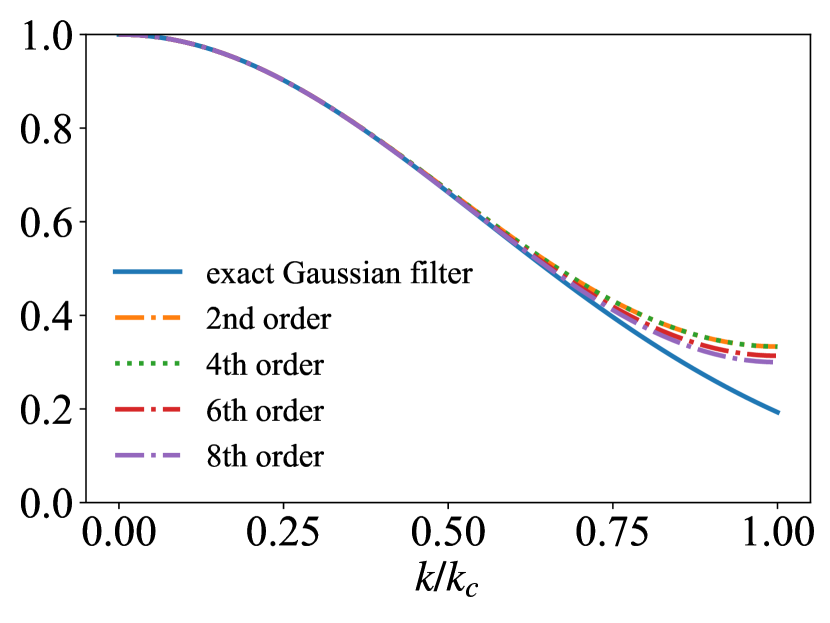
- D3M-2 进一部使用局部离散格式近似原始高斯滤波器的逆,从而实现完全局部的模型,无需全局运算。
- 离散滤波器及其逆通过类似有限差分的模板构建,实现在物理空间中的高效且局部的计算。
- 通过使用谱方法和2/3去混叠技术,对湍流混合层模拟进行先验和后验测试以验证模型。
- DSM和DMM中的动态模型系数通过在多个尺度上对测试滤波场进行最小二乘法最小化计算得出。
- 该框架采用伪谱方法高效计算卷积和非线性项,通过逆傅里叶变换返回物理空间。
实验结果
研究问题
- RQ1离散的、局部的直接反卷积模型近似是否能在重构亚网格尺度应力方面优于传统的动态SFS模型?
- RQ2在先验评估中,D3M-1和D3M-2的相关系数和相对误差与DSM和DMM相比如何?
- RQ3D3M在多大程度上能准确预测关键湍流统计量,如速度能谱、SFS应力的PDF以及SFS能量通量?
- RQ4D3M模型能否在湍流混合层中解析复杂的空间结构,如Q准则等值面?
- RQ5D3M-2的完全局部化结构是否在提升计算效率的同时保持了与非局部或连续反卷积方法相当的精度?
主要发现
- 在先验研究中,D3M-1和D3M-2的相关系数显著更高,相对误差更低,表明其在SFS应力重构方面优于DSM和DMM。
- 在后验模拟中,两种D3M模型均能准确预测湍流混合层中的速度能谱、SFS应力的概率密度函数(PDF)以及SFS能量通量。
- 模型能够高保真地捕捉随时间演化的动能能谱、动量厚度和雷诺应力。
- D3M-2 展现出解析Q准则等值面空间结构的能力,表明其能准确表征相干湍流涡旋。
- D3M-2 的离散且完全局部的特性使其在保持与非局部或连续反卷积模型相当精度的同时,实现了高效的计算。
- 结果证实,D3M是大涡模拟中亚网格尺度建模的一种有前景且高效的方法。
更好的研究,从现在开始
从阅读论文到最终审阅,大幅缩短您的研究时间。
无需绑定信用卡
本解读由 AI 生成,并经人工编辑审核。