
[论文解读] The dust enrichment of early galaxies in the JWST and ALMA era
该研究使用 delphi 半解析模型,具有两个随红shift与质量无关的参数,预测高红移星系在 z~20 之前的紫外和红外(UV/FIR)性质,强调尘埃效应、紫外可见性和 FIR 演化。
Recent observations with the James Webb Space Telescope are yielding tantalizing hints of an early population of massive, bright galaxies at $z > 10$, with Atacama Large Millimeter Array (ALMA) observations indicating significant dust masses as early as $z\sim 7$. To understand the implications of these observations, we use the DELPHI semi-analytic model that jointly tracks the assembly of dark matter halos and their baryons, including the key processes of dust enrichment. Our model employs only two redshift- and mass-independent free parameters (the maximum star-formation efficiency and the fraction of supernova energy that couples to gas) that are tuned against all available galaxy data at $z \sim 5-9$ before it is used to make predictions up to $z \sim 20$. Our key results are: (i) the model under-predicts the observed ultraviolet luminosity function (UV LF) at $z > 12$; observations at $z>16$ lie close to, or even above, a "maximal" model where all available gas is turned into stars; (ii) UV selection would miss 34\% of the star formation rate density at $z \sim 5$, decreasing to 17\% by $z \sim 10$ for bright galaxies with $ m{M_{UV}} < -19$; (iii) the dust mass ($M_d$) evolves with the stellar mass ($M_*$) and redshift as $\log(M_d) = 1.194\log(M_*) + 0.0975z - 5.433$; (iv) the dust temperature increases with stellar mass, ranging between $30-33$ K for $M_* \sim 10^{9-11}M_\odot$ galaxies at $z \sim 7$. Finally, we predict the far infrared LF at $z \sim 5-20$, testable with ALMA observations, and caution that spectroscopic redshifts and dust masses must be pinned down before invoking unphysical extrema in galaxy formation models.
研究动机与目标
- 理解尘埃富集及其对 JWST 与 ALMA 时代早期星系可观测性影响的动力学与动机。
- 预测高红移星系的 UV 与 FIR 光度,以及尘埃对紫外光的衰减。
- 把尘埃质量与温度与恒星质量和红shift 联系起来,为 FIR 光度函数提供信息。
- 将模型预测与从 z~5 到 z~20 的 UV 光度函数、恒星质量函数和宇宙 SFR 密度进行对比测试。
提出的方法
- 采用 delphi 半解析模型,跟踪暗物质晕的聚合和含尘物质的演化。
- 使用两个随红shift与质量无关的自由参数:最大恒星形成效率 f_* 与超新星能量耦合分数 f_w,基于 z~5-9 的数据进行标定。
- 通过耦合的金属与尘埃微分方程(含生长与破坏)计算气体吸积、恒星形成、SN 反馈与尘埃演化。
- 通过 BPASS 恒星族群生成内在 UV 光度,并使用带尘埃光学厚度与 M_d、r_d 相关的板状几何模型应用尘埃衰减。
- 执行能量平衡以推导 FIR 光度并从 L_FIR 与 M_d 推估尘埃温度,考虑高 z 时的背景辐射(CMB)影响。
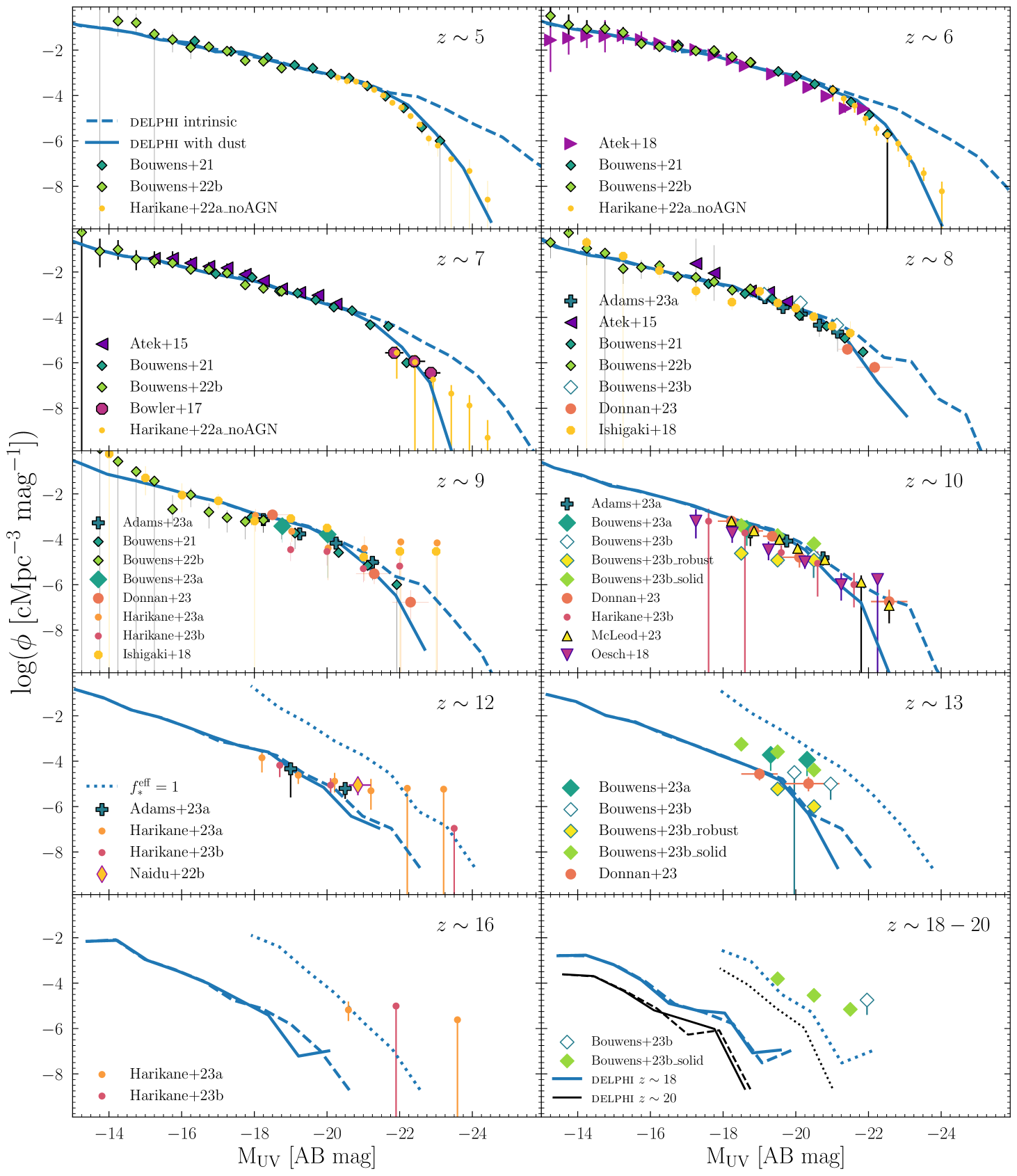
实验结果
研究问题
- RQ1尘埃富集如何影响紫外光 luminosity 函数及高红移星系在 z~20 的紫外可见性?
- RQ2在早期星系中,尘埃质量、恒星质量、恒星形成与红shift之间的关系,以及它们对 FIR 发射的影响?
- RQ3模型是否能再现从 z~5 到 z~9 的观测 UV 与恒星质量函数,并预测 z~5-20 的 FIR 光度函数?
- RQ4由于尘埃衰减,UV 选择会错过多少星形成分数,特别是对明亮星系?
- RQ5尘埃温度与 UV逃逸分数如何随星系质量与红shift 演化?
主要发现
- 模型在 z>12 的 UV LF 预测偏低;在 z>16 时观测数据接近具有高恒星形成效率的最大模型。
- 在 z~5 时,对于明亮星系(M_UV<-19),UV 选择会错过 34% 的 SFR 密度,至 z~10 降至 17%。
- 尘埃质量与恒星质量及红shift 的关系为 log(M_d)=1.194 log(M_*)+0.0975 z-5.433。
- 在 z~7 时,M_* 约为 10^9-10^11 M_sun 的星系,尘埃温度约在 ~30-33 K,并随恒星质量增加而升高。
- 模型预测 FIR 光度并可约束 z~5-20 的远红外 LF,但需谨慎对待光谱红shift 与尘埃质量确定问题。
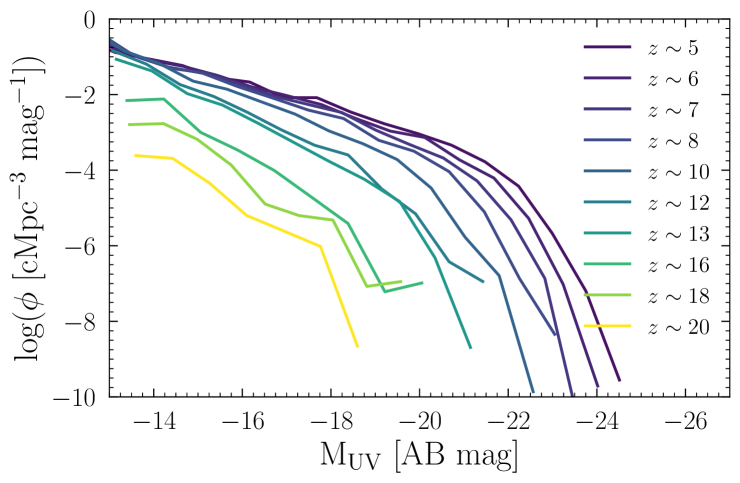
- UV LF 的演化表明尘埃影响在 z~5-10 的较 faint/moderate 光度段开始显现,而对于 brightest 系统在 z>12 时可忽略尘埃影响。
更好的研究,从现在开始
从论文设计到论文写作,大幅缩短您的研究时间。
无需绑定信用卡
本解读由 AI 生成,并经人工编辑审核。