
[论文解读] The Effect of Thermal Torques on AGN Disc Migration Traps and Gravitational Wave Populations
本文分析了AGN盘中的热力矩如何为恒星质量黑洞创建迁移陷阱,从而改变迁移、EMRI供给以及LVK GW种群。
Accretion discs in active galactic nuclei (AGN) foster black hole (BH) formation, growth, and mergers. Stellar mass BHs migrate inwards under the influence of hydrodynamical torques unless they encounter a region where the torque flips sign. At these migration traps, BHs accumulate and merge via dynamical or gas-assisted interactions, producing high-frequency LIGO/Virgo/KAGRA (LVK) gravitational wave (GW) sources and potentially cutting off the supply of extreme mass ratio inspirals that would otherwise make low-frequency, {\it LISA}-band GWs. In this paper, we study the interplay between different types of migration torques, focusing especially on the ``thermal torques'' generated by the thermal response of the AGN to embedded stellar-mass BHs that accrete through their own mini-discs.In contrast to previous work, we find that Type I torques cannot produce migration traps on their own, but thermal torques often do, particularly in low-mass AGN. The migration traps produced by thermal torques exist at much larger radii ($\sim 10^{3-5}$ gravitational radii) than do previously identified Type I traps, carrying implications for GW populations at multiple frequencies. Finally, we identify a bifurcation of AGN discs into two regimes: migration traps exist below a critical AGN luminosity, and do not at higher luminosities. This critical luminosity is fit as $\log_{10} L_{ m AGN}^c = 45 - 0.32 \log_{10}{(α/0.01)}$ where $α$ is the AGN alpha viscosity parameter, a range compatible with recent claims that LVK GWs are not preferentially associated with high-luminosity AGN.
研究动机与目标
- 评估热力矩对AGN盘中黑洞迁移的影响。
- 确定在何种条件下会形成或消失迁移陷阱。
- 识别迁移陷阱对引力波源种群(LVK和EMRI)的影响。
- 探讨对AGN光度和盘参数(α、dot{m}、MBH质量)的依赖性。
提出的方法
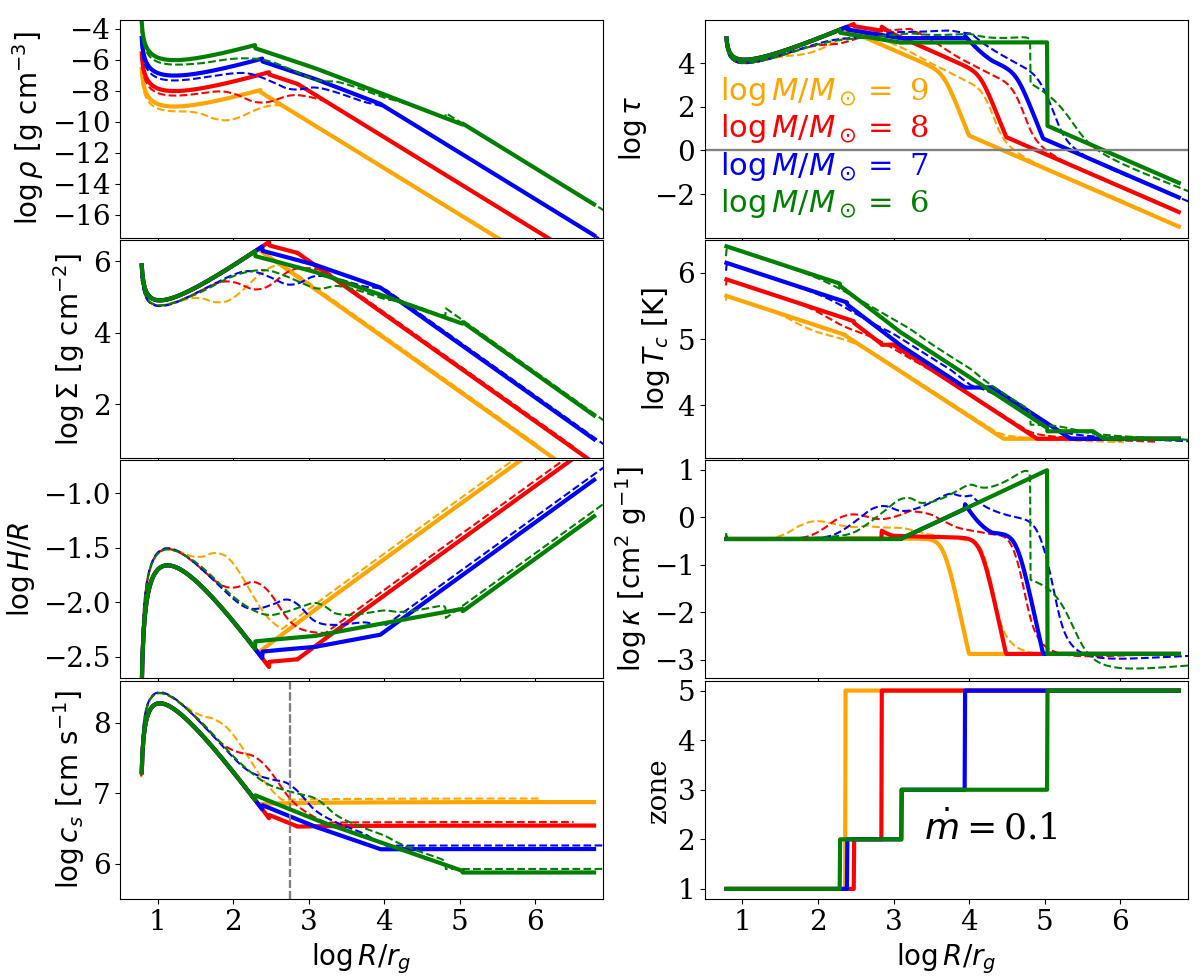
- 构建一个带有多区和不同比例光学厚度的类似Shakura–Sunyaev的AGN盘模型。
- 使用最近的标定(Paardekooper et al. 2010; Jiménez & Masset 2017)推导更新的Type I迁移矩 torques,并与热力矩贡献进行比较。
- 结合Mass et al. (2017) 热力矩公式,包括临界光度L_c和涡腔扩散尺度λ。
- 通过在不同盘参数和MBH质量下求和Type I与热力矩来计算净力矩。
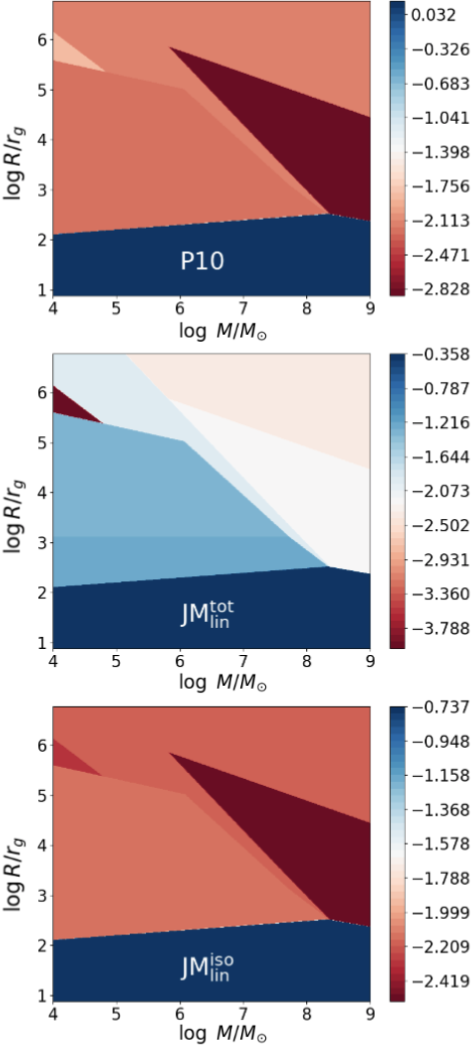
- 识别总力矩符号改变的区域以定位迁移陷阱和反陷阱。
- 分析陷阱的存在如何依赖MBH质量和AGN光度,从而给出临界光度关系。
实验结果
研究问题
- RQ1热力矩是否在AGN盘中主导Type I力矩,在何种条件下它们会产生迁移陷阱?
- RQ2迁移陷阱的位置如何依赖MBH质量、盘黏度α、吸积率dot{m}和AGN光度?
- RQ3盘中是否存在由光度驱动的分叉,在陷阱存在或消失的区域?
- RQ4迁移陷阱对LVK BH并合以及LISA频段EMRI种群有何影响?
主要发现
- 热力矩在很多情况下主导标准Type I力矩,尤其在低质量AGN盘中,甚至在Type I单独无法产生陷阱时也能产生迁移陷阱。
- 由于热力矩引起的迁移陷阱出现在比经典Type I陷阱更大半径的位置(大约10^3–10^5 个重力半径)。
- 在AGN盘中存在一个分岔:迁移陷阱在临界AGN光度以下存在,在更高光度时不出现。
- 临界光度大致可表示为log10 L_AGN^c = 45 - 0.32 log10(α/0.01)。
- 较低MBH质量的盘更易受热力矩推动向外迁移,这影响超大质量黑洞双星环境与GW源种群。
- 结果与LVK GW事件并非偏好与高光度AGN相关的说法一致。
更好的研究,从现在开始
从论文设计到论文写作,大幅缩短您的研究时间。
无需绑定信用卡
本解读由 AI 生成,并经人工编辑审核。