
[论文解读] The Evolution of U.S. Retail Concentration
这篇论文使用新颖的 Census CRT 数据(1992–2012)显示本地和全国零售集中度同步上升,主要由跨市场扩张的多市场零售商推动,对利润率具有显著影响。
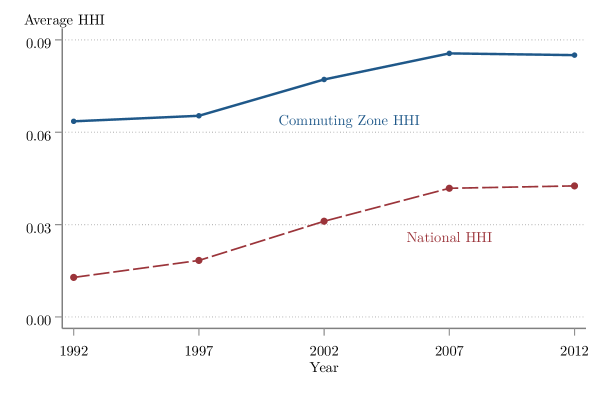
Increases in national concentration have been a salient feature of industry dynamics in the U.S. and have contributed to concerns about increasing market power. Yet, local trends may be more informative about market power, particularly in the retail sector where consumers have traditionally shopped at nearby stores. We find that local concentration has increased almost in parallel with national concentration using novel Census data on product-level revenue for all U.S. retail stores between 1992 and 2012. The increases in concentration are broad based, affecting most markets, products, and retail industries. We show that the expansion of multi-market firms into new markets explains most of the increase in national retail concentration, with consolidation via increases in local market shares increasing in importance between 1997 and 2007, and single-market firms playing a negligible role. Finally, we find that increases in local concentration can explain one-quarter to one-third of the observed rise in retail gross margins.
研究动机与目标
- 调查美国全国与本地零售集中度的趋势。
- 区分产品层面与行业层面的集中度及其含义。
- 评估多市场零售商相对于单市场公司的作用在推动集中度中的角色。
- 检验在线/非店铺零售商对本地集中度和利润率的潜在影响。
提出的方法
- 使用 Census of Retail Trade 数据(1992–2012)构建所有美国门店的店级产品类别收入。
- 为产品市场和行业层面市场计算本地( commuting zone )和全国的 HHI 指标。
- 将门店销售分配给产品市场以处理跨行业竞争与多产品商店。
- 将 national concentration 分解为本地和跨市场组成部分以评估驱动因素。
- 纳入非店铺零售商的边界以评估其对集中度的影响。
- 比较随时间推移的基于产品与基于行业的集中度结果。
实验结果
研究问题
- RQ11992 年至 2012 年本地(commuting zone)与全国零售集中度的趋势是什么?
- RQ2多市场零售商在解释全国集中度上升方面的作用在多大程度上超过单市场公司?
- RQ3产品层面的集中度趋势与行业层面的集中度在零售领域内的比较如何?
- RQ4在线及其他非店铺零售商在塑造本地集中度和利润率方面的作用是什么?
主要发现
- 全国零售集中度在 1992 和 2012 之间从 0.013 增至 0.043,而本地 commuting-zone 集中度从 6.4 增至 8.6。
- 集中度的提升在大多数市场、产品和零售行业广泛存在。
- 多市场零售商的扩张与整合占全国集中度上升(1992–2012)的 89 百分比。
- 单一市场企业由于在众多市场中的分散,对全国集中度影响甚微。
- 本地集中度的上升可以解释在 1993–2012 年观察到的零售毛利率上升的约四分之一到三分之一。
更好的研究,从现在开始
从论文设计到论文写作,大幅缩短您的研究时间。
无需绑定信用卡
本解读由 AI 生成,并经人工编辑审核。