
[论文解读] The extended "stellar halo" of the Ursa Minor dwarf galaxy
本研究利用盖亚 EDR3 数据,在大熊座矮星系的极端外围区域识别出五颗超 faint 恒星——最远可达 12 个半光半径——并通过 GRACES 光谱仪获得的高精度径向速度和金属量确认了其成员身份。详细化学丰度分析揭示了来自核心塌缩超新星、AGB 恒星和 Ia 型超新星的贡献,支持潮汐剥离是其延伸恒星晕形成的起源。
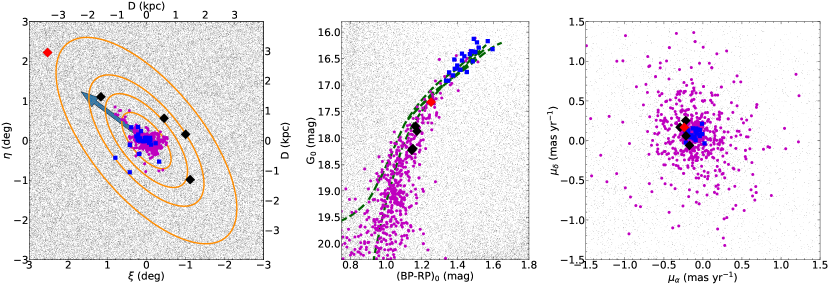
Stellar candidates in the Ursa Minor (UMi) dwarf galaxy have been found using a new Bayesian algorithm applied to extit{Gaia} EDR3 data. Five of these targets are located in the extreme outskirts of UMi, from $\sim5$ to 12 elliptical half-light radii (r$_h$), where r$_h$(UMi) $= 17.32 \pm 0.11$ arcmin, and have been observed with the GRACES high resolution spectrograph at the Gemini-Northern telescope. Precise radial velocities ($σ_{ m{RV}} < 2$ km s$^{-1}$) and metallicities ($σ_{ m{[Fe/H]}} < 0.2$ dex) confirm their memberships of UMi. Detailed analysis of the brightest and outermost star (Target~1, at $\sim12$ r$_h$), yields precision chemical abundances for the $α$- (Mg, Ca, Ti), odd-Z (Na, K, Sc), Fe-peak (Fe, Ni, Cr), and neutron-capture (Ba) elements. With data from the literature and APOGEE DR17, we find the chemical patterns in UMi are consistent with an outside-in star formation history that includes yields from core collapse supernovae, asymptotic giant branch stars, and supernovae Ia. Evidence for a knee in the [$α$/Fe] ratios near [Fe/H] $\sim-2.1$ indicates a low star formation efficiency similar to that in other dwarf galaxies. Detailed analysis of the surface number density profile shows evidence that UMi's outskirts have been populated by tidal effects, likely as a result of completing multiple orbits around the Galaxy.
研究动机与目标
- 识别并确认大熊座矮星系外区极远距离恒星的成员身份。
- 研究大熊座矮星系延伸恒星晕的起源,特别是其是否源于潮汐剥离或并合事件。
- 确定大熊座矮星系最远恒星的化学组成,以推断其形成历史与演化过程。
- 评估最外层恒星的化学模式是否与原位形成或外部吸积一致。
提出的方法
- 应用一种新型贝叶斯算法处理盖亚 EDR3 的天体测量与测光数据,以识别大熊座矮星系极端外围的恒星候选体。
- 利用基特峰-北望远镜上的 GRACES 仪器进行高分辨率光谱观测,测量精确的径向速度(σ < 2 km s⁻¹)与金属量(σ < 0.2 dex)。
- 对位于 ~12 rₕ 处最外层恒星(目标 1)的 α-、奇 Z-、铁峰及中子俘获元素进行详细的化学丰度分析。
- 将化学模式与文献数据及 APOGEE DR17 进行比较,以模拟恒星形成与元素增益历史。
- 分析表面数密度分布函数,评估潮汐效应在填充外区中的作用。
- 采用包含核心塌缩超新星、AGB 恒星与 Ia 型超新星产额的化学演化模型,以解释观测到的丰度趋势。
实验结果
研究问题
- RQ1大熊座矮星系中这些超远距离恒星是否与该星系物理关联,还是场星污染?
- RQ2从其最外层恒星的化学丰度推断,大熊座矮星系的恒星形成历史如何?
- RQ3最外层恒星的化学模式是否支持来自多种超新星类型贡献的由外而内形成情景?
- RQ4观测到的 [α/Fe] 膝点位于 [Fe/H] ≈ -2.1 处,是否与低恒星形成效率一致,如其他矮星系所见?
- RQ5与银河系的潮汐相互作用在多大程度上塑造了大熊座矮星系的延伸恒星晕?
主要发现
- 五颗恒星被确认为大熊座矮星系成员,距离范围为 5 至 12 个半光半径(rₕ ≈ 17.32 弧分),将已知恒星分布扩展至核心区域之外。
- 最外层恒星(目标 1)位于 ~12 rₕ 处,径向速度精确为 226.8 ± 0.8 km s⁻¹,[Fe/H] = -2.12 ± 0.05 dex,确认其成员身份。
- 对目标 1 的详细丰度分析显示,α-、奇 Z-、铁峰及中子俘获元素的丰度模式一致,表明其经历复杂的增益历史。
- 在 [Fe/H] ≈ -2.1 附近存在 [α/Fe] 膝点,提示恒星形成效率较低,与其它矮星系的观测结果一致。
- 大熊座矮星系外区的表面数密度分布显示存在潮汐破坏的证据,可能源于围绕银河系的多次轨道运行。
- 包含核心塌缩超新星、AGB 恒星与 Ia 型超新星产额的化学演化模型最能重现最外层恒星的观测丰度趋势。
![Figure 2: GRACES spectra for the five new UMi member stars. Left panel: Na i Doublet region. Chemical abundance ratios are measurable only for Target 1 given the low SNR of Targets 2–5. Right panel: The second component of the Ca ii Triplet. This spectral line is used to infer [Fe/H] (see Section 6](https://ar5iv.labs.arxiv.org/html/2301.13214/assets/x2.png)
更好的研究,从现在开始
从阅读论文到最终审阅,大幅缩短您的研究时间。
无需绑定信用卡
本解读由 AI 生成,并经人工编辑审核。