
[论文解读] The fate of quasiparticles at high-temperature
本研究揭示,在关联金属Sr2RuO4中,准粒子可存在于200 K以上的温度下,其谱重Z随温度升高而非降低。通过角分辨光电子能谱(ARPES)与动力学平均场理论(DMFT)相结合,作者发现准粒子并非因失去权重而消失,而是通过超普朗克散射和过度展宽而消失,挑战了传统对不良金属中准粒子衰变机制的认识。
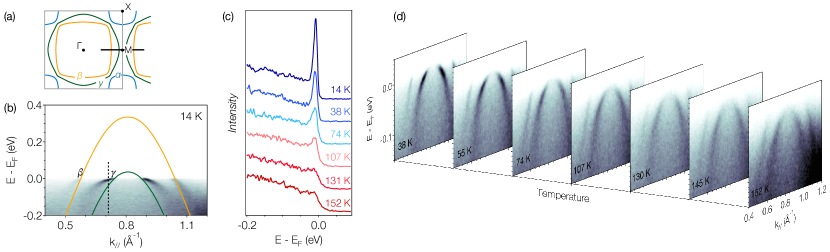
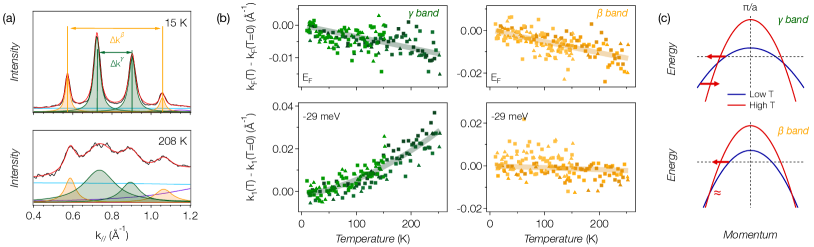
We study the temperature evolution of quasiparticles in the correlated metal Sr_{2}RuO_{4}. Our angle resolved photoemission data show that quasiparticles persist up to temperatures above 200 K, far beyond the Fermi liquid regime. Extracting the quasiparticle self-energy, we demonstrate that the quasiparticle residue Z increases with increasing temperature. Quasiparticles eventually disappear on approaching the bad metal state of Sr_{2}RuO_{4} not by losing weight but via excessive broadening from super-Planckian scattering. We further show that the Fermi surface of Sr_{2}RuO_{4}-defined as the loci where the spectral function peaks-deflates with increasing temperature. These findings are in semiquantitative agreement with dynamical mean field theory calculations.
研究动机与目标
- 为解决在高温下关联金属中准粒子的命运,特别是超出莫特-伊夫勒-雷格尔极限的不良金属区域中的行为。
- 挑战在不良金属中准粒子权重Z随温度升高而减小的普遍假设。
- 确定在Sr2RuO4中,准粒子权重损失还是能谱展宽主导了准粒子特征的消失。
- 检验ARPES实验数据与动力学平均场理论(DMFT)对温度依赖性准粒子行为预测的一致性。
- 阐明谱函数线型演化与背景扣除在提取可靠准粒子参数中的作用。
提出的方法
- 采用角分辨光电子能谱(ARPES)测量了Sr2RuO4在高达约250 K的温度范围内,动量和能量分辨的谱函数。
- 通过在准粒子峰能量ω₀附近对自能进行一阶展开,从能带色散关系中提取准粒子权重Z。
- 采用一种实用的背景扣除方法,利用在π/a动量处无直接跃迁的谱图,以分离本征谱函数。
- 通过使用改进的谱函数表达式建模线型演化:A(k,δω) ≈ Z / π * [Z(Σ′′₀ + αδω)] / [δω² + Z(Σ′′₀ + αδω)²],实现对温度依赖展宽和峰强度的分析。
- 将实验结果与动力学平均场理论(DMFT)计算结果进行比较,采用全局、温度无关的缩放因子对齐谱图。
- 从DMFT数据中计算出自能导数∂Σ′/∂ω,以验证提取的Z值,并确认其与ARPES测得的准粒子权重的一致性。
实验结果
研究问题
- RQ1在Sr2RuO4中,准粒子权重Z是否如传统假设的那样随温度升高而减小?
- RQ2在高温下准粒子峰消失的主要机制是什么——谱权重损失还是过度展宽?
- RQ3在Sr2RuO4中,由谱函数峰值定义的费米表面如何随温度演化?
- RQ4当峰变得宽且强度减弱时,ARPES测得的谱函数在多大程度上仍保持准粒子行为特征?
- RQ5观察到的Z随温度升高是否与多带关联系统中DMFT对温度依赖性的预测一致?
主要发现
- 在Sr2RuO4中,准粒子权重Z随温度升高而增加,与传统预期(高温下Z → 0)相反。
- 准粒子在谱函数中可存在于200 K以上的温度,远超费米液体区和莫特-伊夫勒-雷格尔极限。
- 随着温度升高,谱峰显著展宽,从不对称费米液体线型演化为洛伦兹型,表明存在超普朗克散射。
- 费米表面(定义为谱函数强度最大处的轨迹)随温度升高而收缩,反映出相干性的减弱。
- 经过背景扣除后,ARPES数据与DMFT计算结果在定性与半定量上高度一致,支持了Z随温度升高这一结论。
- 本研究表明,即使峰强度减弱,准粒子权重仍可随温度升高,挑战了‘展宽总是意味着Z减小’的假设。
更好的研究,从现在开始
从阅读论文到最终审阅,大幅缩短您的研究时间。
无需绑定信用卡
本解读由 AI 生成,并经人工编辑审核。