
[论文解读] The first systematically identified repeating partial tidal disruption event
该论文首次通过受控调查系统性地识别出重复部分潮汐破坏事件(pTDE)AT 2020vdq。该源在初始探测三年后表现出一次明亮且快速的光学耀发,伴随宽幅光学/紫外发射(~0.1c)和微弱X射线辐射,且无新的射电辐射,证实其为具有束缚恒星残骸在重复轨道上的pTDE。研究结果表明,前身星可能是一颗通过Hills机制被破坏的紧密双星系统中的恒星,且pTDE速率被限制在10⁻⁶–10⁻⁵ yr⁻¹ galaxy⁻¹,暗示星系核中双星比例约为百分之几。
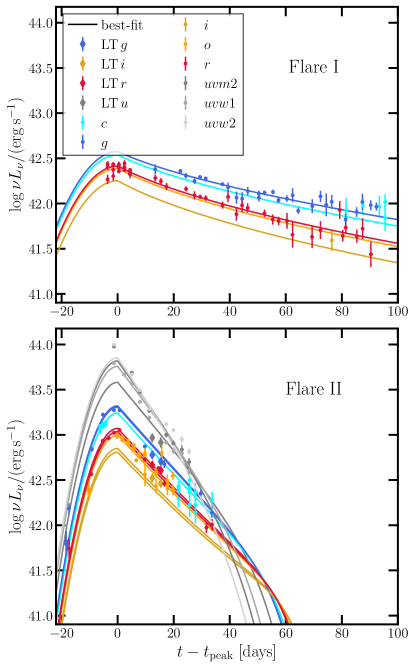
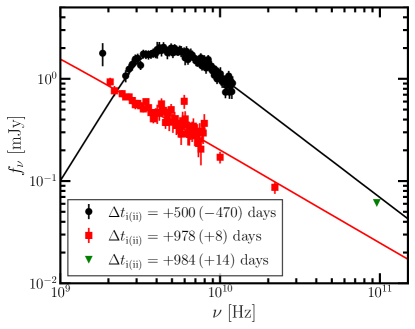
Tidal disruption events (TDEs) occur when a star enters the tidal radius of a supermassive black hole (SMBH). If the star only grazes the tidal radius, a fraction of the stellar mass will be accreted in a partial TDE (pTDE). The remainder can continue orbiting and may re-disrupted at pericenter, causing a repeating pTDE. pTDEs may be as or more common than full TDEs (fTDEs), yet few are known. In this work, we present the discovery of the first repeating pTDE from a systematically-selected sample, AT\,2020vdq. AT\,2020vdq was originally identified as an optically- and radio-flaring TDE. Around $3$ years after its discovery, it rebrightened dramatically and rapidly in the optical. The optical flare was remarkably fast and luminous compared to previous TDEs. It was accompanied by extremely broad (${\sim}0.1c$) optical/UV spectral features and faint X-ray emission ($L_X \sim 3 imes10^{41}$\,erg\,s$^{-1}$), but no new radio-emitting component. Based on the transient optical/UV spectral features and the broadband light curve, we show that AT\,2020vdq is a repeating pTDE. We then use it to constrain TDE models; in particular, we favor a star originally in a very tight binary system that is tidally broken apart by the Hills mechanism. We also constrain the repeating pTDE rate to be $10^{-6}$ to $10^{-5}$ yr$^{-1}$ galaxy$^{-1}$, with uncertainties dominated by the unknown distribution of pTDE repeat timescales. In the Hills framework, this means the binary fraction in the galactic nucleus is of the order few percent.
研究动机与目标
- 通过受控调查识别并表征首个系统性发现的重复部分潮汐破坏事件(pTDE)。
- 确定AT 2020vdq中第二次光学耀发的物理起源,区分pTDE与超新星等其他暂现源的可能性。
- 利用观测到的重复 timescale 约束pTDE速率,并推断星系核中紧密双星的比例。
- 通过分析多次耀发的光变曲线和光谱演化,检验TDE模型,尤其关注吸积动力学和吸积盘形成过程。
提出的方法
- 开展对光学和射电耀发暂现源的系统性调查,以识别候选TDE,包括AT 2020vdq。
- 分析多波段光 light curves(光学、紫外、X射线、射电)及多个历元的光谱数据,以检测耀发的重复性和光谱演化。
- 利用速度宽度(~0.1c)和谱线轮廓(如宽幅He II、N III)推断高速喷流和与TDE一致的吸积动力学。
- 应用X射线和射电上限(如Swift/XRT和VLA)以排除耀发后新的吸积或喷流活动。
- 使用SNID模型拟合耀发后的光谱,以检验Ia型超新星污染的可能性,发现与30天后峰值的Ia型超新星有87%的匹配度。
- 计算在33个星系样本中TDE与超新星事件同时发生的预期概率,以评估第二次耀发作为pTDE而非超新星的显著性。
实验结果
研究问题
- RQ1AT 2020vdq是否为真正的重复部分潮汐破坏事件,其重复性的证据是什么?
- RQ2AT 2020vdq中第二次明亮且快速演化光学耀发的物理机制是什么?
- RQ3第二次耀发是否更可能是Ia型超新星而非pTDE?此类巧合的可能性有多大?
- RQ4观测到的重复 timescale 和耀发特性对星系核中双星比例施加了何种约束?
- RQ5光谱特征(如宽线、N III)以及X射线/射电限制如何影响当前TDE模型的有效性?
主要发现
- AT 2020vdq是首个通过系统调查确认的重复部分潮汐破坏事件,其第二次光学耀发在初始探测约三年后出现,证实了其重复性。
- 第二次耀发极为明亮且快速演化,其黑体温度低于已知所有TDE,且表现出极宽的光学/紫外发射(~0.1c)。
- X射线辐射微弱(L_X ~ 3×10⁴¹ erg s⁻¹),且未探测到新的射电辐射,排除了新喷流或吸积盘形成的可能。
- 光谱分析显示在约5000 Å和5500 Å处存在此前TDE中未见的宽线特征,但与pTDE起源一致,而非标准超新星。
- 耀发后光谱最佳拟合为30天后峰值的Ia型超新星模型(匹配度87%),但缺乏窄线特征且耀发时间与pTDE解释一致。
- pTDE速率被约束在10⁻⁶–10⁻⁵ yr⁻¹ galaxy⁻¹,暗示星系核中双星比例约为百分之几,与Hills机制导致双星恒星潮汐破坏的理论一致。
更好的研究,从现在开始
从阅读论文到最终审阅,大幅缩短您的研究时间。
无需绑定信用卡
本解读由 AI 生成,并经人工编辑审核。