
[论文解读] The GALEX Ultraviolet Virgo Cluster Survey (GUViCS). IV: The role of the cluster environment on galaxy evolution
本研究利用覆盖紫外至射电波段的GUViCS巡天对868个星系进行研究,探讨室女座星系团环境如何驱动星系演化。研究发现,大质量星系通过早期主要并合形成(慢速旋转星系),而低质量恒星形成星系在落入星系团时迅速被激波剥离抑制,转变成静止的红色矮星,且其动力学结构未被破坏——这解释了室女座星系团核心区域密集红色序列的成因。
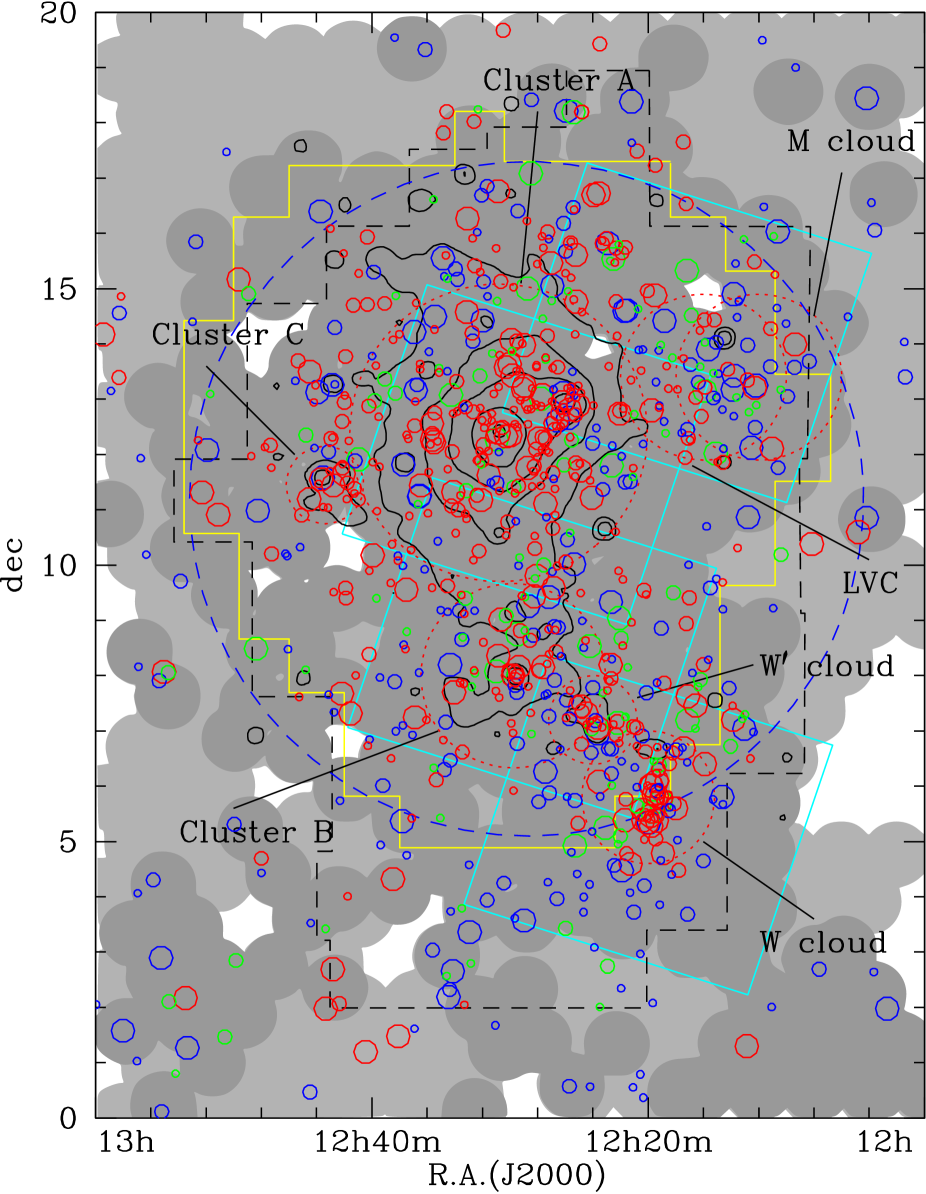
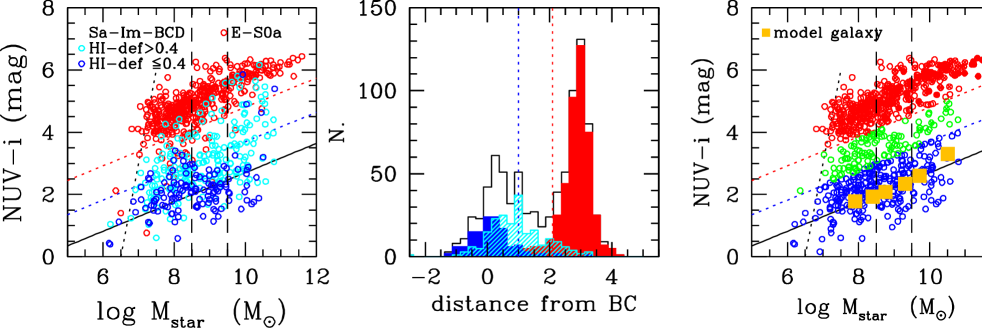
We study the role of the environment on galaxy evolution using a sample of 868 galaxies in the Virgo cluster and in its surrounding regions selected from the GUViCS Survey with the purpose of understanding the origin of the red sequence in dense environments. We collected multifrequency data covering the whole electromagnetic spectrum for most of the galaxies. We identify the different dynamical substructures composing the Virgo cluster and we calculate the local density of galaxies using different methods. We then study the distribution of galaxies belonging to the red sequence, the green valley, and the blue cloud within the different cluster substructures. Our analysis indicates that all the most massive galaxies are slow rotators and are the dominant galaxies of the different cluster substructures generally associated with a diffuse X-ray emission. They are probably the result of major merging events that occurred at early epochs. Slow rotators of lower stellar mass are also preferentially located within the different high-density substructures of the cluster. They are virialised within the cluster, thus Virgo members since its formation. They have been shaped by gravitational perturbations occurring within the infalling groups that later formed the cluster. On the contrary, low-mass star-forming systems are extremely rare in the inner regions of the Virgo cluster A, where the density of the intergalactic medium is at its maximum. Our ram pressure stripping models consistently indicate that these star-forming systems can be rapidly deprived of their interstellar medium during their interaction with the intergalactic medium. The lack of gas quenches their star formation activity transforming them into quiescent dwarf ellipticals. This mild transformation does not perturb the kinematic properties of these galaxies which still have rotation curves typical of star-forming systems.
研究动机与目标
- 理解室女座星系团中星系演化的环境驱动力,特别是致密环境中红色序列的起源。
- 确定星系团内星系熄灭的主要机制是否为激波剥离、饥饿效应或前处理(infalling groups中的预处理)。
- 区分早型星系形成机制的差异:大质量系统主要源于主要并合,而低质量系统则源于环境熄灭。
- 评估动力学亚结构和局部星系密度在星系颜色-星等图中分布中的作用。
- 研究动力学特性(如旋转曲线)在环境演化过程中是否得以保留,特别是熄灭矮星系中。
提出的方法
- 分析了868个室女座星系团星系的多波段数据,涵盖GALEX(紫外)、光学、中红外和远红外,以及光学/HI谱线观测。
- 利用速度和空间分布识别室女座星系团中的动力学亚结构,并通过多种方法量化局部星系密度。
- 基于紫外-光学颜色-星等图,将星系分类为红色序列、绿色山谷和蓝色云团。
- 利用流体动力学模拟建模激波剥离,估算星系形成矮星中气体被移除的时间尺度。
- 利用动力学数据(旋转曲线、速度 dispersion)将星系分类为慢速旋转星系(并合残余物)或快速旋转星系(盘状结构)。
- 假设气体耗尽始于约100亿年前,比较饥饿效应(吸积中断)与激波剥离对熄灭时间尺度的影响。
实验结果
研究问题
- RQ1在室女座星系团核心区域,低质量星系中星形成熄灭的主要机制是什么?
- RQ2熄灭矮星的动力学特性与恒星形成星系相比如何,表明其演化过程中旋转结构是否得以保留?
- RQ3主要并合与星系团前缘群中的预处理在室女座星系团中大质量早型星系形成中分别贡献多大程度?
- RQ4观测到的红色星系、绿色山谷星系和蓝色星系的分布如何与局部密度及亚结构归属相关联?
- RQ5饥饿效应是否足以解释观测到的星系团星系熄灭现象,还是激波剥离更为有效?
主要发现
- 所有质量 $M_{\star} \gtrsim 10^{11} M_\odot$ 的大质量星系均为慢速旋转星系,表明其在早期宇宙即通过主要并合事件形成。
- 在室女座A核心区域,低质量恒星形成星系极为稀少,而该区域星际介质密度最高,表明存在快速的环境熄灭过程。
- 激波剥离模型显示,气体可在 $\sim$1 Gyr 内被从矮星系中剥离,与星系以 $\sim$1000 km s$^{-1}$ 速度从星系团外围运动至核心的时间尺度一致。
- 通过激波剥离将恒星形成矮星转变为静止红色矮星的过程中,其旋转曲线得以保留,表明动力学结构未受显著扰动。
- 即使假设气体吸积在100亿年前即已中止,饥饿效应模型也仅产生可忽略的熄灭效果,因此无法解释室女座星系团中观测到的红色序列。
- 红色序列的低光度端很可能主要由近期通过激波剥离熄灭的矮星构成,而非长期饥饿或预处理所致。
更好的研究,从现在开始
从论文设计到论文写作,大幅缩短您的研究时间。
无需绑定信用卡
本解读由 AI 生成,并经人工编辑审核。