
[论文解读] The Great Wave: Evidence of a large-scale vertical corrugation propagating outwards in the Galactic disc
本论文分析两组年轻恒星样本( giants 与 Cepheids)以绘制银河扭曲,并揭示在扭曲之外的圆盘中向外传播的大尺度垂直起伏。它发现一个高度 150–200 pc 的垂直起伏在 ~10 kpc 的尺度上,随半径向外传播,具有向外的垂直运动和一个传播的波动模式。
We analyse the three-dimensional structure and kinematics of two samples of young stars in the Galactic disc, containing respectively young giants ($\sim$17$\, $000 stars out to heliocentric distances of $\sim$7 kpc) and classical Cepheids ($\sim$3400 stars out to heliocentric distances of $\sim$15 kpc). The vertical structure of the two samples exhibit a consistent shape of the Milky Way's warp, whose amplitude reaches $\sim$700 pc at a Galactocentric radius R $\sim$ 14 kpc. Moreover, both samples show evidence of a large-scale vertical corrugation on top of the warp with a vertical height of $\sim$150-200 pc, extending over a large portion of the Galactic disc between Galactocentric radii $R \sim$ 10-12 kpc in the third Galactic quadrant (galactic longitudes $180^\circ < l < 270^\circ$) and $\sim$12-14 kpc in the second Galactic quadrant ($90^\circ < l < 180^\circ$). Its total length is at least 10 kpc and can possibly reach $\sim$ 20 kpc with the Cepheid sample. The stars in the corrugation exhibit both radial and vertical systematic motions, with Galactocentric radial velocities towards the outer disc of about 10-15 km/s. In the vertical motions, once the warp signature is subtracted, the residuals show a large-scale feature of systematically positive vertical velocities, which is shifted to slightly larger Galactocentric radii with respect to the spatial vertical corrugation (with a phase difference of roughly $π/2$), indicating an oscillatory behaviour. A comparison of the observed shift with a simple toy model suggests that the corrugation can be interpreted as a wave propagating towards the outer disc. The wave mapped in this work is located at larger heliocentric distances compared to the Radcliffe wave, a $\sim$2.7 kpc filament of dense gas clouds close to the Sun, and exhibits a larger coverage of the Galactic disc.
研究动机与目标
- 使用两组年轻恒星样本(巨星和 Cepheids)表征银河盘的三维结构与运动学。
- 绘制扭曲并在外部圆盘上在扭曲之上搜索额外的垂直扰动。
- 量化垂直 corrugation 的振幅、径向范围和运动学特征。
- 评估在扭曲建模之后的残差是否表明存在传播的垂直波。
- 在独立的 tracers 之间比较扭曲结果以测试鲁棒性。
提出的方法
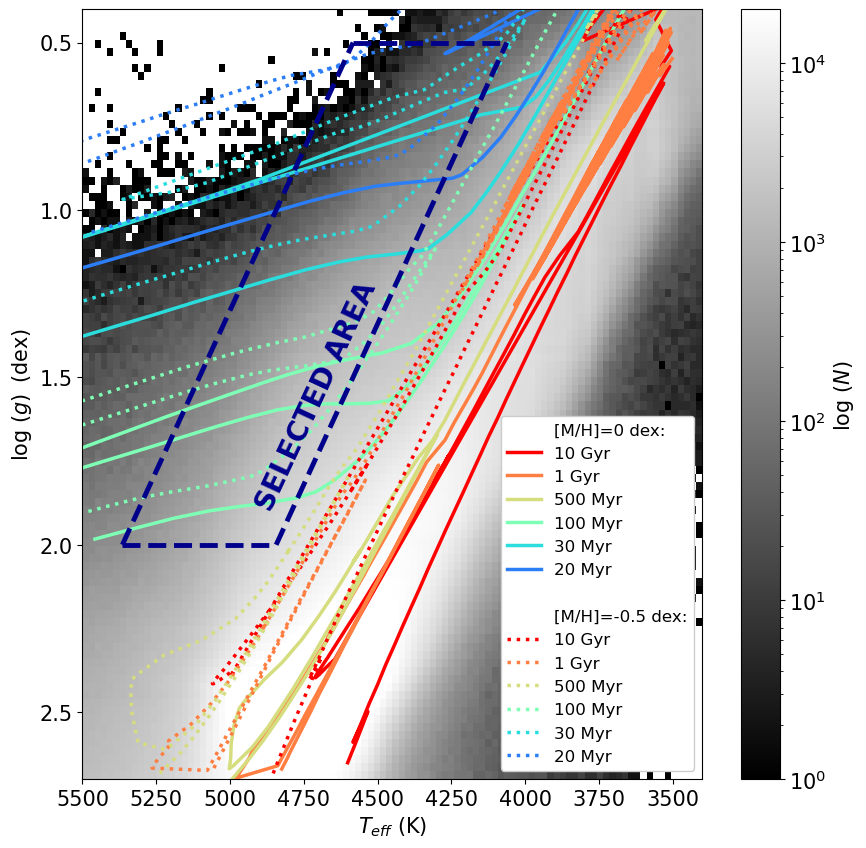
- 从 Gaia DR3 及辅助数据中选择两组年轻恒星样本:约 16,000 颗年轻巨星和约 3,400 颗经典 Cepheids。
- 通过带圆盘基先验和选择函数校正的光度函数,使用贝叶斯距离推断距离。
- 使用 m=1 tilted-ring 方法来建模扭曲,并进行具有振幅 h_w(R) 和线节点相位 φ_LON(R) 的全局参数拟合。
- 将 Z_w(R,phi)=h_w(R) sin(phi - phi_LON(R)) 作为扭曲预测并与观察到的 Z 比较,以推导扭曲参数。
- 在扭曲建模后检查残差以识别非扭曲结构,揭示一个径向 corrugation 特征。
- 对两组样本进行结果验证,并讨论潜在的系统误差(disc thickness、extinction、selection)。
实验结果
研究问题
- RQ1在年轻恒星的追踪下,超出已知扭曲的银河圆盘的大尺度垂直结构是什么?
- RQ2简单的 m=1 扭曲是否足以描述垂直分布,还是存在残留的 corrugation?
- RQ3用年轻巨星和 Cepheids 追踪的银河扭曲的振幅、径向依赖和相位是什么?
- RQ4去扭曲后的残差是否指示外部圆盘中传播的垂直波?
- RQ5跨越独立的年轻恒星示踪(巨星 vs Cepheids)的扭曲测量的一致性如何?
主要发现
- 两组年轻巨星和 Cepheids 显示具有垂直高度 150–200 pc 的扭曲,径向宽度约 3 kpc,长度至少 10 kpc(Cepheids 可能达到 20 kpc)。
- 扭曲振幅随银河系心距的增加而上升;在 R ≈ 11–12 kpc 左右相位角发生变化,线节点相位向更大半径逐渐扭转。
- 径向速度在 V_R 方向显示指向外部圆盘的向内/向外运动,约 ~10–15 km/s。
- 在减去扭曲后,残差揭示一个连贯的、大尺度的垂直 corrugation(特征1),在方位角方向延展约 10 kpc,振幅约 150–200 pc,地图边缘可能存在对称的特征2。
- 该 corrugation 模式与银河圆盘向外传播的垂直波一致,其最大值大致沿着零位移线。
更好的研究,从现在开始
从论文设计到论文写作,大幅缩短您的研究时间。
无需绑定信用卡
本解读由 AI 生成,并经人工编辑审核。