
[论文解读] The GTC exoplanet transit spectroscopy survey I: OSIRIS transmission spectroscopy of the short period planet WASP-43b
本研究利用GTC/OSIRIS仪器的长缝光谱仪对超短周期系外行星WASP-43b凌星过程进行分析,通过测量波长依赖的凌星深度以探测大气成分。研究报告称在行星大气中检测到一个2.9σ的钠吸收特征,同时对轨道周期进行了精化,提示可能存在轨道衰减。
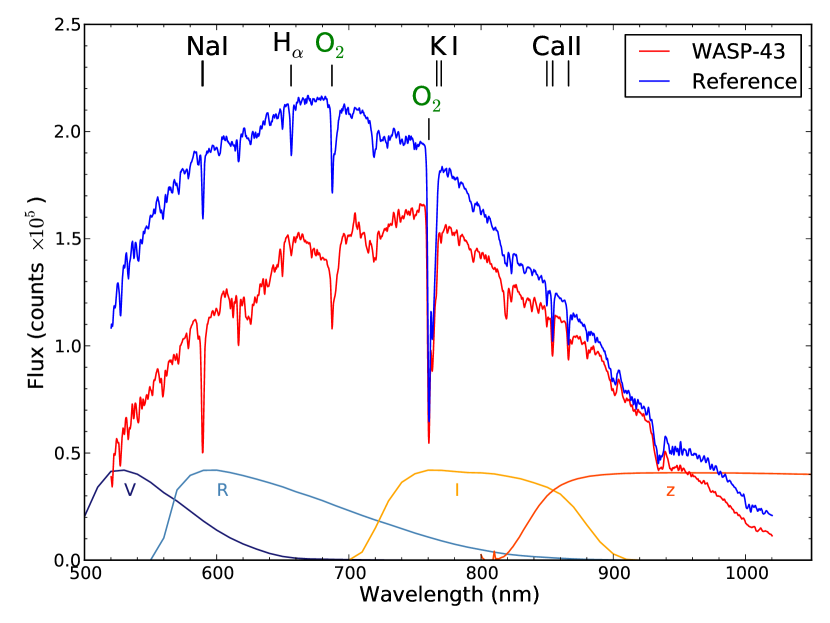
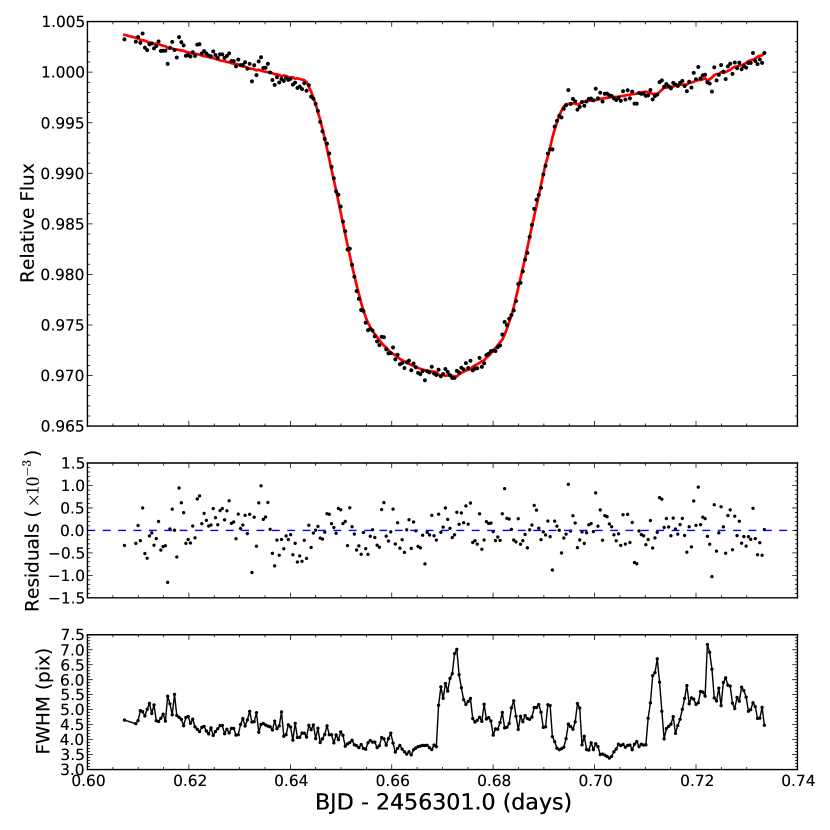
We used GTC instrument OSIRIS to obtain long-slit spectra in the optical range (520-1040 nm) of the planetary host star WASP-43 (and a reference star) during a full primary transit event and four partial transit observations. We integrated the stellar flux of both stars in different wavelength regions producing several light curves. We fitted transit models to these curves to measure the star-to-planet radius ratio, Rp/Rs, across wavelength among other physical parameters. We measure a Rp/Rs in the white light curve of 0.15988^{+0.00133}_{-0.00145}. We present a tentative detection of an excess in the planet-to-star radius ratio around the Na I doublet (588.9 nm, 589.5 nm) when compared to the nearby continuum at the 2.9-sigma level. We find no significant excess of the measured planet-to-star radius ratio around the K I doublet (766.5 nm, 769.9 nm) when compared to the nearby continuum. Combining our observations with previous published epochs, we refine the estimation of the orbital period. Using a linear ephemeris, we obtained a period of P=0.81347385 +/- 1.5 x 10^{-7} days. Using a quadratic ephemeris, we obtained a period of 0.81347688 +/- 8.6 x 10^{-7} days, and a change in this parameter of dP/dt = -0.15 +/- 0.06 sec/year. As previous results, this hints to the orbital decay of this planet although a timing analysis over several years needs to be made in order to confirm this.
研究动机与目标
- 利用地基长缝光谱仪探测WASP-43b在传输光谱中的大气吸收特征。
- 通过结合新的和档案的凌星时刻数据,提高WASP-43b轨道周期的精度。
- 在光学波段(520–1040 nm)内研究钠和钾的潜在大气特征。
- 通过长期凌星时刻变化分析,评估WASP-43b是否存在轨道衰减。
- 验证长缝光谱仪在系外行星凌星过程中的多色光度测量和传输光谱测量的有效性。
提出的方法
- 利用GTC/OSIRIS仪器在五次凌星事件(一次完整,四次部分)期间获取了WASP-43和参考恒星的长缝光谱。
- 对波长区域内的恒星通量进行积分,生成白光和窄带光曲线,用于凌星深度分析。
- 使用马尔可夫链蒙特卡洛(MCMC)方法对光曲线进行拟合,以推导Rₚ/Rₛ及其不确定性。
- 采用线性和二次历表模型拟合凌星时刻残差,估算轨道周期及其导数(Ṗ)。
- 比较以Na I双线(588.9、589.5 nm)为中心的窄带滤波器与附近连续谱区域的行星-恒星半径比(Rₚ/Rₛ)。
- 应用宽通带滤波器(25、18、10 nm)以评估波长依赖的凌星深度变化,并搜索大气吸收特征。
实验结果
研究问题
- RQ1WASP-43b的光学传输光谱中是否存在可探测的大气吸收特征?
- RQ2观测到的凌星时刻数据是否支持WASP-43b存在轨道衰减?
- RQ3基于综合凌星观测,WASP-43b的精化轨道周期是多少?
- RQ4钠和钾特征是否存在于传输光谱中?其表现与模型预测如何比较?
- RQ5长缝光谱仪能否有效获取系外行星凌星过程中的多色光度和传输光谱?
主要发现
- 在588.9和589.5 nm附近的Na I双线处检测到一个2.9σ的行星-恒星半径比超额(Δ(Rₚ/Rₛ) = (2.18 ± 0.74) × 10⁻³),表明大气中可能存在钠吸收。
- 在K I双线(766.5和769.9 nm)处未检测到显著超额,提示光学波段中钾吸收较弱或不存在。
- 白光光曲线得到的平均Rₚ/Rₛ = 0.15988⁺⁰.⁰⁰¹³³₋₀.⁰⁰¹⁴⁵,与先前测量结果一致。
- 使用线性历表模型,轨道周期精化为P = 0.81347385 ± 1.5 × 10⁻⁷天。
- 使用二次历表模型,轨道周期为P = 0.81347688 ± 8.6 × 10⁻⁷天,周期导数为Ṗ = -0.15 ± 0.06 秒/年,提示可能存在轨道衰减。
- 从600到720 nm Rₚ/Rₛ呈上升趋势,从720到880 nm Rₚ/Rₛ呈下降趋势,与行星亮度温度(约1684 K)下包含VO和TiO吸收的大气模型一致。
更好的研究,从现在开始
从论文设计到论文写作,大幅缩短您的研究时间。
无需绑定信用卡
本解读由 AI 生成,并经人工编辑审核。