
[论文解读] The JWST Advanced Deep Extragalactic Survey: Discovery of an Extreme Galaxy Overdensity at $z = 5.4$ with JWST/NIRCam in GOODS-S
本研究利用詹姆斯·韦布空间望远镜(JWST)/NIRCam成像与无 slit 光谱法,在 GOODS-S场发现了一个红移 z = 5.4 的极端星系团块,通过 Hα line 检测确认了 81 个星系。该团块的暗物质晕质量约为 log₁₀(Mₕₐₗₒ/M☉) ≈ 12.6–12.8,显示出更早的恒星形成和更高质量的恒星种群,证明了 JWST 在探测早期大尺度结构形成方面的强大能力。
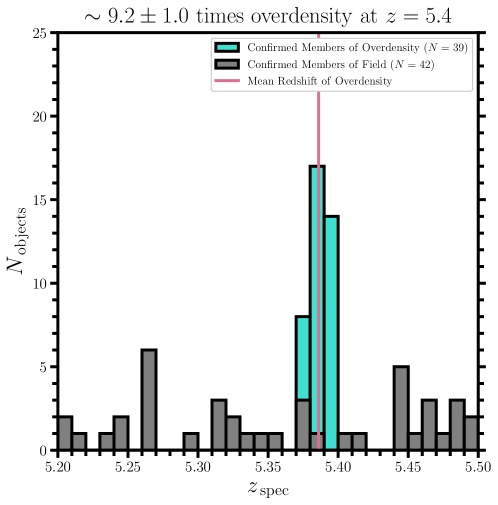
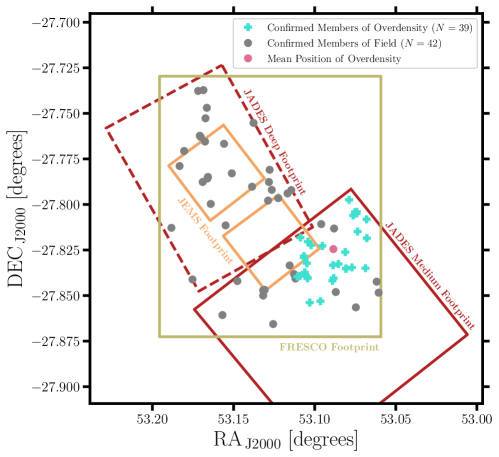
We report the discovery of an extreme galaxy overdensity at $z = 5.4$ in the GOODS-S field using JWST/NIRCam imaging from JADES and JEMS alongside JWST/NIRCam wide field slitless spectroscopy from FRESCO. We identified potential members of the overdensity using HST+JWST photometry spanning $λ= 0.4-5.0\ μ\mathrm{m}$. These data provide accurate and well-constrained photometric redshifts down to $m \approx 29-30\,\mathrm{mag}$. We subsequently confirmed $N = 81$ galaxies at $5.2 < z < 5.5$ using JWST slitless spectroscopy over $λ= 3.9-5.0\ μ\mathrm{m}$ through a targeted line search for $\mathrm{H} α$ around the best-fit photometric redshift. We verified that $N = 42$ of these galaxies reside in the field while $N = 39$ galaxies reside in a density around $\sim 10$ times that of a random volume. Stellar populations for these galaxies were inferred from the photometry and used to construct the star-forming main sequence, where protocluster members appeared more massive and exhibited earlier star formation (and thus older stellar populations) when compared to their field galaxy counterparts. We estimate the total halo mass of this large-scale structure to be $12.6 \lesssim \mathrm{log}_{10} \left( M_{\mathrm{halo}}/M_{\odot} ight) \lesssim 12.8$ using an empirical stellar mass to halo mass relation, which is likely an underestimate as a result of incompleteness. Our discovery demonstrates the power of JWST at constraining dark matter halo assembly and galaxy formation at very early cosmic times.
研究动机与目标
- 利用深度 JWST 观测识别并表征早期宇宙中的极端星系团块。
- 通过联合测光与无 slit 光谱法确定高红移星系的物理性质和红移。
- 估算团块的暗物质晕质量并评估其演化潜力。
- 通过比较团块成员星系与场星系,研究环境对早期星系形成的影响。
- 评估基于 JWST 的巡天在探测 z ≈ 5.4 附近稀有、大质量结构时的完整性和可靠性。
提出的方法
- 利用覆盖 λ = 0.4–5.0 μm 的 HST+JWST 宽波段测光数据,推导出光度红移,深度达到 m ≈ 29–30 mag。
- 通过 JWST/NIRCam 在 FRESCO 巡天中进行无 slit 光谱观测,针对 3.9–5.0 μm 波段的 Hα 发射线以确认红移。
- 通过在最佳拟合光度红移附近进行靶向谱线搜索,筛选出 81 个红移在 5.2 < z < 5.5 之间的星系成员。
- 应用恒星种群合成模型对测光数据进行分析,推断恒星质量、恒星形成历史和年龄。
- 利用经验的恒星质量-晕质量关系,估算该团块的总暗物质晕质量。
- 将团块成员与质量匹配的场星系样本进行比较,评估环境对恒星形成的影响。
实验结果
研究问题
- RQ1利用 JWST 在 z ≈ 5.4 处探测到的最极端星系团块的红移和空间分布是什么?
- RQ2该团块中星系的恒星种群和恒星形成历史与场星系相比有何不同?
- RQ3该大尺度结构的总暗物质晕质量估计值是多少?完整性如何影响该估计?
- RQ4团块环境在多大程度上加速了早期恒星形成和恒星质量的聚集?
- RQ5该结构在多大程度上能代表早期宇宙中大质量大尺度结构的总体群体?
主要发现
- 本研究通过 JWST 无 slit 光谱法确认了 81 个红移在 5.2 < z < 5.5 之间的星系,其中 42 个位于场星系密度 10 倍的区域。
- 该团块在高密度区域包含 39 个星系,表明在 z = 5.4 时存在大量质量大且演化的星系。
- 原星系团成员星系的恒星种群更老,且恒星形成启动时间早于同质量的场星系。
- 总晕质量估计为 12.6 ≤ log₁₀(Mₕₐₗₒ/M☉) ≤ 12.8,但由于巡天不完整性,该值可能被低估。
- 预计该结构将在 z = 0 时演化为类似室女座星系团的结构(log₁₀(Mₕₐₗₒ/M☉) > 15),表明其为一个大质量前体。
- 深度成像与靶向光谱法的结合,实现了对高红移星系高效、高精度的红移确认与物理特性表征。
更好的研究,从现在开始
从阅读论文到最终审阅,大幅缩短您的研究时间。
无需绑定信用卡
本解读由 AI 生成,并经人工编辑审核。