
[论文解读] The JWST-PRIMAL Legacy Survey. A JWST/NIRSpec reference sample for the physical properties and Lyman-$α$ absorption and emission of $\sim 500$ galaxies at $z=5.5-13.4$
本文提出 JWST-PRIMAL 遗产调查,汇集了在 z=5.5–13.4 通过 JWST/NIRSpec Prism 观测并经光谱学证实的约 494 个星系样本,以量化再电离时期的 Lyman-α 抑制、发射及相关的 HI 气体性质,采用统一的数据简化流程和新的衰减诊断 D_Lyα。
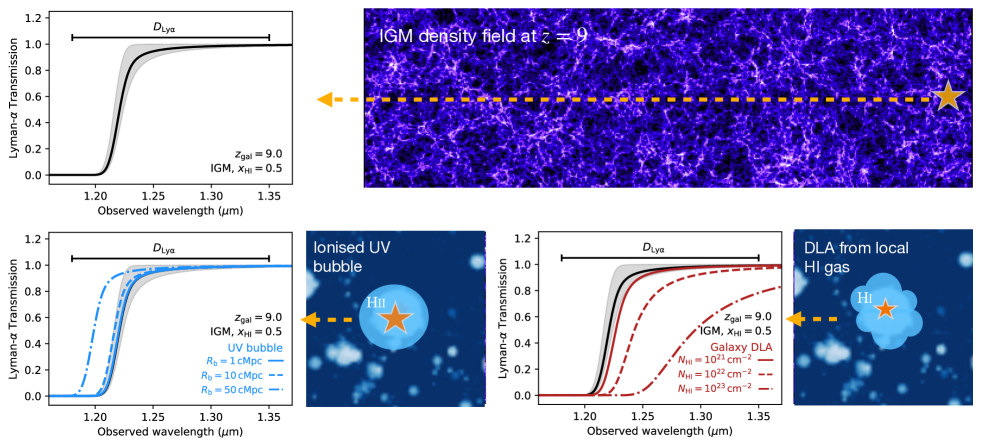
One of the surprising early findings with JWST has been the discovery of a strong "roll-over" or a softening of the absorption edge of Ly$α$ in a large number of galaxies at ($z\gtrsim 6$), in addition to systematic offsets from photometric redshift estimates and fundamental galaxy scaling relations. This has been interpreted as damped Ly$α$ absorption (DLA) wings from high column densities of neutral atomic hydrogen (HI), signifying major gas accretion events in the formation of these galaxies. To explore this new phenomenon systematically, we assemble the JWST/NIRSpec PRImordial gas Mass AssembLy (PRIMAL) legacy survey of 494 galaxies at $z=5.5-13.4$. We characterize this benchmark sample in full and spectroscopically derive the galaxy redshifts, metallicities, star-formation rates, and ultraviolet slopes. We define a new diagnostic, the Ly$α$ damping parameter $D_{ m Lyα}$ to measure and quantify the Ly$α$ emission strength, HI fraction in the IGM, or local HI column density for each source. The JWST-PRIMAL survey is based on the spectroscopic DAWN JWST Archive (DJA-Spec). All the software, reduced spectra, and spectroscopically derived quantities and catalogs are made publicly available in dedicated repositories. The fraction of strong galaxy DLAs are found to be in the range $65-95\%$ at $z>5.5$. The fraction of strong Ly$α$ emitters (LAEs) is found to increase with decreasing redshift, in qualitative agreement with previous observational results, and are predominantly associated with low-metallicity and UV faint galaxies. By contrast, strong DLAs are observed in galaxies with a variety of intrinsic physical properties. Our results indicate that strong DLAs likely reflect a particular early assembly phase of reionization-era galaxies, at which point they are largely dominated by pristine HI gas accretion. [abridged]
研究动机与目标
- 表征大量高红移星系的物理性质(红移、金属丰度、恒星形成率、UV 斜率)。
- 量化 Lyman-α 吸收与发射特征,以诊断再电离期间 ISM/CGM 和 IGM 中的 HI。
- 开发并应用全新的 Lyα 衰减参数 D_Lyα,以区分 DLA、LAE 与 IGM 衰减效应。
- 公开发布降噪后的光谱、测量结果和目录,以促进再电离时代气体的可重复分析。
提出的方法
- 从 DAWN JWST 档案 (DJA-Spec) 汇编一个 494 个星系的样本,其满足 z_spec>5.5、在 Lyα 附近的信噪比 S/N>3,并覆盖完整的 0.6–5.3 μm 的 NIRSpec Prism。
- 使用 Grizli 和 MSAExp 的标准化 DJA-Spec 流程对光谱进行降噪与提取,包括 2D+1D 提取与最优加权。
- 将 Lyα 衰减参数 D_Lyα 定义并计算为在 1180–1350 Å(静止波长)上的等效宽度(EW) 形式的量,并作 (1+z_spec) 的归一化。
- 结合 IGM 气泡尺度和 DLA HI柱密度,建立 Lyα 透射模型,以在不同物理场景下解释 D_Lyα。
- 从 [O II]、[O III]、Hβ、Hα 等线测量星间气体发射线通量及红移,以推导物理性质。
- 通过专门的存储库和项目网页提供公开数据产品与目录。

实验结果
研究问题
- RQ1从 z≈5.5 到 z>13.4,Lyα 衰减翼的发生率与强度如何演变?
- RQ2再电离时代星系中强 DLAs(N_HI>10^21 cm^-2)的普遍性及其与星系性质的相关性如何?
- RQ3Lyα 发射与金属丰度、UV 斜率及在 z=5.5–13.4 跨越的其他固有星系性质之间的相关性如何?
- RQ4是否可以用统一的 Lyα 衰减参数 D_Lyα 将 ISM/CGM HI、离子化泡泡与中性 IGM 对观测到的 Lyα 轮廓的影响区分开?
主要发现
- 在整合的强 DLAs(N_HI>10^21 cm^-2)的星系比例随红移仅略有增加,从 z≈6 时的约 60%到 z>8 时的约 65%–90%。
- Lyα 发射的普遍性和显著性随红移降低而增加,与先前观测在定性上是一致的。
- 强 Lyα 发射星系往往具有低金属丰度和 UV 斜率较低的特征,而强 DLAs 出现在多样的固有性质中,但在高红移和低金属丰度条件下更为常见。
- 将 DLAs 解读为早期组装阶段的原始 HI 气体吸积的标记,而后期阶段则看到气体冷却和恒星形成,使周围环境电离并在 z<8 时获得强 Lyα。
- D_Lyα 诊断在仪器分辨率范围内成功识别出强 LAEs 的极端情况(D_Lyα < 0 Å)和 DLAs(D_Lyα > 50 Å)。
- 所有降噪后的光谱、测量结果和目录均通过专门的存储库公开获取。
更好的研究,从现在开始
从论文设计到论文写作,大幅缩短您的研究时间。
无需绑定信用卡
本解读由 AI 生成,并经人工编辑审核。