
[论文解读] The massive relic galaxy NGC 1277 is dark matter deficient. From dynamical models of integral-field stellar kinematics out to five effective radii
本研究在深度积分场数据上使用 Jeans 各向异性建模,表明 NGC 1277 在5个有效半径内几乎没有暗物质,挑战 LCDM 的预期。
According to the $Λ$CDM cosmology, present-day galaxies with stellar masses $M_\star>10^{11} { m M}_\odot$ should contain a sizable fraction of dark matter within their stellar body. Models indicate that in massive early-type galaxies (ETGs) dark matter should account for $\sim60\%$ of the dynamical mass within five effective radii ($5 R_{ m e}$). Most massive ETGs have been shaped through a two-phase process: the rapid growth of a compact core was followed by the accretion of an extended envelope through mergers. The exceedingly rare galaxies that have avoided the second phase, the so-called relic galaxies, are thought to be the frozen remains of the massive ETG population at $z\gtrsim2$. The best relic galaxy candidate discovered to date is NGC 1277, in the Perseus cluster. We used deep integral field GCMS data to revisit NGC 1277 out to an unprecedented radius of 6 kpc (corresponding to $5 R_{ m e}$). By using Jeans anisotropic modelling we find a negligible dark matter fraction within $5 R_{ m e}$ ($f_{ m DM}(5 R_{ m e})<0.05$; two-sigma confidence level), which is in tension with the expectation. Since the lack of an extended envelope would reduce dynamical friction and prevent the accretion of an envelope, we propose that NGC 1277 lost its dark matter very early or that it was dark matter deficient ab initio. We discuss our discovery in the framework of recent proposals suggesting that some relic galaxies may result from dark matter stripping as they fell in and interacted within galaxy clusters. Alternatively, NGC 1277 might have been born in a high-velocity collision of gas-rich proto-galactic fragments, where dark matter left behind a disc of dissipative baryons. We speculate that the relative velocities of $\approx2000 { m km/s}$ required for the latter process to happen were possible in the progenitors of the present-day rich galaxy clusters.
研究动机与目标
- 使用深度积分场数据在五个有效半径 (5 Re) 外评估 NGC 1277 的暗物质含量。
- 将 DM 含量与 Lambda CDM 对大质量早型星系的预期进行比较。
- 研究 NGC 1277 是否为未经历典型双阶段包层增长的遗留星系。
- 使用动力建模来检验描述观测到的运动学是否需要 DM 暗物质晕。
提出的方法
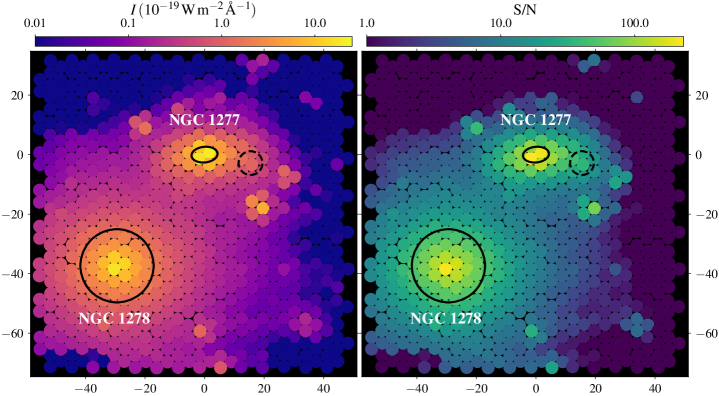
- 获取 NGC 1277 和 NGC 1278 的深度积分场光谱学数据,使用 George and Cynthia Mitchel Spectrograph (GCMS) 将恒星运动信息映射到 ~5 Re。
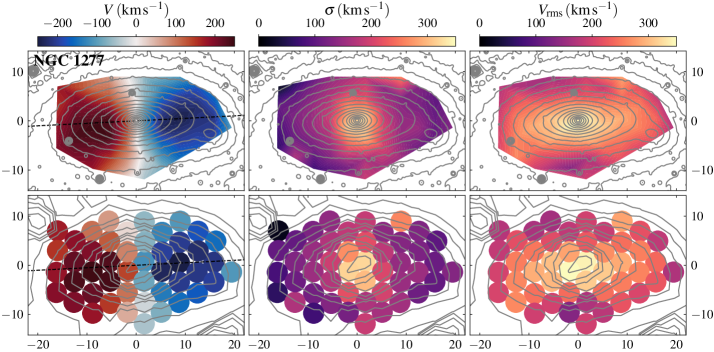
- 使用 pPXF 与 E-MILES 模板提取恒星运动学,得到 V、sigma 和 V_rms 图。
- 通过多高斯展开 (MGE) 从 HST 图像构建光度和质量模型,以追踪重子分布。
- 应用 Jeans 向各向异性建模 (JAM) 推断总质量(包括暗物质晕),并导出 5 Re 内的 DM 百分比。
- 结合高分辨率内核数据(NIFS、HST)约束中心势能和黑洞质量,评估其对外区 DM 的影响。
- 采用平坦宇宙学常数 (H0=71 km/s/Mpc, Omega_m0=0.265) 以及 Perseus 的距离 (z=0.017195) 以获得物理尺度。
实验结果
研究问题
- RQ1NGC 1277 在五个有效半径处的暗物质分数是多少?
- RQ2NGC 1277 是否需要一个暗物质晕来解释其在较大半径处的恒星运动学?
- RQ3NGC 1277 的 DM 含量与 LCDM 对大质量早型星系的预期相比如何?
- RQ4遗留星系的本质是否能够与其在观测范围内的 DM 含量(或缺乏)相协调?
- RQ5对黑洞质量估计和中心质量建模对推断的暗物质分布有哪些影响?
主要发现
- f_DM(5 Re) < 0.05 在两信区间,意味着在5 Re内几乎没有暗物质。
- NGC 1277 在外部区域再现恒星运动学时几乎无需扩展的 DM 晕。
- 观测到的 DM 欠缺与 LCDM 对大质量早型星系在 1 Re 内约 15% DM 与 5 Re 内约 60% DM 的预期相冲突。
- 遗留性质(缺乏扩展包层)可能解释较低的动力摩擦和包层增长,与内区域低 DM 的框架相一致。
- 提出一种情景,DM 可能早期被剥离,或 DM 本身就不足,可能与簇内落入过程或高速度形成事件相关。
更好的研究,从现在开始
从论文设计到论文写作,大幅缩短您的研究时间。
无需绑定信用卡
本解读由 AI 生成,并经人工编辑审核。